
Last updated: September 11, 2026
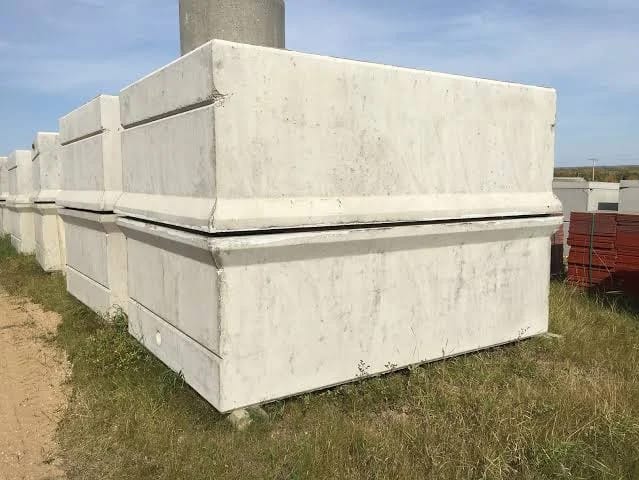
A cistern is a buried potable water tank. It holds hauled or pumped water for a house with no municipal service. On an Alberta acreage it usually goes in the same week as the septic tank, often in the same excavator mobilization.
Most cistern pages list gallons and a price. That is not the spec that gets the tank approved or keeps it in the ground. This page covers the four numbers that do: capacity against turnover, setback distance, burial depth, and dry weight against uplift.
Precast cistern spec table
A precast cistern is a monolithic or two-piece concrete tank with a sealed lid, a 760 mm access manway, a screened vent, and inlet and outlet fittings set at the plant.
| Item | Spec |
|---|---|
| Typical buried capacity | 5,000–15,000 L (1,100–3,300 Imperial gallons) |
| Access manway | 760 mm (30 in.) cast groove in lid |
| Manway and vent height | Minimum 300 mm above finished grade |
| Maximum burial depth to top of tank | About 1.2 m (4 ft) below surface |
| Lid seal | Potable-grade sealant between tank and lid |
| Tank dry weight, precast tank class | 8,000–15,000 lb |
| Traffic rating available | H-20 |
| Plant standard for the concrete | CSA A23.4 |
| Wetted materials standard | NSF/ANSI/CAN 61 |
Capacity, manway size, vent height and burial depth are the figures published by Alberta Agriculture in Maintaining Safe Domestic Water Quality with On-Farm Cisterns. Weight and H-20 rating are the range on our own precast tank line.
There is no Canadian manufacturing standard for potable cisterns
CSA B66 covers prefabricated septic tanks and sewage holding tanks. It does not cover potable water cisterns. Ask a supplier for “the CSA standard” on a cistern and you will get either silence or the wrong standard.
Spec it in two parts instead.
- The concrete. CSA A23.4, plant-certified production. This governs mix, reinforcement, curing, tolerances and handling. We break down the clause language in our drop-in CSA A23.4 spec guide.
- Anything that touches the water. NSF/ANSI/CAN 61. The standard sets health-effects limits for contaminants leached into drinking water by components and materials, and it explicitly covers protective barrier materials such as cements, paints and coatings, plus joining and sealing materials such as gaskets, adhesives and lubricants. Your lid sealant, any interior coating and the pump line fittings fall under it. Bare structural concrete does not need a coating. If someone proposes one, ask for the certification.
That is the whole material spec. Two standards, both nameable on a drawing.
Size for turnover, not for the biggest tank on the price list
Oversizing a cistern degrades the water. Alberta Agriculture puts household demand at about 700 to 1,500 L per day and says stored water should sit “under 2 to 3 months.”
Run the division before you order.
| Household demand | 5,000 L cistern | 10,000 L cistern | 15,000 L cistern |
|---|---|---|---|
| 1,500 L/day (full-time, 4+ people) | 3 days | 7 days | 10 days |
| 1,000 L/day (full-time, 2–3 people) | 5 days | 10 days | 15 days |
| 700 L/day (full-time, 1–2 people) | 7 days | 14 days | 21 days |
| 150 L/day (seasonal cabin, weekends) | 33 days | 67 days | 100 days |
Read the bottom row. A seasonal property in a 15,000 L tank pushes past the 2–3 month window on its own. Size that job down, or accept a shorter fill and more frequent turnover.
For a full-time household the sizing driver is the opposite: fill interval against the cost of a water haul. Fewer, larger deliveries usually beat frequent small ones. Pick the tank that gives you a 10 to 21 day interval at your real demand, then stop.
Two questions settle it:
- How many people live there full time, year round?
- What does the hauler charge per trip, and what is the minimum load?
The setback most people miss
A buried cistern is legally a water source in Alberta. Article 1.1.5.2 of the Private Sewage Systems Standard of Practice 2021 defines a water source as a man-made or natural source of potable water, and states that a cistern is also considered to be a water source when buried in the earth.
Every sewage separation distance therefore measures to your cistern.
| From | To a water source (your buried cistern) |
|---|---|
| Septic tank or holding tank | 10 m (33 ft) |
| Treatment field | 15 m (50 ft) |
| Treatment mound | 15 m (50 ft) |
| Drip dispersal | 15 m (50 ft) |
| Municipal water well (from field, mound or drip) | 100 m (330 ft) |
Distances are from the Alberta separation distance tables for sewage treatment systems. Confirm the current edition with your authority having jurisdiction before you dig.
This is a site planning problem, not a product problem. On a narrow acreage the cistern, the septic tank, the field and the driveway compete for the same envelope. Lay all four out before the excavator books the day. Moving a 12,000 lb tank after it is set costs a second crane call.
Practical consequences:
- The cistern and the septic tank cannot share a trench.
- The fill port needs truck access that does not cross the treatment field.
- A cistern placed downslope of a field is a permit conversation you do not want.
Burial depth, access and venting
Bury the tank shallow. Top of tank sits about 1.2 m (4 ft) below surface at maximum, and the 760 mm manway and the air vent both extend at least 300 mm above finished grade.
Above grade, not flush. A flush lid in a Calgary spring is a surface water inlet.
- Screen the vent. Insects and rodents are the failure mode.
- Riser the manway to grade in one piece if you can. Every joint is a seal to maintain.
- Set the lid on potable-grade sealant, not mortar.
- Mark the lid location before backfill. Snow finds cisterns; loaders find them harder.
Deeper burial is possible with an engineered lid, but it buys nothing on a residential job and it adds an H-20 conversation you may not need. Rate for H-20 only where a vehicle can actually reach the tank.
Flotation: mass helps, mass does not exempt you
An empty buried tank floats when the excavation fills with water. Buoyant force equals the weight of the water displaced, roughly 1 kg per litre of external tank volume.
Worked example, round numbers. A tank with about 11,500 L of external volume displaces about 11,500 kg, near 25,000 lb of uplift with the hole flooded to grade. A precast tank in the 8,000–15,000 lb class resists a large share of that on dead weight alone. A poly tank of the same capacity weighs a few hundred pounds and resists almost none of it.
That is the honest version of the concrete advantage, and it is the same physics we covered in concrete vs poly septic tanks for Alberta acreages. Concrete narrows the problem. It does not delete it.
Control the water instead of arguing with it:
- Backfill granular and drain the excavation.
- Do not leave the tank empty through spring melt. Ballast it with water.
- Add an anti-flotation collar or deadman where the water table is high or the site is a low spot.
- Never set a tank in a hole with standing water in it.
Water quality after the tank is in
Chlorinate on a schedule and the tank stops being the problem.
| Task | Dose or target | Frequency |
|---|---|---|
| Shock chlorination | 1 L unscented household bleach per 1,000 L, at least 50 mg/L held 6 hours minimum contact | At least once per year, and after any opening |
| Batch recharge on refill | About 20 mL of 5% bleach per 1,000 L | Every delivery |
| Residual target | 1.0 mg/L total chlorine, 0.2 mg/L free chlorine | Maintain |
| Residual testing | Test strips or kit | 2–3 times per week |
| Clean out | Full pump, wash, shock | At least annually |
All five figures are Alberta Agriculture’s. Hand this table to the owner at handover. It is the difference between a cistern that works for decades and one that gets blamed for the water.
Ordering and lead time
Quote a cistern the way you would quote any precast unit. Send us four things and the number comes back with a date on it.
- Capacity, from the turnover table above.
- Traffic rating — landscape only, or H-20.
- Burial depth to top of tank, so riser height is right the first time.
- Site access — approach grade, overhead lines, and whether a picker can get within reach. Our crane access checklist for a rural yard covers what stalls a set.
Combine the cistern and the septic tank on one delivery where the layout allows it. One mobilization, one crane, one day. The specs that matter on the wastewater side are in our acreage septic tank spec guide.
Tanks are cast, cured and water-tested before they leave the plant. Fittings are pre-set. Lids accept risers for grade adjustment.
Request a spec sheet, a shop drawing, or a quantity price on precast tanks: see precast tanks or book a delivery and installation window.
FAQ
Is a buried cistern considered a water source in Alberta? Yes. Article 1.1.5.2 of the Private Sewage Systems Standard of Practice 2021 states that a cistern is also considered to be a water source when buried in the earth. Sewage separation distances measure to it.
How far does a cistern have to be from a septic tank in Alberta? 10 m (33 ft) from a septic tank or holding tank, and 15 m (50 ft) from a treatment field, mound or drip dispersal system. Confirm the current edition with your authority having jurisdiction.
What size cistern do I need for an acreage? Size it for a 10 to 21 day fill interval at real demand. Alberta Agriculture puts household demand at about 700 to 1,500 L per day, so most full-time households land between 5,000 and 15,000 L. Do not oversize: stored water should not sit more than 2 to 3 months.
How deep can a concrete cistern be buried? About 1.2 m (4 ft) to the top of the tank. The manway and vent must extend at least 300 mm above finished grade.
Will a concrete cistern float? It can, if the excavation floods while the tank is empty. A precast tank in the 8,000–15,000 lb class resists most of the uplift on dead weight, far more than a poly tank of the same capacity. Drain the excavation, backfill granular, and keep water in the tank through spring melt.
Does a concrete cistern need an interior coating? No. Bare structural concrete is standard. Anything applied to a wetted surface — coating, lining, sealant — should be certified to NSF/ANSI/CAN 61.
What standard applies to a precast cistern? CSA A23.4 for plant-produced precast concrete, and NSF/ANSI/CAN 61 for wetted materials. CSA B66 covers septic and sewage holding tanks, not potable cisterns.
Can the cistern and septic tank be delivered together? Usually yes, if the setback layout allows both to be set in one crane call. It is the cheapest way to buy the pick.