
Last updated: August 4, 2026
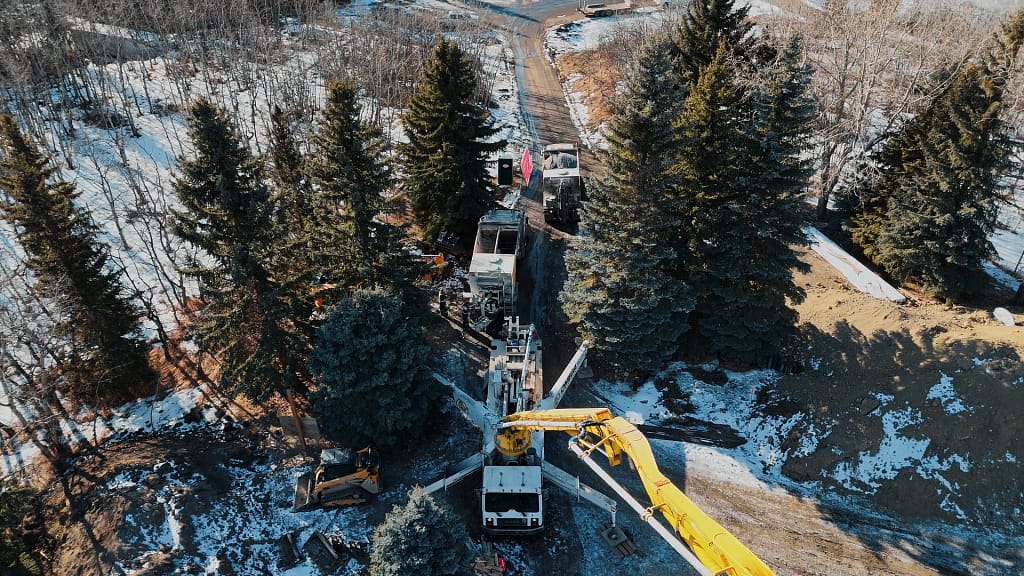
Planning crane or boom-truck access on a rural yard comes down to five things: firm, level ground that can carry the outrigger loads; a clear swing radius with a setup spot inside the crane’s reach; overhead power-line clearance; awareness of buried lines, the septic field, and the well; and, on a tight or remote site, the chance of building a temporary access road.
In Alberta you must keep the crane and load at least 3.0 m from power lines of 750 V to 40 kV, more for higher voltages, and at least 7 m if the voltage is unknown, under the Alberta OHS Code, Schedule 4. Confirm all of this with your supplier before delivery day. The lift is planned, not improvised.
(Source: Alberta OHS Code, Schedule 4, https://search-ohs-laws.alberta.ca/legislation/occupational-health-and-safety-code/schedule-4-safe-limit-of-approach-distances/ .)
Concrete’s one real trade-off is weight, and the question every acreage buyer asks is “can you even get it onto my yard?” The honest answer is yes, with planning. Wondering what actually happens once the crane arrives? Read Crane Day at the Site: Honest Step-by-Step of an Omega Precast Foundation Install in Calgary for a complete walkthrough of setup, lifting, placement, and final positioning on an Alberta job site.
1. Ground bearing: can your yard carry the load?
This is the single biggest rural-yard variable. A crane or picker doesn’t rest on its wheels during a lift, it rests on outriggers, and those outriggers concentrate the whole load onto a few small pads. The ground under those pads has to hold.
A crane “must not be assembled or used unless ground conditions are firm, drained, and graded” to meet the manufacturer’s support and level specifications. (Source: VelSafe crane-setup guide.) On soft, wet, or freshly filled ground, the crew spreads the load with steel plates, timber mats, or a gravel pad. (Source: Bigfoot Outrigger Pads.)
The cribbing or blocking under the outriggers also has to be strong enough “to prevent crushing, bending, or shear failure” and must fully support the outrigger float. (Source: VelSafe, above.) A common rule of thumb keeps cribbing height under the size of the base pad, so a 36-inch-square pad pairs with cribbing under 36 inches tall. (Source: CraneTech.)
Your job as the homeowner is simple: flag the soft spots. Point out recent fill over a new build, a yard that’s soggy in spring, a wet swale, or any area that feels spongy underfoot. Calgary-area acreages often sit on the same heavy clay and high-water-table ground that drives the concrete-tank choice in the first place, and that ground reduces bearing capacity exactly when it’s wet.
2. Swing radius and reach: where the truck sets up
The crane needs a clear path to swing the load and a setup spot close enough to reach where the unit goes. The lift planner needs a swing radius free of obstructions, and reach is what drives where the truck parks.
(Source: Maxim urban lift planning.)
A 360-degree articulating knuckle-boom picker offers roughly 30 ft of reach, which is what lets it place a septic tank or a set of steps without the truck sitting right on top of the spot. Specialized telescopic rotating cranes reach about 21 ft at 6,000 lb. HIAB notes its knuckle-booms handle “all types of precast product,” including manholes, septic tanks, and pipes.
This is why your supplier asks about access width, gate clearances, obstructions, and where the unit needs to land relative to the driveway. The answers decide which machine shows up.
3. Overhead power-line clearance: the binding Alberta number
This is the one rule you should know by heart, and the Alberta figure is what governs, not the US one. Rural yards often have an overhead service drop running to the house or an outbuilding, sometimes right where a tank or set of steps needs to go.
Under the Alberta OHS Code, Part 17 and Schedule 4, the safe limits of approach for a crane or its load near overhead power lines are:
| Line voltage | Minimum clearance |
|---|---|
| 0 to 750 V (bare) | 1.0 m |
| 0.75 to 40 kV | 3.0 m |
| 69 to 72 kV | 3.5 m |
| 138 to 144 kV | 4.0 m |
| 230 to 260 kV | 5.0 m |
| 500 kV | 7.0 m |
| Voltage unknown | at least 7 m |
You may see American crane-safety pages cite figures in feet (a 10-foot or 20-foot rule). Those come from US OSHA and don’t apply in Alberta. The binding numbers here are the metres above. Before any work inside the safe limit, the crew has to contact the utility and take precautions. A typical rural distribution line falls in that 0.75 to 40 kV band, so plan for the 3.0 m clearance, and if nobody can confirm the voltage, the crew holds 7 m.
(Source: Alberta OHS Code)
4. Buried hazards: what the outriggers can’t sit on
On an acreage, the things you can’t see are as important as the overhead lines. Crane-setup guidance is to “avoid areas with buried pipes, water lines, or electrical cables” and to set up on ground that’s “level and free from any obstructions.”
(Source: JSABuilder crane operations.)
On a rural property, that translates to a specific flag list:
- The septic field. Outriggers and wheels can’t sit over the drainfield without risking the lines.
- The well. The well casing and the area around it stay clear.
- The buried service to the house. The power and water lines running from the road or a pole to the house are easy to forget and expensive to hit.
- Recent backfill. Anywhere the ground was dug and refilled is both a soft-ground risk and a buried-utility risk.
A planned lift keeps the crane off all of these, which is exactly why the supplier asks you to mark them in advance. Your septic setbacks matter here too; for the layout, see our concrete vs poly septic tanks guide, which covers the well-to-tank and well-to-field distances.
5. The honest worst case: building access
Sometimes the site needs prep, and a good supplier tells you that up front. If a delivery point is far from where a truck can safely set up, or the only route in won’t carry the equipment, the options are a longer-reach crane, a boom truck running a pup trailer where access allows, or, in the extreme case, building a temporary road.
As one precast delivery account puts it, “if the job is extreme, homeowners may have to pay extra to have a road built to deliver the septic tank,” while a boom truck can carry two tanks on one trip where access permits.
(Source: Jensen Precast boom-truck septic delivery.)
This is the part of the “concrete is heavier” trade-off that’s real, and it’s solvable with planning rather than a deal-breaker.
The lift is governed by real standards
One line of reassurance: a mobile crane in Alberta has to meet CSA Z150 (Safety Code on Mobile Cranes) under the OHS Code, Part 6, and operators are trained and qualified.
(Sources: CSA Group, CSA Z150:20)
The planning above is how a qualified crew sets up to those standards on your specific yard, not optional courtesy.
FAQ
What do I need to plan for crane access on an acreage? Firm, level ground for the outriggers (mats or plates on soft ground), a clear swing radius, overhead power-line clearance, awareness of buried lines plus the septic field and the well, and possibly a temporary access road on a remote or tight site. Your supplier plans the lift with you before delivery day.
How far does a crane have to stay from power lines in Alberta? At least 3.0 m for lines of 750 V to 40 kV, more for higher voltages (up to 7.0 m at 500 kV), and at least 7 m if the voltage is unknown. These are Alberta OHS Code, Schedule 4 figures in metres. US figures in feet don’t apply here.
Can a crane sit on soft or wet ground? Not safely without support. Outrigger pads, timber mats, or steel plates spread the load. Soft, wet, or freshly filled ground reduces the ground’s bearing capacity, so flag any spongy or recently filled areas to your supplier.
How close does the truck need to be to where my tank or steps go? Within the crane’s reach. A knuckle-boom picker reaches roughly 30 ft, so the truck can set up off to the side. The further or more obstructed the spot, the bigger the crane or the more site prep needed.
What if my yard is hard to access? The options are a longer-reach crane, a boom truck with a trailer, or, in the worst case, a temporary access road. A good supplier raises this during planning, before the delivery date, so there are no surprises.
Can the crane damage my septic field, well, or buried lines? It shouldn’t if the lift is planned. The operator keeps outriggers and wheels off the drainfield, the well, and the buried power and water lines. That’s exactly why you flag those locations in advance.
Do I need to clear my yard before the crane arrives? Clear the swing path and the setup area of obstructions, and mark the septic field, the well, buried services, and any soft or recently filled ground. The crew handles the rigging and the lift; your part is access and flagging hazards.
Make Crane Day Predictable—Before Delivery Day
Successful precast installation starts long before the crane arrives. Confirming ground conditions, access routes, overhead clearances, buried utilities, and equipment requirements in advance helps prevent delays, protects your property, and allows the installation to proceed safely and efficiently.
Omega Precast works with homeowners, builders, and acreage developers throughout the Calgary region to review site access before delivery, identify potential challenges early, and coordinate the right lifting equipment for each project.
Contact Omega Precast today to schedule a site review or discuss crane access requirements for your upcoming precast delivery.