
Last updated: July 23, 2026
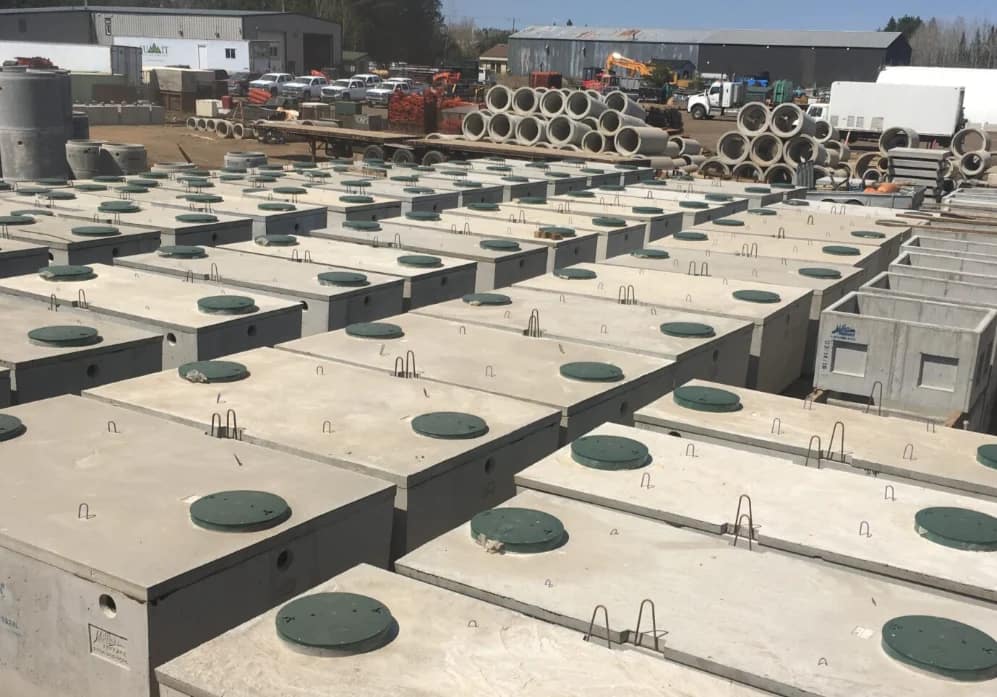
A precast septic tank is buried, so finish and colour don’t matter; watertightness does. The specs that count are the seam (monolithic or two-piece), the sealed joint, the coatings that resist sewer gas, and the concrete mass that keeps the tank from floating. Here’s what to actually ask.
If you are building or replacing a septic system on an acreage outside Calgary, the tank spec sheet can read like a foreign language. This guide translates the parts that decide whether your tank stays sealed and in the ground for decades, so you can ask a precast supplier the right questions before you buy.
1. Why colour is the wrong question
With precast steps or a window well, colour and finish are a real decision, because you see them every day. A septic tank is different. Once it is set and backfilled, it lives underground for its entire service life. Nobody, including you, will ever look at it again.
That makes colour a non-question. There is no meaningful finish choice on a buried tank, and any producer who leads with appearance is answering the wrong problem. The right problem is whether the tank holds its contents, keeps groundwater out, resists the corrosive gas inside, and stays put when the water table rises.
So the useful conversation is about performance, not looks. The National Precast Concrete Association frames the core job of a septic tank the same way: it must be watertight in both directions, meaning wastewater cannot leak out to contaminate soil and groundwater, and groundwater cannot leak in to overload the system. Everything that matters flows from that single requirement. The next three sections cover the specs that deliver it.
2. Watertightness: the seam, one-piece vs two-piece
Watertightness is the whole point of a septic tank, and the most important variable is how the tank is built: as one monolithic piece, or as two pieces joined by a seam.
A monolithic (one-piece) tank is cast as a single unit with no horizontal joint in the wall. There is simply no seam through the water-bearing portion of the tank to leak. For many acreage sites this is the simplest path to long-term watertightness. Two-piece construction, where a separate top is joined to the base, is common because it eases handling and delivery, but it introduces a joint that has to be sealed and stay sealed under pressure.
The seam’s location matters as much as its existence. On a high-water-table site, a top-seam configuration keeps the joint above the tank’s liquid line. That means the seam is not sitting under a constant column of wastewater and is not fighting hydrostatic pressure from the inside for years on end. If your lot sits low, holds water in spring, or has a shallow water table, ask specifically where the seam falls relative to the liquid level.
When there is a seam, the sealant is what makes it watertight. ConSeal, a supplier of precast joint sealants, specifies a butyl (butyl-rubber) sealant at the seam to resist hydrostatic pressure and hold a watertight joint over the life of the tank. Butyl is flexible and does not become brittle, so the joint can accommodate small movements without opening a leak path. A dry-set or mortared joint with no engineered sealant is not the same thing, and it is worth confirming which you are getting.
The final watertightness check happens before the tank ever reaches your property. Quality producers vacuum-test or water-test each tank for watertightness in the yard, so a leaking unit is caught at the plant rather than in your backfilled hole. Ask your supplier whether they test every tank and whether they will show you the result. Rather than take any certification claim at face value, verify your producer and ask for the test.
3. Coatings and sewer gas
A septic tank does not just hold liquid. In the airspace above the liquid line, called the headspace, bacteria generate hydrogen sulphide (H2S) gas, the source of the rotten-egg smell associated with sewage. That gas is not just unpleasant. In the presence of moisture it can convert to acid on exposed concrete surfaces and, over many years, erode unprotected concrete in the headspace and around the lid.
This is a known and manageable issue. Modern concrete mixes and protective coatings are formulated to resist H2S attack in the headspace, protecting the crown of the tank and the underside of the lid where the gas concentrates. When you compare tanks, ask what the producer does about sewer-gas resistance, whether through the mix design, a protective coating, or both.
There is a soil-side chemistry question too, and in Alberta it is not optional. Much of the province has sulphate-bearing soils and groundwater, and sulphate in the ground can attack ordinary concrete from the outside. The answer is sulphate-resistant cement. A tank cast with Type HS (high-sulphate-resistant) cement is built for continuous ground contact in Alberta’s sulphate soils. If you don’t know your site’s sulphate exposure, a soil test tells you, and it is a fair question to bring to both your installer and your precast supplier.
CSA A23.4-16 (R2021), the Canadian standard for precast concrete materials and construction, governs how a compliant precast tank is made, from materials through production. It is the document behind a properly built tank, and asking whether a producer builds to CSA A23.4-16 (R2021) is a reasonable way to separate an engineered product from an unspecified one.
4. Concrete vs plastic: the anti-float difference
The concrete-versus-plastic question comes up on almost every acreage build, and for a rural Alberta lot it often comes down to a single word: floating.
A polyethylene (plastic) tank is light. That is a genuine advantage for delivery and for setting it in the hole. But the same light weight becomes a liability underground. When the water table rises, in spring melt, after heavy rain, or on a naturally wet lot, and the tank happens to be empty or low, the surrounding groundwater can push the tank up out of the ground. This is buoyancy, the same force that floats a boat. A floated tank can shift, disconnect its plumbing, or break to the surface, and correcting it means excavating and often anchoring the tank with a concrete deadman or ballast.
A concrete tank solves this with mass. It is heavy enough that its own weight resists the uplift force, so it stays put even when the ground around it is saturated and the tank is empty. On an Alberta acreage with a variable or high water table, that anti-float mass is frequently the whole decision. You are not paying for concrete because it is fancier; you are paying for weight that keeps the tank where you set it.
Mass also brings durability and predictability. A concrete tank is rigid, resists the ground pressure of backfill and traffic loads without deforming, and has a long service life when it is built watertight and set correctly. Plastic has real uses, particularly where access is difficult, but if float risk is on the table, that is exactly where concrete’s weight earns its keep. Weigh both honestly against your own site conditions rather than assuming one material always wins.
If you’re still deciding between the two materials, read our Concrete vs Poly Septic Tanks for Alberta Acreages guide for a detailed comparison of installation, lifespan, buoyancy, maintenance, and long-term ownership costs before choosing a system.
5. What to ask your precast supplier
You do not need to be a concrete technologist to buy well. You need a short list of questions that surface the specs above. Bring these to any precast supplier:
- Is the tank monolithic (one-piece) or two-piece? If two-piece, where does the seam sit relative to the liquid line, and is it a top-seam design for high-water-table sites?
- What seals the seam? Confirm a butyl sealant engineered to resist hydrostatic pressure, not a dry or mortared joint.
- Do you test every tank for watertightness before it leaves the yard? Ask whether they vacuum-test or water-test, and whether they will show you the result.
- How is sewer gas addressed? Ask what the mix or coating does to resist H2S attack in the headspace.
- Is it cast with Type HS sulphate-resistant cement? For Alberta ground contact, this matters; pair it with a soil sulphate test for your site.
- Do you build to CSA A23.4-16 (R2021)? A yes tells you the tank is made to the current Canadian precast standard.
Notice that none of these questions is about colour. A tank that is monolithic or top-seamed with a butyl joint, water-tested in the yard, gas-resistant in the headspace, cast in Type HS cement, and heavy enough to resist float is a tank that does its job for decades underground. That is the spec sheet worth reading.
FAQ
Q1: Do concrete septic tanks float? A properly set concrete septic tank resists floating because of its own mass. That is the main reason acreage owners choose concrete: when the water table rises and the tank is empty, its weight counteracts the buoyant uplift force and keeps it in the ground. A lightweight plastic tank in the same conditions can float and often needs to be anchored with ballast to prevent it.
Q2: Is a one-piece or two-piece precast septic tank better? A monolithic (one-piece) tank has no horizontal seam through the water-bearing wall, so there is no joint to leak, which is the simplest route to watertightness. A two-piece tank is easier to handle and deliver and can be fully watertight when the seam is sealed with a butyl sealant and, on wet sites, positioned above the liquid line as a top-seam design. Confirm the seam location and sealant with your supplier.
Q3: What makes a precast septic tank watertight? Watertightness comes from the construction and the joint. A monolithic tank has no seam; a two-piece tank relies on a butyl sealant engineered to resist hydrostatic pressure at the seam. Quality producers then vacuum-test or water-test each tank before it leaves the yard, so a leak is caught at the plant rather than after backfill.
Q4: What colour are precast septic tanks, and does it matter? Colour does not matter, because the tank is buried and never seen again after installation. There is no meaningful finish choice on a septic tank, and appearance is the wrong question. What matters is watertightness, the seam and its sealant, sewer-gas resistance in the headspace, sulphate-resistant cement for the soil, and enough mass to resist floating.
Q5: Why do septic tanks need sulphate-resistant cement in Alberta? Much of Alberta has sulphate-bearing soils and groundwater, and sulphate can attack ordinary concrete from the outside over time. A tank cast with Type HS (high-sulphate-resistant) cement is built for continuous ground contact in those conditions. A soil test tells you your site’s sulphate exposure, which is worth confirming with your installer and precast supplier.
Q6: How do I check that a precast septic tank is well made? Ask the producer directly rather than relying on a label. Confirm whether the tank is monolithic or two-piece, what seals the seam, whether every tank is water- or vacuum-tested in the yard, how sewer gas is addressed, whether it uses Type HS cement, and whether it is built to CSA A23.4-16 (R2021). Verify your producer and ask to see the watertightness test result.
Sources
- National Precast Concrete Association — Septic tanks — https://www.nepca.com/why-choose-precast-concrete/septic-tanks/
- ConSeal — Watertight precast concrete tanks / septic sealants — https://conseal.com/technical-resources/application-specifications/septic-tanks/
- CSA A23.4-16 (R2021) — Precast concrete: materials and construction (CSA Group) — https://www.csagroup.org/store/
About Omega Precast
Omega Precast launched late 2025 as the precast arm of the Omega Group, supplying precast concrete stairs and steps, window wells, and septic tanks to acreage and residential customers across the Calgary region. We build to CSA A23.4-16 (R2021) and are glad to answer spec questions before you buy.
Build Your Septic System Once—and Build It Right
A septic tank will spend decades underground, so the details you can’t see matter far more than the ones you can. Whether you’re building a new acreage home or replacing an existing system, Omega Precast can help you choose the right tank for your site, explain the differences between monolithic and two-piece designs, discuss groundwater and sulphate considerations, and answer any specification questions before you buy.
Talk with Omega Precast today for straightforward advice, transparent pricing, and a precast septic tank built to CSA A23.4-16 (R2021) for Alberta conditions.