
Last updated: September 16, 2026
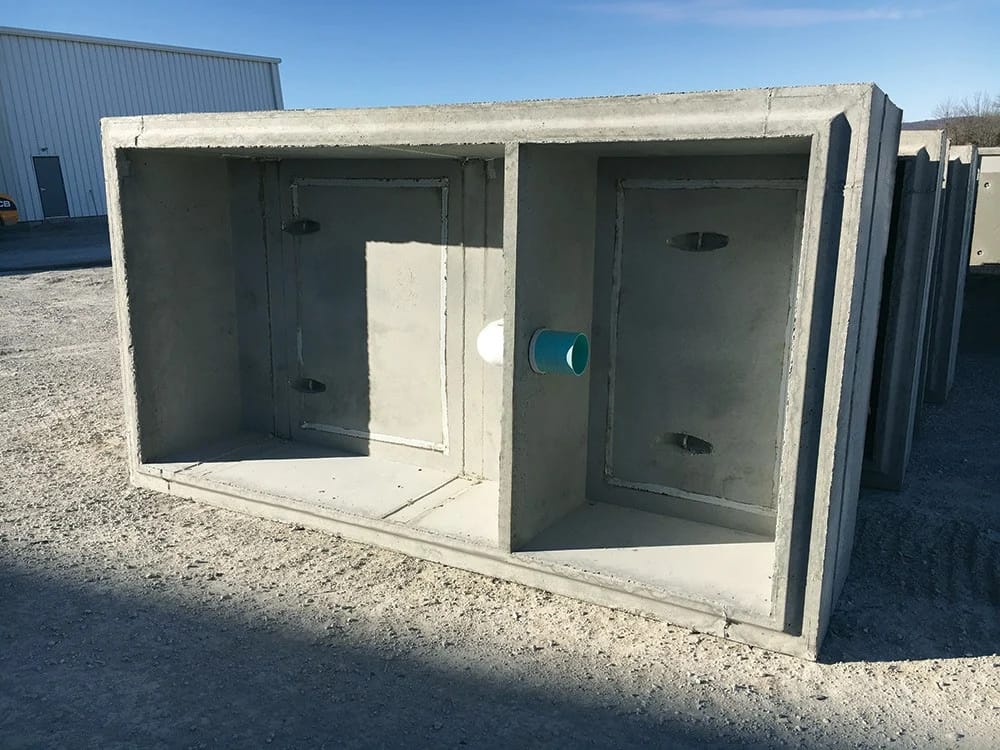
A grease interceptor is not an accessory. In Calgary it is a condition of operating. Get the size wrong and the kitchen fails inspection. Get the burial wrong and the lid sits proud of a parking stall for the life of the building.
This page covers what the tank has to do, how the City wants it sized, what standards apply to the concrete, and what we need before we can quote one.
What a gravity grease interceptor is
A gravity grease interceptor is a buried tank that holds wastewater long enough for fats, oils and grease to float and solids to settle. Clear water leaves through the outlet. FOG stays behind until a vacuum truck removes it.
Two devices carry the same job title. They are not interchangeable.
| Gravity grease interceptor | Hydromechanical grease interceptor | |
|---|---|---|
| Location | Buried outside the building | Inside, under or near the fixture |
| Material | Precast concrete | Steel, stainless, polymer |
| Typical volume | 500 to 3,000+ US gallons (1,893 to 11,356 L) | Tens of litres |
| Separation | Retention time and gravity | Baffles, flow control, internal media |
| Service | Vacuum truck | Manual skim or pump |
| Suits | Full-service kitchens, food production, multi-tenant ICI | Single fixtures, tight retrofits |
The volume band above is the range NPCA publishes for gravity units in its operations and maintenance best practices. Metric figures are converted from those US gallon values.
Gravity units win on capacity and service interval. They lose on footprint. You need excavation, cover and truck access. That is the trade.
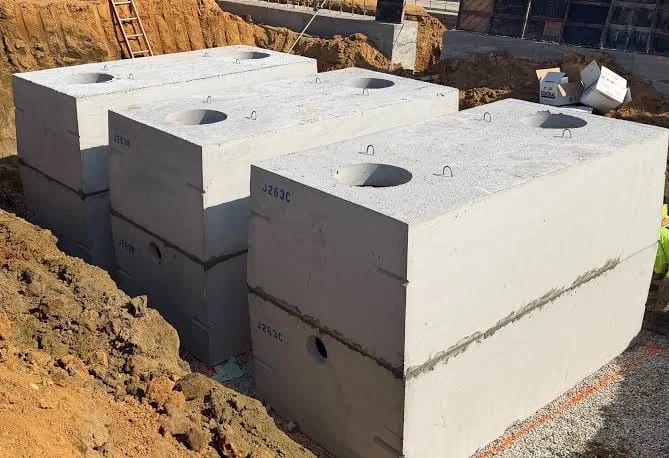
Calgary’s rule: every fixture that releases FOG
The threshold is zero. The City states that all industrial, commercial and institutional facilities where food is cooked, processed or prepared — or where any FOG is released — must install a grease interceptor. There is no minimum quantity that exempts you.
The City lists the fixtures it means: rinse sinks, pot sinks, prep sinks, floor drains, mop sinks. The governing instrument is Wastewater Bylaw 14M2012.
Two more rules decide who does the work:
- Selection and installation must be completed by a licensed plumber.
- The work runs under a plumbing permit issued by a City of Calgary Plumbing and Gas Inspector.
That matters for scheduling. The tank is one line on a permitted plumbing scope. Order it against the plumbing schedule, not the concrete schedule.
Outside Calgary, the municipality writes its own wastewater bylaw and the Alberta edition of the National Plumbing Code applies to the plumbing design. Confirm the local bylaw before you order. The tank geometry rarely changes. The paperwork does.
Sizing: use the City’s own worksheet
The City of Calgary publishes a sizing method. Use it. It is the number an inspector can reproduce.
The method works on fixture volume, not on seats or meals per day:
- Volume (m³) = length × width × depth of the fixture, in metres.
- Convert to litres: multiply by 1,000.
- Usable volume = total volume × 0.75.
- Peak flow (L/min) = usable volume ÷ drain time in minutes. The City’s example assumes one minute.
- Add the usable volume of every fixture that drains to the interceptor.
The City’s worked example: a 0.4 × 0.4 × 0.4 m sink is 64 L, and 64 × 0.75 = 48 L. A 0.3 × 0.3 × 0.3 m sink is 27 L, and 27 × 0.75 = 20.25 L. Together, 68.25 L. The City concludes an interceptor rated above 68.25 L/min should be adequate.
Applying that same formula to common commercial fixtures gives the following. These are calculations from the City’s method, not published City values — check your own fixture dimensions.
| Fixture (L × W × D, m) | Volume | Usable volume at 0.75 | Contribution at 1-minute drain |
|---|---|---|---|
| Bar / rinse sink, 0.3 × 0.3 × 0.3 | 27 L | 20.25 L | 20.25 L/min |
| Prep sink, 0.4 × 0.4 × 0.4 | 64 L | 48.00 L | 48.00 L/min |
| Mop sink, 0.5 × 0.5 × 0.3 | 75 L | 56.25 L | 56.25 L/min |
| Pot sink compartment, 0.6 × 0.5 × 0.35 | 105 L | 78.75 L | 78.75 L/min |
| Scullery sink, 0.75 × 0.6 × 0.4 | 180 L | 135.00 L | 135.00 L/min |
A three-compartment pot sink at 0.6 × 0.5 × 0.35 m per bay contributes 236.25 L. Add a prep sink and a bar sink and the demand reaches 304.5 L/min. That is a different tank than the 68.25 L/min example. Count every bay.
Automotive and industrial sites size differently. The City’s automotive guidance calls for an interceptor designed and sized to the National Plumbing Code of Canada with a minimum retention time of two hours based on the maximum expected flow. Retention time, not fixture count, drives that volume.
CSA B481.3 is the standard that covers sizing, selection, location and installation of grease interceptors. Cite it in the spec. It sits alongside B481.0 for material, design and construction, B481.1 and B481.2 for lard and oil performance testing, and B481.4 for maintenance.
The limits the tank is being measured against
The interceptor exists to keep the outfall inside Schedule A and Schedule B of the bylaw. The automotive numbers the City publishes are the clearest published set:
| Parameter | Limit |
|---|---|
| Hydrocarbons | 50 mg/L |
| Total suspended solids | 300 mg/L |
| BTEX | 1.0 mg/L |
| Benzene | 0.5 mg/L |
| Toluene | 0.5 mg/L |
| Ethylbenzene | 0.5 mg/L |
| Xylene | 0.5 mg/L |
| pH | Discharge below 5.5 or above 10 is prohibited |
Two operating rules protect those numbers and both are bylaw matters, not housekeeping preferences. Water entering the interceptor must stay below 60°C. Emulsifiers, enzymes, bacteria, solvents and hot water may not be used to push FOG through the device. Grease that leaves the tank dissolved is still grease in the sewer.
Spec the tank, not the gallon count
A gallon figure is not a specification. Four clauses are.
ASTM C1613 — Standard Specification for Precast Concrete Gravity Grease Interceptor Tanks. It covers design, manufacturing practice and performance for monolithic and sectional precast interceptor tanks. Name it.
CSA A23.4 — precast concrete manufacture. The plant-side standard for production, curing and tolerance. Our precast manufacturing process runs against it.
CPCQA — the Canadian Precast Concrete Quality Assurance certification program. Certification is by category. Specify the category that covers the product, not the program in general. We break the categories down in a specifier’s guide to CPCQA.
Load rating on the casting — an H-20 rating corresponds to a 16,000 lb wheel load. AASHTO M306 sets a 40,000 lb proof load for H-20 castings and 50,000 lb for H-25. A lid in a drive aisle needs the rated casting. A lid in landscaping does not.
Add watertightness to the submittal. An interceptor that leaks is a contamination path and a maintenance cost. Specify a leakage test and require the result in writing.
Interceptor tanks are custom precast work. They are built to the approved drawing rather than pulled from a stock line. Send the drawing with the enquiry.
Burial, access and Alberta ground
The tank is buried. Everything that goes wrong afterwards is an access problem.
- Risers to grade. Every access point needs a riser stack to finished grade and a lid a vacuum crew can lift. Buried lids get paved over. Paved-over lids get cut out later at full cost.
- Cover depth. Set cover from the invert of the incoming service, not from a rule of thumb. Deep inverts mean tall risers and heavier lifting.
- Traffic loading. Confirm whether the lid lands in a drive aisle, a stall, or soft landscaping before the shop drawing is stamped. The rating changes the casting and the top slab.
- Groundwater. A tank pumped empty for service is a buoyant tank. Where the water table is high, the anti-flotation check belongs in the design, not in the field.
- Truck access. A vacuum truck needs a route and a place to stand. Confirm it at site plan stage.
Winter shortens the window for the excavation, not for the tank. A buried, full, continuously used interceptor holds warm wastewater. The risk is the crew and the open hole in February, not the process inside the concrete.
Maintenance the owner is signing up for
Put this in the O&M manual at handover. The obligation follows the operator.
| Requirement | Food service (Calgary) | Automotive (Calgary) |
|---|---|---|
| Service trigger | Before combined FOG and solids exceed 25% of liquid volume | Solids over the lesser of 15 cm or 25% of wetted height; floating oil over the lesser of 5 cm or 5% of wetted height |
| Minimum frequency | At least once every four weeks | Full vacuum cleaning at least annually |
| What counts as service | Remove 100% of contents, clean the interceptor, inspect components | Full cleaning with a vacuum power unit |
| Records | Maintenance schedule and records, retained two years | Written maintenance, cleaning and inspection records, retained two years |
NPCA’s best practice guidance is tighter than a calendar rule in one respect worth repeating to owners: pump out when combined FOG and solids reach at least 25% but not more than 40% of total liquid depth, and measure it with a sludge judge rather than guessing. New installations should be checked monthly or bimonthly until the accumulation rate is predictable. Before any dormant period over 30 days, pump the tank and refill it with clean water.
Concrete outlasts the service contract. Our notes on maintenance of precast concrete structures cover the structure itself.
Precast or cast-in-place
| Precast interceptor | Cast-in-place interceptor | |
|---|---|---|
| Production | Plant, controlled conditions, CSA A23.4 | Site, weather-dependent |
| Joints | Factory joints, tested | Cold joints at every pour break |
| Site duration | Set and backfill in a day | Forms, pour, cure, strip |
| Weather exposure | Minimal | Full |
| Testing | Leakage tested before it ships | Tested in the hole, if at all |
The comparison runs the same way across most buried structures. We set it out in full in precast vs cast-in-place.
What we need to quote
Send these five items and you get a price and a lead time:
- Required flow rating in L/min, or the fixture schedule with dimensions.
- Invert elevation of the incoming service and finished grade elevation.
- Traffic loading over each lid.
- Pipe size and material at inlet and outlet.
- Site address and required delivery window.
We return a shop drawing for approval, a firm lead time and a delivery and set schedule. For ICI projects, start at our commercial precast solutions. For plants, shops and wash bays, start at industrial.
Decades of buried structures across Alberta. Hundreds of set days. Send the drawing.
FAQ
Does every restaurant in Calgary need a grease interceptor? Yes. The City states that all industrial, commercial and institutional facilities where food is cooked, processed or prepared, or where FOG is released, must install one. There is no minimum amount that exempts a facility.
How do I size a grease interceptor in Calgary? Use the City’s worksheet. Multiply each fixture’s length, width and depth in metres, convert to litres, multiply by 0.75 for usable volume, then divide by the drain time in minutes to get peak flow. Add every fixture that drains to the interceptor.
How often does a grease interceptor have to be cleaned? In Calgary, before combined FOG and solids exceed 25% of the liquid volume, and at least once every four weeks. Service means removing 100% of the contents and inspecting the components. Keep the records for two years.
What is the difference between a grease interceptor and a grease trap? Size and location. A gravity grease interceptor is a buried precast tank sized in hundreds or thousands of gallons. A hydromechanical unit, often called a trap, is a small device installed inside near the fixture.
Can a grease interceptor be installed inside the building? Hydromechanical units are designed for interior installation. Gravity precast interceptors are buried outside. The plumbing designer makes the call under the Alberta edition of the National Plumbing Code and the local wastewater bylaw.
Who is allowed to install one in Calgary? A licensed plumber, under a plumbing permit issued by a City of Calgary Plumbing and Gas Inspector.
What standards should I name in the spec? ASTM C1613 for the precast tank, the CSA B481 Series for the interceptor itself — B481.3 covers sizing, selection, location and installation — CSA A23.4 for precast manufacture, and the appropriate CPCQA certification category.
Does the lid need a traffic rating? If it lands in a drive aisle or parking stall, yes. An H-20 rating corresponds to a 16,000 lb wheel load, with a 40,000 lb proof load under AASHTO M306. Confirm the location before the shop drawing is approved.
Sources
- City of Calgary — Fats, oil and grease: food service establishments
- City of Calgary — Sizing your grease interceptor (PDF)
- City of Calgary — Automotive industry wastewater compliance information (PDF)
- CSA Group — CAN/CSA B481 Series, Grease interceptors
- ASTM International — C1613 Standard Specification for Precast Concrete Gravity Grease Interceptor Tanks
- NPCA — Best Practices for Operation and Maintenance of Precast Concrete Gravity Grease Interceptors (PDF)
- Municipal Castings Association — AASHTO load rating standards