
Last updated: July 27, 2026
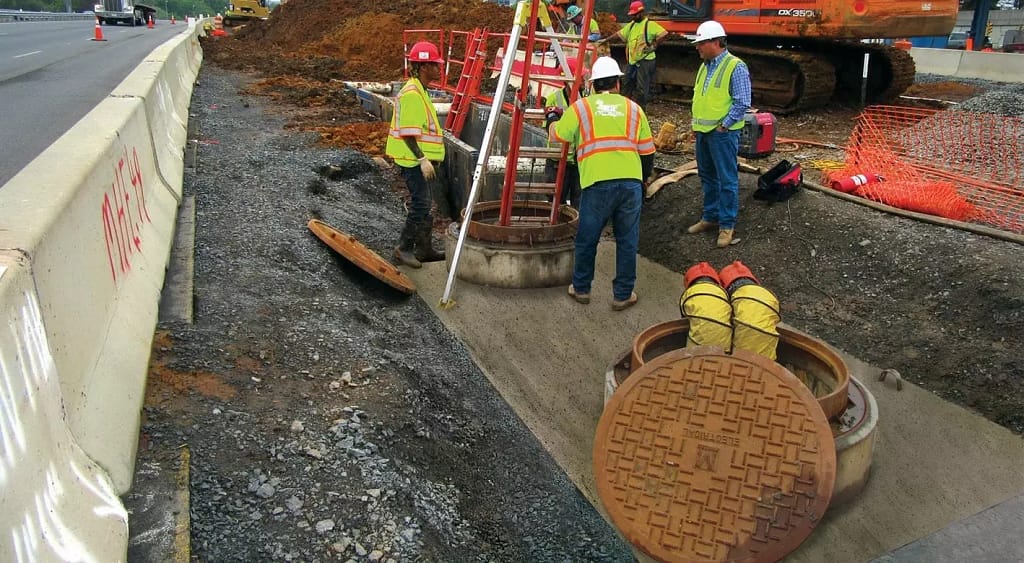
A precast utility vault or manhole’s load rating tells you whether it can be installed where vehicles drive. The key threshold is “traffic rated” — AASHTO H-20 / HS-20 — which assumes a 16,000 lb wheel load (about 71 kN) and a 32,000 lb axle load (about 142 kN), rising to roughly 45,000 lb at the wheel once impact and load factors are applied; a non-traffic-rated structure is only for landscaped, sidewalk, or off-roadway locations. The structural design loads for underground precast utility structures are standardized by ASTM C857, with manufacturing under ASTM C858.
Precast manholes are made to ASTM C478/C478M-22 (or, in Canada, CSA A257.4), and box culverts to ASTM C1433 / AASHTO M259. The newer AASHTO HL-93 design live load uses the same HS-20 truck wheel loads, so it “is not meant to cause redesign of underground precast structures.” In short: confirm the structure carries the H-20/HS-20 traffic rating before it goes under a roadway, and confirm it was made to the manhole, vault, or box standard your municipality specifies.
Vendor pages list “H-20 rated” as a checkbox, and the standards themselves are paywalled. This page decodes the actual load numbers in plain English, pairs them with the Canadian CSA path a Calgary spec invokes, and frames the buyer’s real decision: does the rating match the install location.
What does “traffic rated” actually mean?
The single decision behind a utility-structure spec is: will vehicles drive over it? That splits every product into two camps.
A traffic-rated structure carries vehicular wheel loads and can go under or near a roadway. A non-traffic-rated structure is for off-roadway use only: landscaping, sidewalks, a utility right-of-way away from traffic. As one supplier puts it, “there are few construction materials designed to withstand these types of loadings other than concrete and cast iron / ductile iron steel,” which is why heavy-traffic vault product lines are marketed explicitly as “H-20 / HS-20 rated.”
(Sources: Locke Solutions, “Translating HS-20 Traffic Lingo,” https://lockesolutions.com/translating-hs-20-traffic-lingo/ ; American Tech Supply, H-20 vaults, https://americantechsupply.com/heavy-traffic-rated-h-20-h-20-heavy-traffic-vaults-concast-heavy-traffic-rated-vaults-christy-traffic-rated-vaults/ .)
That is the practical core of the whole topic. Match the rating to where the structure is going. Under a road, you need a traffic rating. Off the road, you may not. The rest of this article is what the rating numbers mean and which standard your spec is pointing at.
What is an H-20 / HS-20 load rating?
H-20 and HS-20 are AASHTO truck loadings. HS-20 “describes normal MOVING traffic loading conditions up to 18-wheeler loading,” assuming “a 16,000 lbs wheel load and therefore a 32,000 lbs axle load,” and it “refers to traffic loading conditions with wheel loads up to 45,136 lbs when considering impact and load factors.” (Source: Locke Solutions, URL above.)
In metric, that’s roughly a 71 kN wheel load and a 142 kN axle load, climbing to about 201 kN at the wheel once impact and load factors are added. H-20 and HS-20 are “generally speaking, used interchangeably, but there is a slight difference,” with a minimal cost difference between them. (Source: Locke Solutions, URL above.) For most buyers, “H-20 rated” and “HS-20 rated” mean the structure is built for highway traffic.
How does HL-93 relate to HS-20?
Newer specs increasingly call for HL-93, and buyers ask whether an H-20 vault still qualifies. For buried structures, the answer is yes.
HL-93 is “the Basic LRFD Design Live Load,” a combination of “Design Truck Plus Design Lane Load” or “Design Tandem Plus Design Lane Load.” Its design truck matches HS-20 loads, and per ASTM C1577 the “Design Lane Load … does not apply to below ground structures,” so HL-93 “is not meant to cause redesign of underground precast structures.”
(Sources: Locke Solutions, URL above; NPCA, “HL93 Truck Loads vs. HS20 Truck Loads,” https://precast.org/blog/hl93-truck-loads-vs-hs20-truck-loads/ .)
So if your spec says HL-93 and a product is H-20/HS-20 rated, the truck wheel loads align for a buried structure. The lane load that distinguishes HL-93 is a surface-bridge consideration that doesn’t apply below ground. Worth confirming with the project engineer for the specific structure, but the two are reconcilable by design.
Which standards govern manholes and vaults?
This is where buyers get lost, because manholes, vaults, and box culverts each have their own standard, and Canada and the US each have a version. Here is the stack.
Precast manholes. The US standard is ASTM C478/C478M-22, which covers “the manufacture and purchase requirements of products used for the assembly and construction of circular, vertical precast concrete manholes,” requiring steam or water curing plus compression and absorption testing; the AASHTO equivalent is M199.
(Sources: ASTM C478/C478M-22, https://store.astm.org/c0478_c0478m-22.html ; NPCA, “ASTM Manhole Specifications,” https://precast.org/blog/astm-manhole-specifications/ ; Rinker, C478/M199, https://www.rinkerpipe.com/product_specifications/astm-c478-aashto-m199-precast-reinforced-concrete-manhole-sections/ .)
The Canadian counterpart, and the one a Calgary or Alberta spec is more likely to name, is CSA A257.4:24, covering precast reinforced circular concrete manhole sections, catch basins, and fittings, with test methods in CSA A257.0:24 (three-edge-bearing, compression, absorption, hydrostatic, flat-slab-top, and manhole-step tests).
(Sources: CSA A257 Series:24, https://www.csagroup.org/store/product/2427206/ ; Rinker, CSA A257.4, https://www.rinkerpipe.com/product_specifications/csa-257-4-precast-circular-concrete-manhole-sections-catch-basins-and-fittings/ .)
Utility vaults. Vaults have their own pair. ASTM C857 is the “Minimum Structural Design Loading for Underground Precast Concrete Utility Structures,” and it standardizes the design loads, including traffic. ASTM C858 is the specification for “Underground Precast Concrete Utility Structures,” the design criteria and manufacturing practice.
(Sources: ASTM C857, https://store.astm.org/c0857-07.html ; ASTM C858, https://store.astm.org/c0858-19.html ; NPCA Utility Structures Best Practices Manual, https://precast.org/wp-content/uploads/100323_Products_UtilityStructureBestPracticesManual.pdf .)
Box culverts. Precast box sections are made to ASTM C1433 / AASHTO M259; for box sections designed to AASHTO LRFD / HL-93, ASTM C1577 applies.
(Source: NPCA, Box Culverts, https://precast.org/precast-product/box-culverts/ .)
One nuance that trips up buyers
The manhole standard does not tell you what the buried structure can carry. ASTM C478 states plainly: “This specification is a manufacturing and purchase specification only and does not include requirements for backfill, or the relationship between field load conditions and the strength requirements.”
In other words, C478 governs how the manhole is made. The installation and field-load design (what it carries once it’s in the ground, under what backfill) is handled separately, through ASTM C857 and the project engineer. That separation is exactly why a load rating and the engineering behind it matter on top of the product standard.
Selecting the correct traffic rating is only part of the specification. Proper installation sequencing is equally important. Our Erection Sequencing 101 for GCs guide explains how delivery, crane access, and installation order affect schedule certainty and project risk.
What strength is in these structures?
Precast utility structures and manholes are high-strength concrete, commonly around a 4,000 psi (roughly 28 MPa) class, and where Alberta soil sulphate applies they run to Type HS per CSA A23.1:24.
(Sources: NPCA, Manholes, https://precast.org/products/manholes/ ; Omega Knowledge Base, S-2 / Type HS spec.)
That gives the chloride, sulphate, and freeze-thaw resistance a buried structure needs. The ~4,000 psi figure is an industry baseline in US units, so treat it as typical and confirm the project’s specified strength rather than assuming a fixed product value.
The Calgary and Alberta layer
Three local facts a Calgary municipal or utility buyer should hold.
Your spec names both ASTM and CSA. A Calgary buyer specs to City of Calgary sewer and waterworks specifications and Alberta Transportation standards, so the article names CSA A257.4 (the Canadian manhole/catch-basin standard) alongside ASTM C478, and you’ll see both in the field. Alberta Transportation’s water-control-structures guidance references C478 for precast manhole sections, publishes a standard drawing CB6-2.10M9 for a 1200 mm diameter precast concrete manhole, and covers manholes, inlets, and catch basins in Section 2.10 of its Highway Construction Standard Specifications.
(Sources: AT Water Control Structures Design Guidelines, https://open.alberta.ca/dataset/fd3fd9f5-89c7-4522-830a-40191346d9ac/resource/fff66b70-dc1f-499d-b855-c131f31f1bc8/download/trans-water-control-structures-design-guidelines-section-2.pdf ; AT drawing CB6-2.10M9, https://www.alberta.ca/system/files/trans-dwg-cb6-2-10m9rev1.pdf ; AT Standard Specifications for Highway Construction, https://www.transportation.alberta.ca/Content/docType245/Production/2010_Highway_Construction.pdf . Confirm the exact load class and standard callouts on the live AT drawing at spec time.)
Sulphate and frost set the durability spec. A Calgary vault or manhole sits below the 1.2 m frost line in sulphate soil, so the mix runs to Type HS per CSA A23.1:24. That’s a core reason concrete, not plastic, dominates buried utility structures here.
“Where is it going?” is a roadway-versus-boulevard call. Under a Calgary arterial, you need an H-20/HS-20 traffic rating. In a utility right-of-way or boulevard, a non-traffic rating may suffice, but confirm against the City spec for that specific location before you order.
(This is the decision rule; confirm per the City of Calgary specification for the location.)
Omega Precast enters this category as a Calgary solid-concrete precast manufacturer. The strength and rating figures here are industry baselines and standard requirements, not asserted Omega product specs; we frame our role as building capability to the referenced standards.
FAQ
What does “traffic rated” mean for a precast vault or manhole? It means the structure carries vehicle wheel loads (AASHTO H-20/HS-20) and can be installed under or near a roadway. A non-traffic-rated structure is for off-roadway use only, such as landscaping or sidewalks.
What is an H-20 / HS-20 load rating? An AASHTO truck loading that assumes a 16,000 lb wheel load (about 71 kN) and a 32,000 lb axle load (about 142 kN), rising to roughly 45,000 lb at the wheel once impact and load factors are applied.
How does HL-93 relate to HS-20 for buried structures? HL-93’s design truck uses the same HS-20 wheel loads, and its lane load doesn’t apply below ground, so HL-93 doesn’t trigger redesign of underground precast structures.
Which standards govern precast manholes and vaults? Manholes: ASTM C478/C478M-22 or, in Canada, CSA A257.4:24. Utility structures: ASTM C857 for the design loads plus C858 for the product. Box culverts: ASTM C1433 / AASHTO M259.
Does the manhole standard (C478) cover the load it can carry once buried? No. C478 is a manufacturing and purchase specification only. Field-load and backfill design are handled separately, for example through ASTM C857 and the project engineer.
What load rating does a manhole under a Calgary road need? A traffic rating (H-20/HS-20), confirmed against the City of Calgary or Alberta Transportation specification for that location.
What concrete strength is in a precast manhole? Commonly around a 4,000 psi (roughly 28 MPa) class, with Type HS concrete per CSA A23.1:24 where Alberta soil sulphate applies. Treat that as an industry baseline and confirm the project’s specified strength.
Specify the Right Precast Utility Structure the First Time
Need a traffic-rated precast vault, manhole, or utility structure for a Calgary or Alberta project? Omega Precast manufactures engineered precast products to recognized CSA and ASTM standards and works with engineers, municipalities, and contractors to help match the correct structure to your project’s loading and installation requirements.
Contact Omega Precast today to discuss your project or request a quotation.