
Last updated: August 5, 2026
There are three real foundation-wall systems in Calgary, and they solve different problems. Poured (cast-in-place) is the monolithic, no-seam default, cured on your lot. Solid-concrete precast is a factory-cast solid reinforced wall — Omega Precast’s category — set in about a day at full design strength. Superior Walls is an insulated composite panel (concrete face + steel studs + bonded foam, R-12.5 to R-23), not a solid wall. All three are legitimate; the right answer depends on your build type, schedule, season, and whether you’re finishing the basement.
Most online “precast foundation” content was written for the U.S., quietly compares everything to the Superior Walls composite system, and skips the factors that actually decide it in Calgary — S-2 sulphate soil, the six-month cold-weather window, ~128 freeze-thaw cycles a year, and a surging Net Zero builder roster. This is the honest side-by-side. We run Calgary’s residential solid-precast plant, and we’ll tell you exactly when poured concrete is the better call instead.
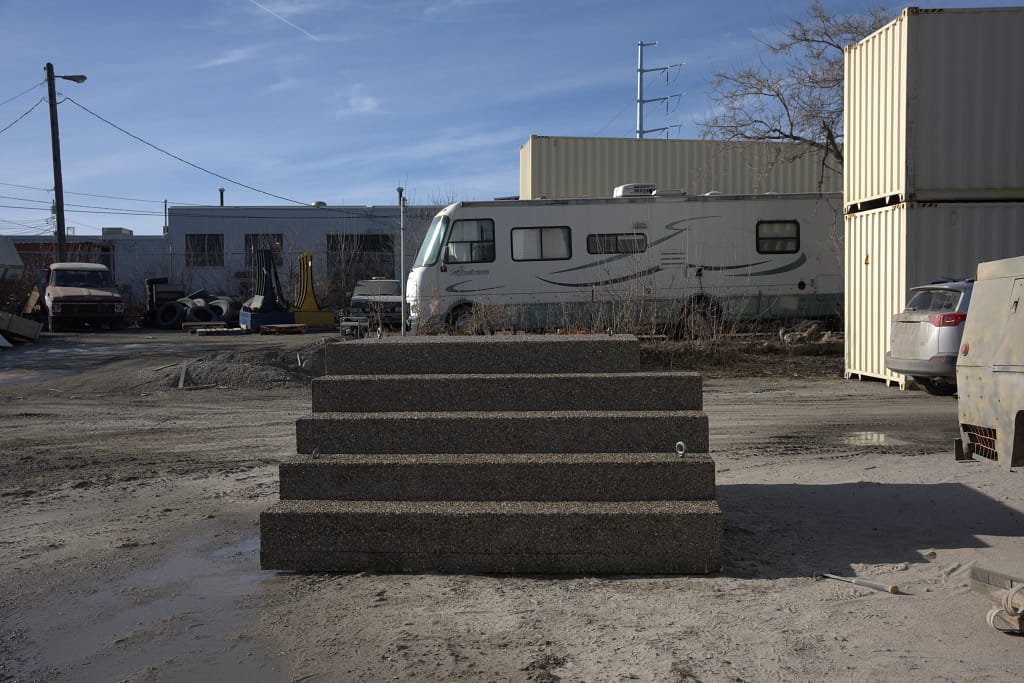
The three systems, plainly
Searchers usually arrive thinking “precast = Superior Walls.” That conflation is the single biggest source of confusion in the residential foundation conversation, so resolve the fork first.
1. Poured / cast-in-place (CIP) — the Calgary default
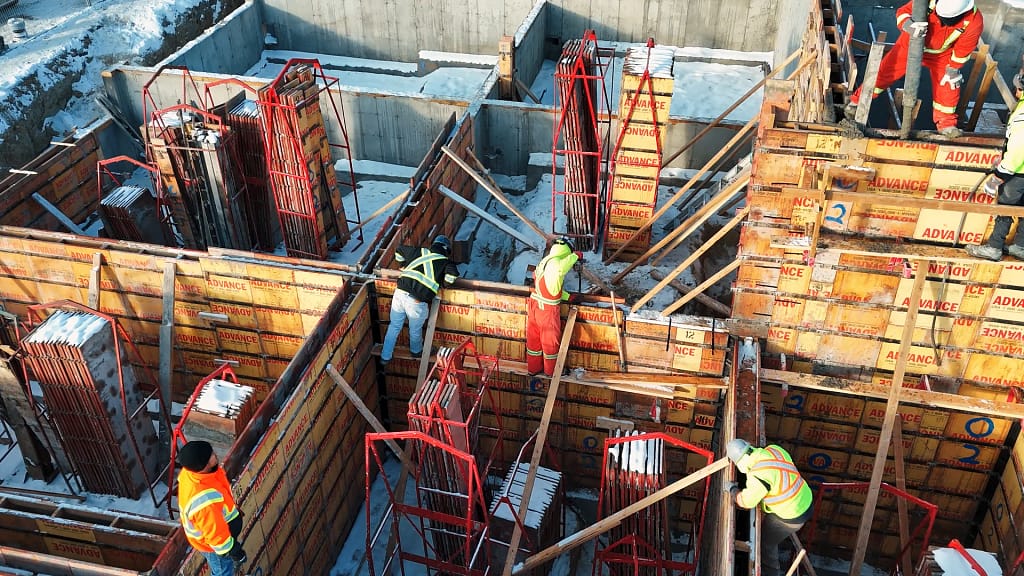
A cribbing crew sets formwork on your lot, places rebar and embedded items, pours concrete from a ready-mix truck, and waits while the wall cures in place. Forms strip once the wall reaches strength. Its defining structural virtue: a monolithic pour with no seams or joints — an advantage regarding potential leak issues (NJGCB). It’s also the most adaptable on site for one-off custom geometry. Governed by CSA A23.1:24 (concrete materials and methods), the National Building Code (Alberta Edition) for structural design, and CSA A3001 for cement type.
2. Solid-concrete precast — Omega Precast’s category
A plant casts a solid reinforced concrete wall in a steel form, cures it under controlled temperature and humidity, and ships it to site at full design strength for a crane-and-set install. It is the same material as a poured wall — 35 MPa high-strength concrete at the 56-day spec point, sulphate-resistant cement — just cured indoors instead of on your lot. There is no foam and there are no studs in the panel; you insulate and frame the interior the same way you would behind a poured wall. Governed by CSA A23.4 (precast materials and construction, reaffirmed 2021) plus CSA A23.1:24 and CSA A3001. Peers in this solid-concrete category include Eagle Builders and Westcon Precast.
3. Insulated composite-panel precast — Superior Walls / Structural Precast
A sandwich, not a solid wall: a thin high-strength concrete face (the Xi system family runs roughly 1¾–2½ inches), galvanized steel studs embedded during the pour, and bonded rigid-foam insulation. It arrives already insulated and ready for interior electrical and drywall. Superior Walls publishes Xi at R-12.5 and Xi Plus at R-21.3, with panels bolted top and bottom and the joints sealed with a one-part polyurethane sealant (Superior Walls FAQ). In Alberta it’s sold and installed through Structural Precast (Calgary HQ, Claresholm plant).
The structural assumptions, connection details, install rhythm, finished wall section, and price are all different across the three. Choosing isn’t about which is “better precast.” It’s about which problem your project is solving.
The three-way comparison table
| Factor | Poured / cast-in-place | Solid-concrete precast (Omega) | Insulated composite (Superior Walls) |
|---|---|---|---|
| What it is | Concrete poured into site forms | Factory-cast solid reinforced wall | Concrete face + steel studs + bonded foam |
| Seams/joints | None — monolithic pour | Sealed panel-to-panel joints (fewer than a stud-frame panel) | Bolted + one-part polyurethane sealed joints |
| Insulation | Added on site (none in the wall) | Added on site (none in the wall) | Built in: R-12.5 (Xi) / R-21.3 (Xi Plus) |
| Cure environment | Your lot — ambient temp, wind, freeze-thaw | Plant — controlled temp & humidity | Plant — controlled temp & humidity |
| On-site wall timeline | ~7–10 days (set, pour, cure, strip) | ~1 day (arrives at design strength) | ~1 day (arrives at design strength) |
| Winter capability | Triggers cold-weather premium after Sep 30 | Wall pour is off-site — bypasses the trigger | Wall pour is off-site — bypasses the trigger |
| Best for | One-off custom geometry, warm-season builds, tight crane-access infill | Heavy lateral load, walk-outs, repeated plans, finished basements, Q4–Q1 builds | Single-family / two-storey, minimal on-site labour, ready-to-finish interior |
| Governing standard | CSA A23.1:24 | CSA A23.4 + A23.1:24 | CSA A23.4 + A23.1:24 |
Figures: Superior Walls R-values from the manufacturer FAQ (linked above); install timelines from NPCA / precast.org. Validate any project number against real quotes.
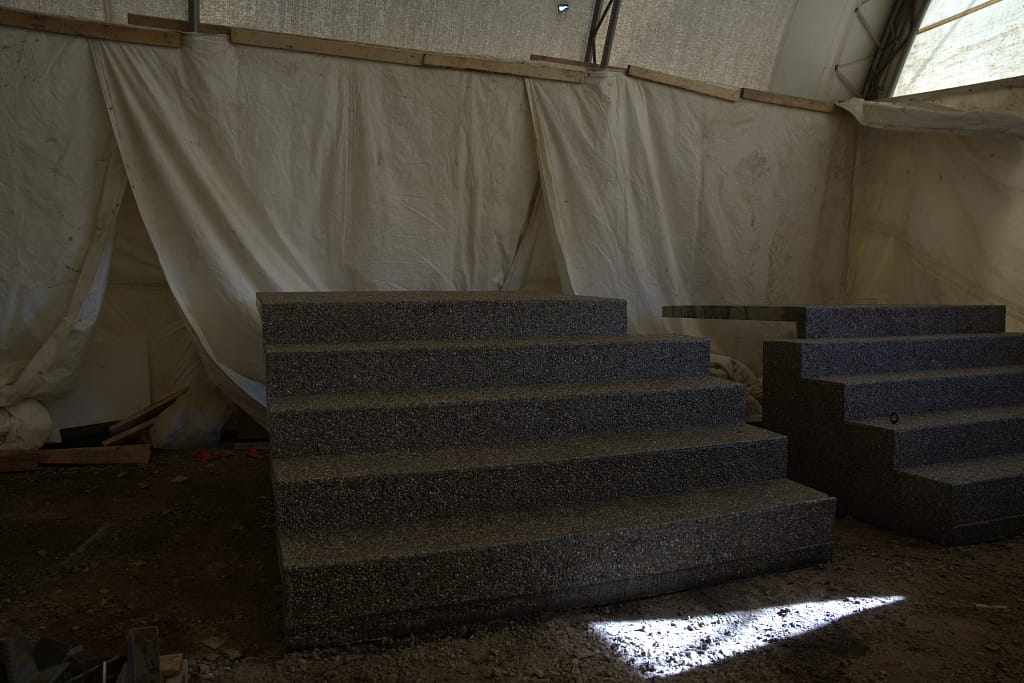
Do solid precast walls leak? (Killing the joint myth)
This is the fear searchers carry, and it’s borrowed almost entirely from Superior Walls joint-and-caulking lore — including public complaints about leaking seams and bowing on the composite system (reviews). It deserves a precise answer, not an insult: the composite system has many satisfied owners, and the leak question is about joint count and detailing, not the word “precast.”
Here’s the honest physics. A poured wall wins on this single axis because it has no joints at all — that’s the monolithic advantage. A composite panel is a stud-frame assembly with bolted, sealed panel joints. A solid precast wall sits between them: far fewer joints than a stud-frame composite, each sealed with a high-performance polyurethane bead, and — critically — no foam-and-stud cavity behind the concrete that changes the vapour-control picture.
But the part every homeowner misses: no foundation wall waterproofs itself. All three are backfilled against an engineered exterior waterproofing membrane and drainage course designed for Calgary clay. Skip that step and any wall leaks. Joint detailing and exterior dampproofing follow the same code for all three. With proper installation, a solid precast wall performs no worse than poured — and often better than a wall that was site-cured through freeze-thaw, because it arrives without cure-condition micro-cracking.
The Calgary factors that actually drive the decision
Three local realities make this decision different here than in milder markets.
The 5 °C trigger and the September 30 cutoff. CSA A23.1:24 mandates cold-weather procedures whenever ambient or substrate temperature drops below 5 °C, and Concrete Alberta advises against placement after September 30 without the full procedure stack — heated mix water, accelerators, insulated forms, blanket curing, hoarding, maturity monitoring. That stack typically adds 10–25% per pour. Calgary hits the trigger from late September into mid-April — about six months a year. Both precast systems take the wall pour off-site, sidestepping the single largest cold-weather exposure point. (The footings still pour on site — a far smaller volume.)
~128 freeze-thaw cycles a year. The City of Calgary’s Climate Hazards review documents a 30-year average of roughly 128 freeze-thaw cycles annually — among the highest of any major Canadian metro. Each cycle stresses curing concrete. A wall poured in October or March can be forced through several cycles in its first week. Plant-cured panels never see them during cure.
S-2 sulphate soil. Calgary soil routinely tests at S-2 sulphate exposure, mandating Type HS sulphate-resistant cement at the 35 MPa / 56-day spec point under CSA A23.1:24. Type HS gains strength more slowly (lower C3A content trades early strength for sulphate durability). All three systems can deliver compliant HS concrete; plant curing simply reduces the variability around the spec target.
R-value: off the truck vs in the assembly
This is the headline difference between solid and composite, and where most builder confusion lives.
Superior Walls delivers bonded insulation in the panel — R-12.5 (Xi) or R-21.3 (Xi Plus) — so the interior face arrives ready for drywall. A solid precast wall (like a poured wall) arrives as bare concrete; its finished R-value is whatever you specify behind it. In a Calgary Net Zero or Net Zero Ready build, that’s usually semi-rigid mineral wool or closed-cell spray foam in a stud cavity, often R-22 to R-32 effective.
There’s no “winner” here — both wall sections hit Net Zero targets when designed properly. The real question is when the R-value gets added and who adds it. If you want to minimize on-site labour, the composite panel does more work before it arrives. If you want to tune the interior assembly to your energy model — or change insulation spec late — the solid wall leaves that decision open. Talk to your energy advisor about the assembly as a whole (continuous insulation, vapour control, air barrier) before assuming the panel choice settles the energy model.
What plant certification (CPCQA) is — and why you should ask for it
Before pricing any manufactured-wall product, ask the producer about CPCQA — the Canadian Precast Concrete Quality Assurance program, administered by CPCI and CCPPA. It’s the only North American program that certifies plants to CSA A23.4 (including Appendices A & B) together with PCI MNL-116 (structural) and MNL-117 (architectural), with unannounced audits twice a year on the more stringent of the two programs (CPCQA program; CCPPA). It is product-category-specific — a structural cert does not transfer to architectural, and vice versa.
This matters as buyer due diligence: it’s a tighter, more frequent quality bar than cast-in-place foundations typically pass through, because the audits are unannounced and the standards are specific to manufactured concrete. The four Calgary-area plants currently in the public CPCQA directory are Amrize Canada, Eagle Builders, Knelsen Sand & Gravel, and Proform Construction Products (directory). When you evaluate any precaster, ask to see current CPCQA certification status for the relevant product category, the most recent third-party audit summary, and project-specific shop drawings stamped by a P.Eng. licensed in Alberta. If a producer can’t show those, the conversation shouldn’t move to pricing.
Cost: the honest version
Most online comparisons go sideways here. Cost depends on what you measure and where.
- Direct wall cost is project-specific. The factors that move it more than the type of wall: wall height and perimeter shape, the opening schedule (every door/window is engineering + form labour), lot access and crane reach, the season, and the insulation/finish package. A composite panel arrives with R-value in it; behind a solid panel you buy insulation and framing separately, which narrows the apparent gap. Any blog quoting a fixed per-square-foot number is bluffing — get real quotes.
- Schedule cost is where precast (either kind) separates from poured: roughly 6–9 days of on-site compression per single-family lot, compounding into weeks across a multi-lot phase, with smoother downstream trade handoffs.
- Winter premium is the asymmetric one. Poured pours after September 30 carry the 10–25% cold-weather premium; precast wall pours don’t. For builds running Q4 into Q1, or any fixed delivery date that can’t slip to spring, that gap is the real economic driver.
- Lifecycle: all three produce durable CSA-compliant walls. Plant-cured concrete tends to show less micro-cracking from cure-condition variability — a small but real durability factor over decades.
Industry context worth stating plainly: residential precast still holds a small market share (around 3.56% of the U.S. concrete-foundation market in recent data), and single-family economics make a one-off harder to justify — precast wins on repeated plans and schedule-critical work (Offsite Builder). One veteran builder’s line captures the adoption logic: “Time is money, so if you’re able to shorten your cycles by using a prefabricated system, it’s much easier to rationalize a slight premium in cost.”
When poured (cast-in-place) is the right answer
We say this directly — Omega 2000 Cribbing pours cast-in-place walls across Calgary daily, and for these projects it’s the call:
- Custom builds with unusual geometry — stepped walls, irregular walk-out elevations, architecturally driven shapes that don’t fit standard panels.
- Warm-season builds (May–September) — no cold-weather premium, predictable cure; poured is the cost-effective default.
- Tight-access infill (Inglewood, Hillhurst, Bridgeland) where a crane footprint won’t fit.
- Builds inside a larger CIP envelope (commercial/mixed-use with poured slabs, parkades, integrated walls).
When solid precast is the right answer
- Heavy lateral load — deep backfill, multi-storey load above the basement, walk-out steps, podium transfer conditions. Where the engineer wants sectional thickness, solid concrete is the default.
- Repeated plans at production scale — same-spec single-family or townhome blocks where the panel design repeats (precast’s economic sweet spot).
- Multi-family / R-CG rowhouse blocks — the repeated geometry makes the case.
- Q4 / shoulder-season builds — anywhere the September 30 trigger would compound the premium across multiple pours.
- Finished-basement builds where schedule compression and dry-by-design cure matter.
When the composite (Superior Walls) is the right answer
- Single-family or two-storey envelopes within the system’s published capacity.
- Tight schedules with limited on-site framing/insulation labour — the panel arrives ready to finish.
- The tightest infill lots — the composite panel’s lower per-piece weight can simplify the lift.
A note on the Alberta peer landscape
It would be easy to pretend Omega Precast is the only Alberta precaster worth a call. It isn’t. Eagle Builders (Blackfalds) is Western Canada’s largest precast design-manufacture builder, largely commercial/industrial. Westcon Precast (Calgary + Edmonton) does retaining walls, stormwater, septic, and custom precast. Superior Walls of Alberta, made locally by Structural Precast, has served single-family builders wanting the composite insulated wall since the mid-2010s. Omega Precast is the newest Calgary residential entrant, focused specifically on solid concrete foundation walls for the missing-middle, Net Zero, and townhome market. The market is large enough for all of us, and the work is better when builders understand the product differences before the RFQ.
FAQ
Is Superior Walls the same as solid precast concrete? No. Superior Walls is an insulated composite panel — a thin concrete face with embedded steel studs and bonded foam (R-12.5 to R-21.3 off the truck). Solid precast is a full-thickness reinforced concrete wall with no foam or studs in the panel. Same word, different products.
Do solid precast concrete walls leak? With proper installation and joint sealing, no more than a poured wall — and often less than a wall site-cured through freeze-thaw. A solid wall has far fewer joints than a stud-frame composite. Critically, no wall waterproofs itself: all three must be backfilled against an engineered exterior waterproofing assembly.
Solid precast vs poured — which is cheaper in Calgary? At the per-wall level it’s project-specific. Poured is usually the cost-effective default for warm-season, one-off custom builds; precast often wins on repeated plans, multi-family, and any build running through the September 30 cold-weather trigger (where poured carries a 10–25% premium). Real quotes beat online benchmarks.
What R-value does a solid precast wall have versus Superior Walls? A solid precast wall ships as bare concrete — its finished R-value is whatever you specify behind it (commonly R-22 to R-32 effective in a Net Zero build). Superior Walls ships with bonded insulation built in: R-12.5 (Xi) or R-21.3 (Xi Plus). The difference is when the insulation is added and who adds it.
Which foundation is best for a Calgary winter build? Either precast system, because the large wall pour happens off-site at the plant and bypasses the September 30 cold-weather trigger. A poured wall can be built in winter, but it requires the full CSA A23.1:24 cold-weather procedure stack at a 10–25% premium per pour.
Can I finish a basement faster with precast? The on-site wall work compresses from ~7–10 days to about one day because panels arrive at design strength. A composite panel also arrives ready for interior electrical and drywall; behind a solid panel you frame and insulate as you would behind a poured wall.
Which lasts longest in Calgary’s freeze-thaw and S-2 soil? All three, when built to spec with Type HS cement and proper waterproofing, are multi-decade walls. Plant-cured precast tends to show less cure-related micro-cracking. Durability in Calgary is decided more by waterproofing, drainage, and cement type than by which of the three systems you choose.
Is precast a “non-standard” foundation that hurts resale or appraisal? No. Solid precast and composite walls are both recognized CSA-compliant structural systems, and both are covered as major structural components under the Alberta New Home Buyer Protection Act’s structural-defects warranty. The builder registers the warranty regardless of wall method.
Not sure which foundation system fits your project?
Talk with the Omega team about your lot, schedule, winter timeline, crane access, insulation goals, and build type. We’ll tell you honestly whether poured, solid precast, or composite panels are the better fit for your project.