
Last updated: August 5, 2026
Solid-concrete precast and insulated composite walls answer two different needs. Solid precast (Omega) delivers a dense, monolithic, highly durable foundation wall; insulated composite (Superior Walls) integrates rigid insulation for thermal performance. Builders should choose based on whether structural solidity or built-in R-value matters most for the project.
There is a conversation we keep having on the phone at our Calgary plant, and we suspect every Alberta precast producer is having a version of it.
A builder calls and says, “We’re quoting precast for the foundation. I need a number.”
We ask the right follow-up — what kind of precast? — and there is a pause. Then either, “Aren’t you all the same?” or, “I thought precast was precast.”
It isn’t. And the gap between the two main residential precast products in Alberta is wider than the marketing language suggests.
At Omega Precast we manufacture solid concrete foundation walls. Reinforced. Factory-cast. 35 MPa high-strength concrete at the 56-day spec point per CSA A23.1:24. Sealed at the joints with high-performance polyurethane, set on engineered footings, and waterproofed with the same Calgary-clay-soil discipline our parent crew at Omega 2000 Cribbing has used since 1988.
Superior Walls of Alberta — the Alberta licensee of the Superior Walls patented system, sold and installed locally through Structural Precast (Calgary HQ, Claresholm plant) — manufactures a composite insulated panel. A face of 5,000+ psi concrete, embedded steel studs, and bonded rigid-foam insulation that comes off the truck already R-12.5 to R-23 depending on the wall option.
Both are legitimate Alberta products. Both are made by serious Alberta companies. They are not the same product, and they do not solve the same problem.
We owe builders, owners, and architects a clean comparison written by a producer who respects the peer. Here it is.
What you’re actually buying when you order each system
A solid concrete precast foundation wall from our plant is exactly what it sounds like. Reinforced concrete, cast in a steel form to the engineered thickness for the project (typically 200–250 mm for residential), cured under factory conditions, and shipped to your site as a finished panel with cast-in lift points, embedded plates for connection, and pre-formed openings for windows, doors, and service penetrations. There is no insulation bonded to the panel. There are no studs. The interior face is bare concrete unless you specify a form-liner finish. You will insulate and frame the interior the same way you would behind a poured wall — and most Calgary builders do that with R-22 or R-24 batt, semi-rigid mineral wool, or spray foam, depending on the energy model.
An insulated composite precast panel — Superior Walls is the dominant patented version, and Structural Precast manufactures it in Alberta — is a sandwich. A high-strength concrete face (typically 1¾ to 2½ inches thick on the Xi system family) is cast against rigid foam insulation, with galvanised steel studs spaced at 16 or 24 inches on centre embedded into the face during the pour. You receive a panel that is already insulated, already ready to receive electrical and drywall on the interior, and lighter on a per-panel basis than solid concrete. The R-value comes off the truck.
This is two different products. The structural assumptions, the connection details, the install rhythm, the long-term wall section, and the price are all different. Choosing between them is not a matter of which one is “better precast”. It is a matter of which problem the project is trying to solve.
Where the structural mass actually lives
A solid precast wall is doing structural work all the way through its thickness. If your project has heavy lateral earth pressure — deep backfill, expansive Calgary clay against the wall, walk-out elevations with stepped grade conditions, multi-storey load above — the engineering case for a solid section is straightforward. There is concrete where the design needs concrete.
An insulated composite panel concentrates its concrete in a thinner structural face supported by the embedded steel studs. The manufacturer’s published structural capacity for the Superior Walls system covers the residential single-family range comfortably — the system is rated for the standard backfill conditions and a continuous unsupported vertical wall of around 20 feet, which is roughly the two-storey envelope.
For most single-family builds in Calgary, either product will engineer without drama. Where the question gets sharper is at the design extremes. Three-storey rowhouses with significant load above the basement wall. Walk-out lots with stepped panel heights and large open spans. Stem walls supporting parkade transfer beams or heavy podium structure. In those cases, the conversation moves toward solid concrete by default, because that is where the design wants the mass.
We have a working principle on the plant floor: if the structural engineer is asking for sectional thickness anywhere on the wall, we are usually the right product. If the engineer is asking for thermal performance and ready-to-finish interior, the composite-panel producer is usually the right product. Most projects need both kinds of clarity early — before the quote, not after.
R-value off the truck versus R-value in the assembly
This is the headline difference, and it is where most of the confusion in residential builder conversations lives.
The Superior Walls Xi and Xi Plus systems deliver real, bonded insulation in the panel itself. Xi nominal R-12.5; Xi Plus published at R-21.3 in US markets and R-23 in the Canadian market. The interior face arrives at the site already studded and ready for drywall over insulation in the stud cavity if the wall section calls for it.
A solid precast wall arrives at the site as concrete. The R-value of the finished assembly is whatever the builder specifies behind the wall — and that is typically not a small layer. In a CHBA Net Zero or Net Zero Ready build in Calgary, the basement wall assembly behind a solid precast section usually carries semi-rigid mineral wool or closed-cell spray foam in a stud cavity, plus the framed interior, totalling R-22 to R-32 effective depending on the energy model. The wall is not insulated when it leaves our plant. It becomes insulated when the framers and insulators finish their portion of the assembly.
There is no “wins” here. Both wall sections can hit Net Zero performance targets when designed properly. The right question is when in the project the R-value gets added, and how that interacts with the rest of the schedule. If a builder is trying to minimise wet trades and on-site labour, the composite panel is doing more of the work before it arrives. If a builder wants the flexibility to tune the interior assembly to the energy model, change insulation specs late, or use a particular continuous-rigid product on the inside face, the solid panel leaves that decision open.
For our two Net Zero clients in the Alberta market — Sterling Homes Calgary, the Qualico-owned CHBA Qualified Net Zero Builder running the Wedderburn Okotoks program inside the Anthem master plan, and Avalon Master Builder, the long-time Net Zero specialist with the Greystone rowhouses in Cochrane — the choice has been a solid precast section with an engineered interior assembly. The reasons are project-specific. For other builders we work with on more standard builds, the calculation lands differently.
The connection details that quietly drive the schedule
The way panels lock to each other on site is one of the parts of precast nobody asks about until they are on site, and then it is the only thing they ask about.
Both systems use a combination of welded-plate connections at corners and panel ends, mechanical fasteners through embedded inserts, and elastic joint sealant between panels. The sequence is similar: the panel is craned into final position, levelled and plumbed against adjustable steel braces, locked into the adjacent panel, the perimeter joints are sealed, and the wall is ready for the next pour, brick, or framing pass.
The differences show up in two places.
First, panel weight and crane sizing. A solid concrete panel of a given height and length is the heavier piece. That has consequences for the crane class booked for the day, the access route into the site, and the order of staging. A composite panel of the same dimensions is lighter, which can simplify the lift on tight infill sites. Neither is a deal-breaker; both are scheduling inputs the producer flags early.
Second, the interior-side finishing rhythm after the install. Behind a composite panel, the embedded studs and the foam insulation give the next trades a ready surface to start running electrical and rough-in. Behind a solid panel, the next step is the framing pass that creates the cavity for insulation and services. Both are well-understood sequences and neither slows the project meaningfully if the build sequence is set up to expect them. But they are different sequences, and the GC’s site supervisor wants to know which one is coming.
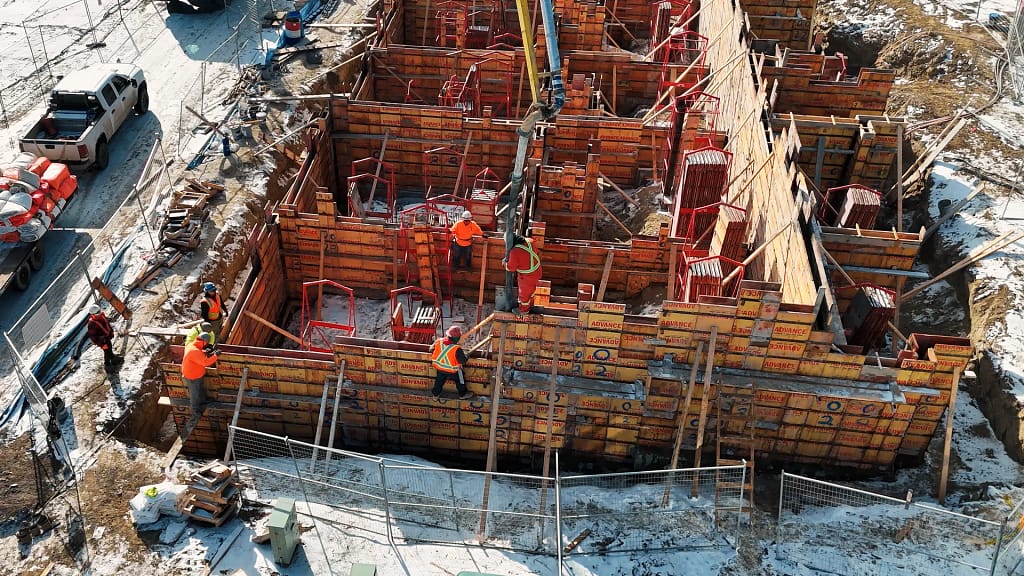
Joints and waterproofing in Calgary clay soil
Calgary clay is unkind to foundation walls. It expands when saturated and shrinks when it dries; the freeze-thaw cycle compounds the cyclic load against the wall; the soil chemistry and the seasonal moisture swing both matter. This is the part of the conversation where the Omega 2000 Cribbing crew’s nearly four decades on Calgary lots — back to 1988, when our parent company started — actually does the work.
Both precast systems live or die in Calgary on the same three details: the joint between panels, the wall-to-footing seal, and the exterior waterproofing membrane and protection course applied before backfill.
For solid precast walls we use a triple-bead polyurethane sealant in every panel-to-panel joint, with a backer rod where the joint width calls for it, and we run a continuous bond-break and waterproofing system on the exterior face. The detail is the same one our parent cribbing crew has been doing on cast-in-place residential walls for nearly four decades; the manufacturing has moved indoors but the soil hasn’t changed.
For the composite-panel system the published Superior Walls / Structural Precast detail uses a sealed joint between panels and the same expectation of a code-compliant exterior waterproofing membrane and drainage course. The interior wall section, because of the foam and studs already in the panel, has slightly different vapour-control assumptions than a solid wall does — that is a design conversation between the producer, the builder, and the energy advisor for that particular project.
The takeaway: neither product waterproofs itself. Either system has to be backfilled against an engineered waterproofing assembly designed for Calgary clay. Builders who try to skip that step do so at their own peril, regardless of which precast they bought.
Plant certification: what CPCQA is and why both producers should hold it
The plant certification language in residential precast is one of those acronyms that quietly does a lot of work in the spec. The Canadian Precast Concrete Quality Assurance (CPCQA) program is the merged certification administered by CPCI and CCPPA since 2018, and it is the only North American program that requires plants to meet CSA A23.4 (including Appendices A and B) together with PCI MNL-116 and MNL-117. The certification is product-category-specific. A plant certified for structural precast is not automatically certified for architectural precast. Unannounced audits happen twice a year.
Omega Precast operates on the CPCQA certification pathway — manufacturing per CSA A23.4 and PCI MNL-116 from day one of plant operation in late 2025. Our peer Alberta plants — Eagle Builders in Blackfalds, Westcon Precast in Calgary, and Structural Precast / Superior Walls of Alberta — each operate under their own quality-assurance regimes appropriate to their product mix.
If you are an architect or a building official asking why this matters: the certification is a tighter, more frequent quality bar than what cast-in-place residential foundations typically pass through, because the audits are unannounced and the standards are specific to manufactured concrete. That is a structural argument for either product over a poured wall on a marginal site. It is not an argument between two manufactured-wall products. Both are working from the same standards family.
Cost: the conversation that is more honest than the SERP suggests
We will say this as plainly as our pricing desk says it. Per-square-foot prices for residential precast are project-specific, and any blog that gives you a fixed number is bluffing. The factors that move the price more than the brand of precast on the panel:
- The wall height and the perimeter shape (a rectangular bungalow versus a walk-out with two grade steps and three corners runs different per-foot pricing).
- The opening schedule (every door and window opening is engineering and form labour).
- The lot access (a city-centre infill with a 20-metre crane reach is a different day than a suburban acreage with open access).
- The schedule (a winter pour in cold-weather mode is a different cost than a summer pour booked four weeks out).
- The insulation and finish package (a composite panel arrives with R-12.5 to R-23 already in it; behind a solid panel you are buying the insulation and the framing separately).
In residential builder forums, the rule-of-thumb we see most often is that an insulated composite panel runs around 30 to 40 percent less than a higher-end insulated precast option for the panel itself, with the trade-off being the structural envelope of the panel and the finished R-value. Once you add the cost of insulation behind a solid panel, the gap narrows considerably. When you add the schedule value of either system relative to a poured wall, both products typically pay for themselves on the schedule alone.
Numbers in a real quote. Not in a paragraph.
Choosing the right product for your project: a working checklist
Take this to your structural engineer, your energy advisor, and your site super:
- Is the project asking for a structurally heavier wall section — deep backfill, two- or three-storey load above the basement, walk-out steps, or a podium transfer condition? Solid concrete is the default starting point.
- Is the project asking for ready-to-finish interior and a panel that arrives with R-value already in it — a tight infill schedule with limited stud-framing and insulation labour available — and a single-family or two-storey envelope? Composite insulated panel is the default starting point.
- Is the project a CHBA Net Zero or Net Zero Ready build? Either product engineers to Net Zero. Talk to your energy advisor about the wall assembly as a whole — including continuous insulation, vapour control, and air barrier — before assuming the panel choice settles the energy model.
- Is the lot infill, with restricted crane access? Both products require crane access. The composite panel’s lower per-piece weight can be a deciding factor on the tightest lots.
- Is the schedule the primary driver — for example, you need to be out of the ground before the September 30 cold-weather trigger pushes you into winter concreting? Either precast product beats a poured wall on schedule. Choose between them on the other factors above.
When the answer is “we are not sure”, we are happy to put you on the phone with the structural engineer or the production team and walk through the project specifics before anyone writes a quote.
A note on the Alberta peer landscape
This is one of those topics where it would be easy to write a piece that pretends Omega Precast is the only Alberta precaster worth talking to. That would be inaccurate and unhelpful.
Eagle Builders in Blackfalds is Western Canada’s largest precast design-manufacture builder, second-generation family-owned, in business since 2000. Their work is largely commercial and industrial, and they earn that scale. Westcon Precast in Calgary is a multi-generational Alberta family company with plants in Calgary and Edmonton; their residential work has historically been retaining walls, stormwater systems, and custom precast rather than foundation walls. Superior Walls of Alberta, manufactured locally by Structural Precast, has been in the Calgary residential market since the mid-2010s and has built a real client base among single-family builders who want the composite insulated wall.
Omega Precast is the newest entrant in the Calgary residential precast market and the only one focused specifically on solid concrete foundation walls for the missing-middle, Net Zero, and townhome market that CMHC’s December 2025 release shows is now around 60 percent of Calgary and Edmonton’s new housing starts. The Alberta precast market is large enough for all of us, and the work is better when builders understand the product differences before the RFQ.
FAQ
Is one product warmer than the other once the basement is finished? No. The finished assembly determines the wall’s effective R-value, and a properly insulated solid-precast wall and a properly specified composite-panel wall can both hit Net Zero performance targets. The difference is when the insulation gets installed and who installs it.
Can both products be used in Calgary’s clay soil? Yes. Both must be backfilled against an engineered exterior waterproofing assembly and on engineered footings. The clay does not care which precast you used. It cares what you put between the wall and the soil.
Does Omega Precast also do above-grade walls? Our launch product is solid-concrete foundation walls. We are in conversation with several Calgary builders about above-grade applications, and projects are in the design phase. For projects requiring patented insulated composite above-grade panels today, our Alberta peer Structural Precast is the established producer.
Which product is faster to install? Both are dramatically faster than cast-in-place. A typical single-family panel set is one crane day for the wall set, plus brace cycle and joint sealing. The schedule gain over poured walls is roughly 6 to 9 days per single-family lot regardless of which precast product is used.
What certification should we ask the producer to show? Ask for CPCQA certification status (per CSA A23.4 + PCI MNL-116), the most recent third-party audit summary, and the project-specific shop drawings stamped by a P.Eng. licensed in Alberta. If the producer cannot show those, the conversation should not move to pricing.
Talk to us before you write the spec
If you have a project on the board and you are weighing precast — solid or insulated — get on a call with us early. We will give you the honest answer about whether our product is right for the build, and where it isn’t, we will tell you that too. The Alberta precast market is small enough that everyone benefits from clarity, and your project benefits most.
info@omegaprecast.ca 403-217-4888
Across the Omega Precast, the 1988 cribbing crew, the 2023 ready-mix plant, and the late-2025 precast plant work the same problems for the same Calgary builders. The product changes. The standard doesn’t.
Related reading from Omega Precast:
Citations and references:
- Canadian Precast Concrete Quality Assurance (CPCQA) — precastcertification.ca
- Canadian Precast/Prestressed Concrete Institute (CPCI) — cpci.ca
- PCI MNL-116-21 Quality Control Manual for Plants and Production of Structural Precast Concrete Products
- CSA A23.1:24 Concrete materials and methods of concrete construction
- CSA A23.4 Precast concrete — Materials and construction
- Superior Walls patented insulated wall systems product documentation; Structural Precast (Calgary) corporate site
- Concrete Alberta Cold Weather Concrete Practices technical bulletin
- CMHC Housing Starts December 2025 release; Spring 2026 Housing Supply Report
- CHBA Net Zero Home Labelling Program documentation
Omega Precast is a sister brand of Omega 2000 Cribbing (Calgary, 1988) and Omega Ready Mix (Calgary, 2023). The Calgary precast plant launched in late 2025.