
Last updated: August 5, 2026
In Calgary, solid precast and ICF (insulated concrete forms) both make strong walls but differ in approach: precast arrives factory-cast and is set fast by crane, while ICF is built and poured on site with integral insulation. Precast wins on speed and quality control; ICF builds in insulation — the choice depends on schedule, thermal goals, and site.
If you sat in on the morning estimating call at our plant in Calgary, here is one of the questions you would hear three times a week.
“We have a custom build on a sloped lot in west Calgary. The owner wants Net Zero. The energy advisor is recommending ICF. The structural engineer is open to precast. The schedule is tight because we want to be out of the ground before September. What is the actual difference?”
This is the most-asked head-to-head comparison in residential foundation work right now, and not just in Calgary. Walk any builder forum from Fine Homebuilding to GreenBuildingAdvisor to City-Data and the precast-vs-ICF thread is the one that runs the longest, the one with the most disagreement, and the one where the most marketing language gets mistaken for engineering. We have read all of them. They are useful for sentiment and useless for a quote.
The honest answer is that precast and ICF are both excellent foundation choices for Calgary, and they are not the same project decision. They diverge on schedule, on R-value, on labour intensity, on crane logistics, on what happens to the wall in cold weather, and on what is actually being asked of the structural engineer. Most builders we work with end up choosing on one of two factors: the schedule, or the wall section the energy model wants.
This is the Alberta-specific version of that comparison, written by a Calgary precast producer that respects ICF as a serious competitor and has worked alongside ICF crews for years through our sister company, Omega 2000 Cribbing.
What the two systems actually are
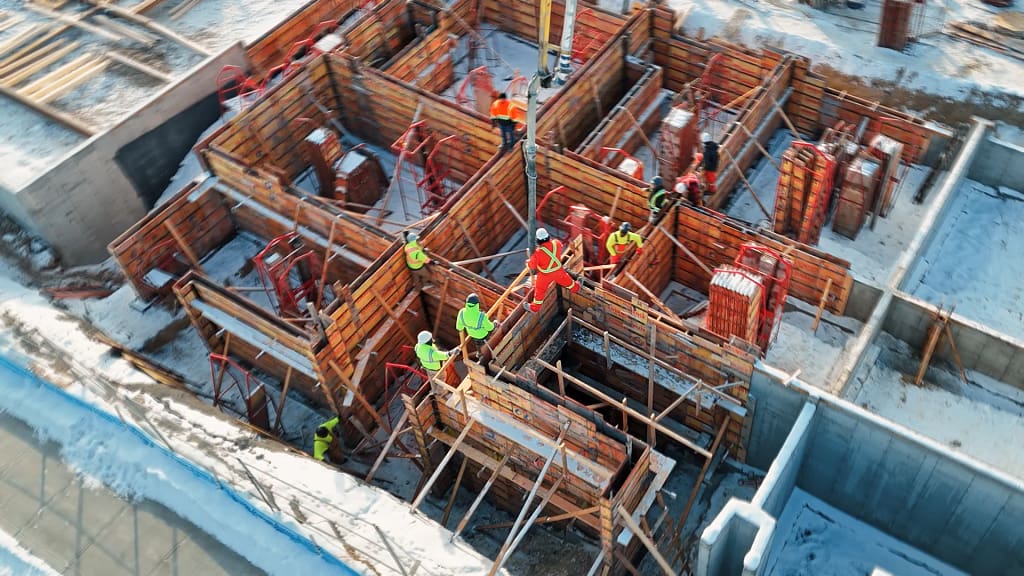
Insulated Concrete Forms (ICF). A modular forming system, typically interlocking polystyrene blocks (Fox Blocks, Nudura, Amvic, Logix, and similar systems in the Canadian market), that an on-site crew stacks and braces in place on the footing. Steel reinforcement is tied into the cavity. Concrete is poured into the cavity through the top, vibrated, and allowed to cure. The form stays in place permanently as the insulation on both sides of the wall. The finished wall is cast-in-place concrete with permanent rigid foam insulation on both interior and exterior faces. Nominal R-22 to R-24 from the form itself, before any additional interior assembly.
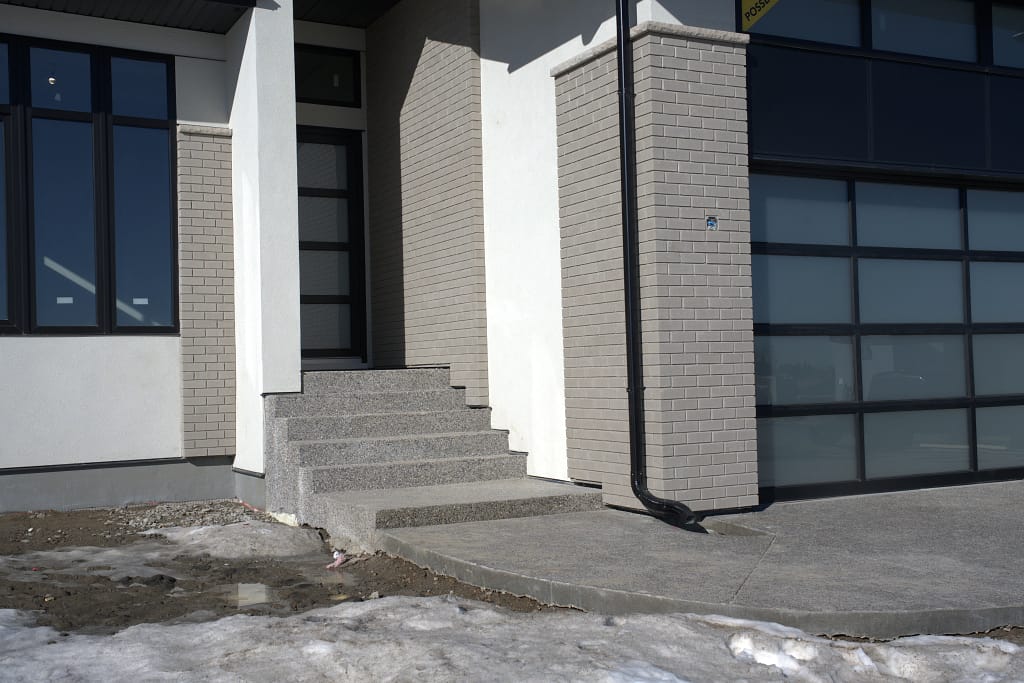
Precast. A finished concrete wall panel — in our case, a solid reinforced 35 MPa high-strength concrete section at the 56-day spec point per CSA A23.1:24 — that is cast in our Calgary plant under controlled humidity and temperature, cured to specified strength, shipped to the site by truck, and craned into position on the engineered footing. Joints are sealed with high-performance polyurethane, panels are locked together through welded plates and mechanical connectors, and the wall is ready to backfill and frame within hours of the crane leaving. The finished panel is solid concrete, with the insulation added later as part of the interior wall assembly.
If the way that paragraph reads makes you think they sound like two different jobs — they are. The structural result is similar (both are reinforced concrete walls that engineer comfortably for residential foundation loads), but the path to that result is fundamentally different. Different trades, different schedule, different weather exposure, different equipment.
Schedule: where the two systems separate fastest
This is the cleanest divergence and usually the deciding factor on the projects we win.
A precast wall arrives at the site already cured. The pour happened weeks earlier, at our plant, in steam-cured factory conditions. The wall has hit its specified strength before the crane shows up. The on-site sequence is:
- Footings poured and cured at site.
- Panels delivered (usually two to three truck trips for a single-family).
- Crane sets the panels in one day for most single-family projects.
- Joints sealed, brace cycle completes within roughly 24 hours, exterior waterproofing applied.
- Backfill and framing start.
Total foundation timeline from “footings ready” to “framers on site”: typically two to three days.
ICF on a Calgary residential lot is a different rhythm. The on-site sequence is:
- Footings poured and cured.
- ICF crew stacks the forms (a moderately sized residential foundation is typically 2 to 4 days of stacking and bracing depending on crew size and wall complexity).
- Bracing inspection.
- Concrete pour into the form cavity.
- 7 to 10 days of cure before the wall is loaded.
- Exterior waterproofing membrane applied (you waterproof over the exterior foam, which has its own membrane-compatibility considerations).
- Backfill and framing.
Total foundation timeline from “footings ready” to “framers on site”: typically two to three weeks. Faster crews can compress that; cold weather lengthens it materially. The bottleneck is always the on-site cure cycle, because the ICF wall is still cast-in-place concrete — and Calgary’s seasonal weather impacts that cure exactly the way it impacts any other site-poured wall.
The schedule gap is the single biggest reason builders trying to beat the September 30 cold-weather concrete trigger that the City of Calgary’s specs and Concrete Alberta’s bulletins recognise tend to land on precast. We can ship to site any week of the year; once the wall is sealed and braced, the cold doesn’t matter the way it matters to fresh concrete.
R-value and the energy model: where ICF wins on paper, and where the wall section is more complicated than that
A typical 6-inch ICF block carries roughly R-22 to R-24 of continuous insulation built into the form, split between the inside and outside faces of the wall. That R-value is continuous — there are no thermal bridges through the concrete, because the foam runs on both faces uninterrupted. It is one of the cleanest residential wall sections you can build for thermal performance, and it is the reason ICF has a strong following among Net Zero specialists.
A solid precast wall arrives at the site with no insulation. The interior is bare concrete. The R-value of the finished assembly depends entirely on what the builder, the energy advisor, and the framer specify behind the panel.
There are three honest ways to think about that.
One, on a CHBA Net Zero or Net Zero Ready build in Calgary, the standard precast assembly is solid concrete plus a framed interior stud cavity filled with either semi-rigid mineral wool batt or closed-cell spray foam, with the framing typically holding R-22 to R-24 in the cavity and continuous rigid insulation sometimes added against the concrete face. Effective R-value of the assembly with a thoughtful spec lands in the R-22 to R-32 range — comparable to or exceeding ICF, but built up in layers rather than continuous through the wall section.
Two, ICF’s continuous foam does eliminate thermal bridging at the structural level, which is a small but real win in the energy model. For a precast wall, an energy advisor who specifies continuous rigid against the concrete face inside the framed cavity can close most of that gap.
Three, the finished wall section matters more than the as-shipped R-value. A poorly insulated ICF wall (rare, but possible if the spec gets cheapened during VE) can underperform a thoughtfully insulated precast assembly. A poorly insulated precast wall will underperform almost anything. The question for the energy model is whether the builder is investing in the wall assembly behind the precast, not whether precast can “hit Net Zero”. Precast can. The investment has to be there.
For the Calgary Net Zero builders we are seeing on the brief — Sterling Homes Calgary (Qualico’s CHBA Qualified Net Zero Builder), Cedarglen Homes, Trico Homes, Avalon Master Builder, Capstone Custom Homes (the only Calgary-area BONE Structure certified builder) — the wall-assembly conversation is the one that actually decides the spec. The form/factory side of the question is upstream of the energy model, not downstream.
Cost: where the public data gets messy and where the project specifics dominate
Public cost data for ICF foundations in Alberta is actually reasonably consistent. The figures you will see quoted from Concrete Alberta and from regional ICF contractors in 2025 and 2026 cluster around:
- Roughly $40 to $45 per linear foot for the ICF foundation system itself (footings, walls, finish-ready for backfill) on a standard single-family project.
- Roughly $22 to $26 per square foot of basement on the same basis.
- For a 40-by-40 single-family bungalow at 9-foot wall height, total all-in ICF foundation cost in the range of $48,000 to $58,000, including the wall, footings, weepers, floor, openings, and waterproofing.
Public cost data for residential precast is harder to anchor to a single number because the product range is wider (solid vs composite, different panel thicknesses, different opening schedules). Industry rule-of-thumb in the residential builder forums is that precast lands in the same general price band as ICF for the system itself, with cost variation driven more by the lot geometry, the access conditions, the opening schedule, and the panel insulation choice than by the producer brand.
The cost factor that the public number consistently undercounts is schedule value. A builder who saves seven days on the foundation phase saves seven days of on-site overhead, financing carrying cost, and project-management labour. On a single-family lot that schedule value is real money. On a townhome row with multiple foundation cycles, the schedule value compounds. The CMHC December 2025 data showing 60 percent of Calgary and Edmonton’s 2025 housing starts in the missing-middle wedge (rows and townhouses) is exactly the segment where the schedule arithmetic on either precast or ICF starts to beat cast-in-place poured walls definitively.
If a builder is comparing line-item per-square-foot prices and ignoring schedule value, the analysis is incomplete.
Labour intensity and the trades you need on site
ICF is a labour-intensive system. A residential ICF foundation needs a crew skilled at stacking and bracing the forms, tying the reinforcement, managing the pour through the cavity (the consolidation has to be right or you get voids), and handling the cure cycle. Good Calgary ICF contractors exist — and they are busy. The system rewards experienced crews and punishes inexperienced ones, because the on-site quality control is on-site.
Precast moves the labour upstream. The skilled concrete work happens at our plant, under our quality program, under unannounced CPCQA audits per CSA A23.4 and PCI MNL-116. The on-site crew is smaller: typically three to four people set the panels with the crane, seal the joints, and brace the wall. Less labour on site, less weather exposure, less coordination between trades during the foundation phase.
Two practical takeaways for the GC’s site super.
If your project sequence depends on tight coordination between trades on the foundation phase — say, multi-family with stacked schedules — precast’s smaller, faster on-site footprint usually wins. If your project is a custom one-off with a strong relationship to a specific ICF crew and the schedule is forgiving, ICF can absolutely deliver the wall the energy model wants.
What the foundation does in a Calgary winter
This is where the conversation often ends.
Calgary’s official cold-weather concrete trigger lands at September 30 per City of Calgary specs and the Concrete Alberta cold-weather bulletins. After that date, any cast-in-place concrete pour — including the pour into an ICF cavity — has to use cold-weather concreting practices: heated enclosures, insulated blankets, accelerators in the mix, extended monitoring, and longer cure protection. ICF’s permanent foam form actually helps with cold-weather cure (the form itself is an insulating blanket against the freshly poured wall), and good Calgary ICF contractors run year-round with the right protocols. It is harder, slower, and more expensive than summer ICF work, but it is doable.
Precast is largely indifferent to the seasonal calendar. Our plant runs in a climate-controlled environment with steam-cure capability — the concrete sees factory conditions, not Calgary January conditions. The on-site set is weather-sensitive in only one way that matters: wind speed. Crane lifts on residential precast wall panels are typically halted when sustained winds exceed roughly 24 to 30 km/h. That happens in any season in Calgary. The seasonal cold itself does not stop a precast set.
The practical result for builders planning around the September 30 trigger:
- A precast foundation can be set in October, November, December, February — almost any week we can get a crane to site safely.
- An ICF foundation can be set in October, November, December, February — but the pour cost and complexity rises, and the schedule lengthens.
- A poured-wall foundation is the one fighting the calendar hardest, and is the wall most likely to push to the spring on a marginal late-September start.
This is the dynamic that has moved a meaningful share of Calgary builders toward year-round precast scheduling. It is not an argument against ICF. It is the seasonal reality.
Code path, certification, and what the building official wants to see
Both products are recognised under the National Building Code of Canada and the Alberta Building Code, and both pass standard residential building inspection without drama on properly engineered jobs.
For precast, the certification path is CPCQA per CSA A23.4 with PCI MNL-116 for the plant. Each project ships with engineered shop drawings stamped by a P.Eng. licensed in Alberta. The product’s quality control is upstream at the plant; the inspector is verifying the install, the joints, the waterproofing, and the backfill.
For ICF, the certification path is at the form manufacturer (Fox Blocks, Nudura, Amvic and others publish CSA / NRC technical evaluations and product approvals) and at the contractor’s quality of installation. The inspector is verifying the form layout, the reinforcement placement, the pour, the cure, and the waterproofing.
Neither system has a code advantage in Calgary. They have different oversight rhythms.
Joints, waterproofing, and Calgary clay soil — neither system gets a pass
Calgary clay is a hard substrate. It expands when saturated, shrinks when it dries, exerts cyclic load on the foundation, and freezes and thaws on a brutal schedule. Foundation walls that get the soil-side detailing right last decades; walls that don’t, leak.
Precast: triple-bead polyurethane sealant at every panel-to-panel joint, with a continuous exterior waterproofing membrane and protection course. The detail is descended from the Omega 2000 Cribbing crew’s nearly four decades of Calgary cast-in-place residential work, applied now to a manufactured wall.
ICF: continuous exterior waterproofing membrane applied over the exterior foam face, with attention to membrane-compatibility (some membranes are not formulated for adhesion to rigid foam — the spec matters). Backfill protection course required to prevent membrane damage during backfill.
Both are well-understood waterproofing assemblies. Both fail if the spec is cheap. Neither precast nor ICF is a substitute for an engineered waterproofing strategy for Calgary clay.
A working framework for the choice
When a builder calls and says “should we go precast or ICF on this project”, here is the framework we run through with them. Not because it gives a single answer, but because it surfaces the two or three project-specific factors that actually settle the question.
- Schedule pressure. If the project absolutely has to be out of the ground in a specific number of weeks, precast is the lower-risk choice almost every time. ICF can be fast, but it carries the cast-in-place cure cycle.
- Wall section the energy model wants. If the energy advisor has specified continuous insulation and is trying to minimise thermal bridging at the structural level, ICF starts with an advantage. If the energy advisor is open to a built-up interior assembly, precast competes evenly.
- Trade availability on the project. If the project has access to an experienced ICF contractor and an open schedule, ICF can deliver an excellent wall. If the trades for the framing and insulation behind a precast wall are strong, precast can deliver an excellent wall.
- Lot conditions. If the lot is a tight infill with limited crane access, ICF can be the cleaner logistical choice. If the lot is a standard suburban or acreage with crane access, precast’s one-day set is hard to beat.
- Project size. Single-family one-off: either works. Townhome or rowhouse row: precast’s repeat-panel manufacturing efficiency starts to dominate. Custom luxury with one-of-a-kind wall geometry: depends on the geometry — sometimes ICF’s site-formed flexibility wins on a non-repeating wall.
We are happy to be on the call with the energy advisor and the structural engineer when this conversation happens. We are also happy to tell you the project belongs in ICF if that is the right answer.
A note on the Alberta context
The point we want to leave with custom builders, Net Zero specialists, and owner-builders reading this:
Calgary’s residential foundation market is large enough and growing fast enough — CMHC December 2025 has Calgary at the front of Canada’s housing starts for the year, and roughly 60 percent of the new Calgary and Edmonton supply is the missing-middle row and townhouse wedge — that both precast and ICF will play significant roles for years.
Heidelberg Materials’ Edmonton CCUS project is on track to be operational by late 2026, which will progressively decarbonise the Alberta cement supply for both products. The next-decade conversation is not “precast or ICF” — it is “how do we get more Calgary foundations out of the ground faster, with lower carbon, with better Net Zero performance, and with less weather risk.” Both systems will be part of that answer.
Pick on the project, not on the brand.
FAQ
Is ICF stronger than precast?
Both engineer comfortably for residential and most missing-middle multi-family foundation loads. ICF’s wall section is typically thicker than a standard residential precast wall section, but precast’s higher-strength factory concrete (35 MPa at 56 days per our spec, vs typical 20–25 MPa ready-mix into an ICF cavity) closes that comparison quickly. The structural answer is project-specific.
Can I do a walk-out basement with precast?
Yes. Stepped grade conditions and walk-out elevations are handled by engineered panel-height transitions and footing steps. Our parent Omega 2000 Cribbing crew has built stepped walk-out foundations on Calgary slopes since 1988, and the precast version applies the same geometry to manufactured panels.
Is ICF easier to modify after the fact?
Both walls are concrete walls once finished. Cutting a new opening in either after the wall is poured/set is engineering, not weekend DIY. Plan the opening schedule at design.
Which performs better in a Calgary winter for the homeowner?
Both can deliver a warm, dry basement when the wall assembly behind the panel/form is properly specified. A solid precast wall with a properly insulated interior assembly and a Continuous Air Barrier hits the same indoor comfort as an ICF wall. The performance gap, when one exists, is in the spec, not in the product.
We are already committed to ICF on this project. Why are you writing this blog?
Because being honest about the alternatives is the brand the Omega Group operates under. If ICF is right for your project, we want you to land there confidently. The next project you call us about — and there will be one — we will be the right answer.
Get on a call with us
If you have a project on the board, we will get on the phone with you, your engineer, and your energy advisor before any quote is written. We will tell you which way the project leans and why. If the answer is “go ICF”, we will tell you that too.
info@omegaprecast.ca
403-217-4888
The Omega Group‘s standard is the same across the 1988 cribbing crew, the 2023 ready-mix plant, and the late-2025 precast plant: respect the standard, respect the peer, give Calgary builders the honest answer.
Related reading from Omega Precast:
- Solid Concrete or Insulated Composite? How Omega Precast and Superior Walls Alberta Solve Two Different Problems
- How Precast Bypasses Calgary’s September 30 Cold-Weather Trigger
- Precast vs Poured Foundation Walls in Calgary: The Honest Side-by-Side
- Net Zero Homes Calgary: Why Precast Is Becoming the Default
Citations and references:
- Concrete Alberta Cold Weather Concrete Practices technical bulletin (September 2018, current)
- City of Calgary Roads Specs cold-weather concrete cutoff (September 30)
- CSA A23.1:24 Concrete materials and methods of concrete construction
- CSA A23.4 Precast concrete — Materials and construction
- PCI MNL-116-21 Quality Control Manual for Plants and Production of Structural Precast Concrete Products
- CPCQA — precastcertification.ca
- Concrete Alberta ICF technical resources, residential foundation cost data
- CHBA Net Zero Home Labelling Program documentation
- CMHC Housing Starts December 2025 release; Spring 2026 Housing Supply Report
- Heidelberg Materials Edmonton CCUS project announcements (March 2025)
- Fox Blocks, Nudura, Amvic ICF product technical data sheets
Omega Precast is a sister brand of Omega 2000 Cribbing (Calgary, 1988) and Omega Ready Mix (Calgary, 2023). The Calgary precast plant launched in late 2025.