
Last updated: August 6, 2026
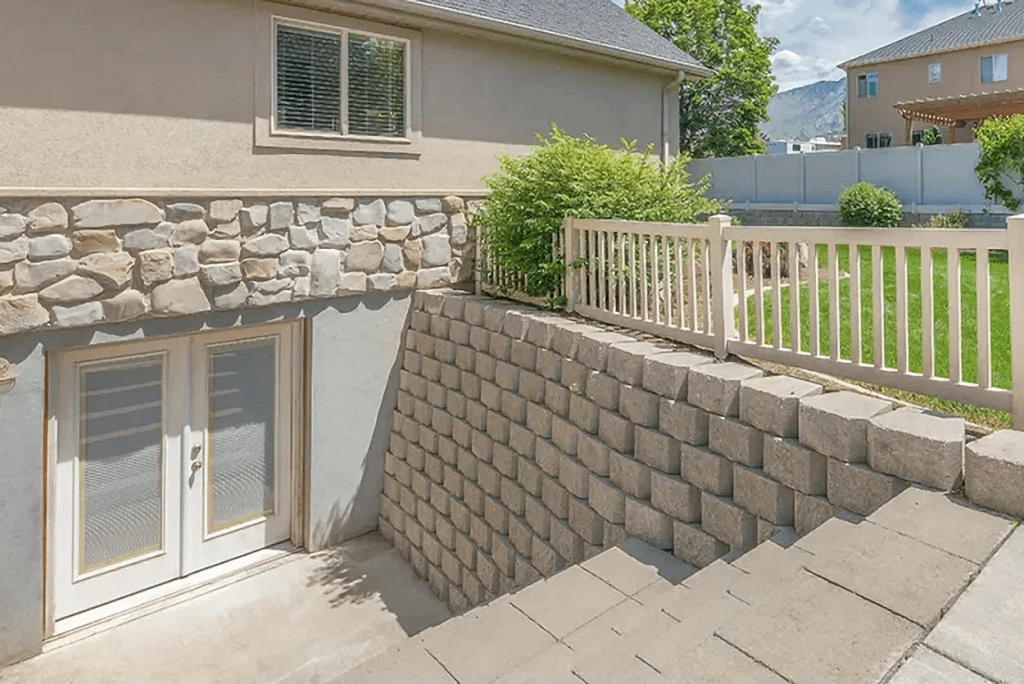
A walk-out basement precast is a basement with a grade-level exit door on the downhill side of the foundation. The basement floor on the downhill end opens onto a patio at grade. The basement floor on the uphill end is a normal buried basement, with a wall that runs full height from footing to first floor.
The foundation underneath that picture is a different animal than the one on a flat lot. The wall steps. The uphill wall is taller and fully buried. The downhill wall is shorter — typically a frost-wall section plus an opening — and exposes to daylight on the outside face. Every wall in between is doing some hybrid of those two jobs at varying elevations.
Walk-outs concentrate in Calgary lots where the topography gives you the slope for free, plus on infill lots in established slope-affected neighbourhoods:
- Acreage country west and southwest — Cochrane, Bearspaw, Springbank, Bragg Creek, Priddis, Foothills MD. Walk-outs are the default rather than the exception.
- Northwest Calgary infill — Patterson, Edgemont, Hamptons, Discovery Ridge, Aspen Estates, Springbank Hills.
- Southeast Calgary hill communities — sections of Cranston, Auburn Bay, Pine Creek, Seton where the eastern boundary slopes meaningfully.
- Airdrie and surrounding — Chinook Gate and other hillside subdivisions.
Walk-outs typically add roughly $30,000 to $80,000 to a Calgary custom-home build — an industry estimate that varies with lot, builder, and depth of engineered solution. The bulk of that adder is not the framing or finishes. It is the foundation: engineering, additional concrete volume, stepped footing and panel detail, retaining-wall reinforcement on the uphill side, waterproofing on the daylight side, and the drainage system that has to manage water on a footing at multiple elevations.
The stepped-footing reality — why a walk-out isn’t a regular foundation with a hole
The most common misconception we hear — from buyers and from builders new to walk-outs — is that a walk-out is a standard basement with a door cut into the downhill wall. The wall on that side gets shorter, the door goes in, the patio gets poured, the rest is the same.
That picture is wrong in five specific ways, every one of which the engineer’s drawing will catch and the field crew has to execute.
The footing steps. A flat-lot foundation runs at one elevation. A walk-out runs at multiple elevations connected by vertical risers. The standard step is 600 mm — roughly the height of a conventional form panel — though the step height is project-specific and engineer-stamped. On a steep lot, you might have three or four step transitions between corners.
The wall above the footing steps with it. On a cast-in-place job the wall is formed and poured in discrete sections to match the stepped footing. On a precast job the panels themselves are manufactured in stepped configurations — engineered shapes with internal step transitions cast into the panel at the plant.
The uphill wall is a retaining wall, not a basement wall. Active earth pressure plus any surcharge from upslope driveways, landscaping, or adjacent structures is pushing on the back wall at a higher elevation than the floor inside. The reinforcement schedule on that wall is heavier than a flat-lot basement wall — more vertical steel, more horizontal steel at the upper third where at-rest pressure concentrates, and additional hooked bars at every step transition. CSA A23.3 sets the structural design framework.
Frost protection still applies on the daylight side. To a crew that does flat-lot work every day, the walk-out wall looks like a wall sitting on a footing at grade. It is not. The local frost line is 1.2 m below the local ground surface, and on a sloped lot the local ground surface follows the slope. The footing on the walk-out face has to be 1.2 m below the patio elevation, or it has to be protected with engineered horizontal frost-protection insulation (typically Type IV or higher EPS).
A footing poured at patio grade with no frost-protection package will heave the walk-out corner within three winters. The repair — excavation, removal, reconstruction below the frost line — is a six-figure correction on a residential build.
Drainage finds the bottom of every step. Water on a stepped footing accumulates at the inside of every step transition. Without an engineered drainage path, it collects, freezes, expands, and produces concentrated frost-heave forces at the points where the footing is structurally most sensitive. A walk-out drainage system is step-aware by design.
A walk-out foundation has to do four jobs at once: bear the building, retain the slope, daylight at the downhill end without freezing, and drain water across a stepped footprint. The engineer’s drawing is a coordinated answer. A precast wall is an engineered manufactured product that has to honour every line on it.
How precast handles stepped panels at the plant
On a cast-in-place walk-out — which our parent Omega 2000 Cribbing crew has been pouring on Calgary lots since 1988 — every step is a discrete pour on site. Form, tie rebar, pour, strip, reset for the next step up, repeat. Cure windows are sequential. Cold joints at step transitions are detailed in the field with hooked rebar tying riser to landing. Weather exposure is real on every pour, and Calgary’s September-30 cold-weather concreting trigger applies to every step pour after that date. The work is good, the crew is good, and the schedule includes several days of pour sequencing on the site.
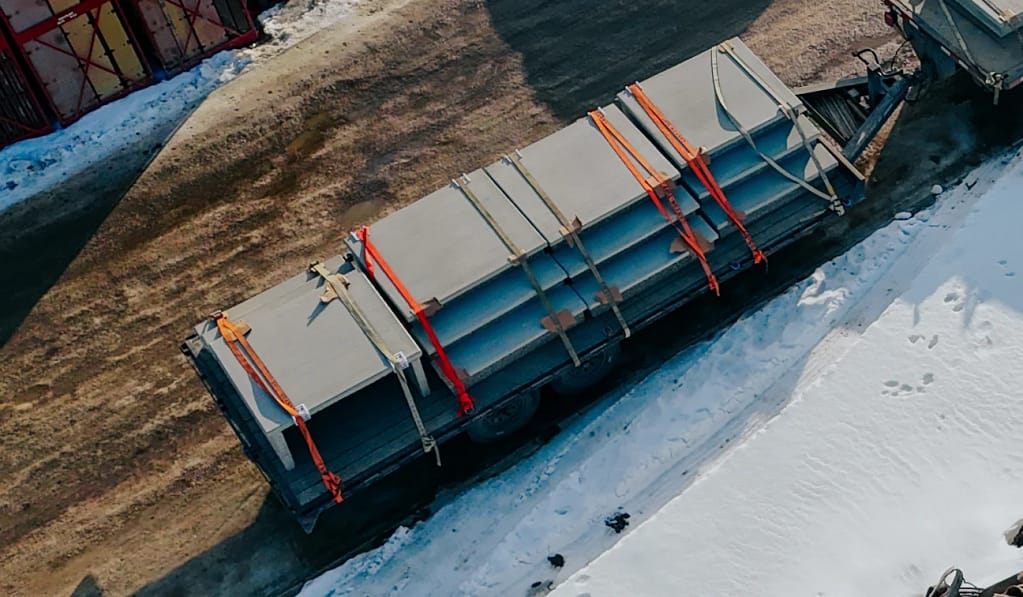
On a precast walk-out, the entire stepped wall is manufactured indoors at our Calgary plant before any of it arrives at the site.
What changes at the plant when the project is a walk-out:
- Shop drawings are panel-by-panel with the stepped geometry stamped. A P.Eng. licensed in Alberta stamps the shop drawing. Each panel is detailed in its stepped configuration — uphill end height, downhill end height, internal step transitions, opening locations for walk-out doors and windows, panel-to-footing and panel-to-panel connection details, and lift-point locations engineered for the panel’s weight and centre-of-gravity in its stepped shape.
- The form is built to the stepped geometry. A stepped walk-out panel is cast in a form that includes the riser-and-landing geometry of the step. Reinforcement is tied into the stepped form, with extra hooked bars across the step transitions, the embedded plates for welded-plate connections, the cast-in inserts for bracing, and the cast-in lift points engineered for that panel’s specific stepped weight distribution.
- The pour is monolithic across the step. This is the part that does not happen on a cast-in-place site. The entire stepped panel is poured in a single continuous placement. There is no cold joint at the step transition. The 35 MPa high-strength concrete mix runs from the bottom landing through the riser into the upper landing as one structural piece. The step is not a joint; it is a moulded feature of a single continuous element.
- The cure is controlled. The 56-day spec point per CSA A23.1:24 applies to a precast panel exactly the same way it applies to a cast-in-place wall — the difference is that the panel reaches its strength milestones under factory-controlled humidity and temperature, not under a tarp in mid-October.
- The plant inspection runs every panel against the shop drawing. Tolerance on step dimensions, opening locations, embedded plate positions, lift-point locations. Anything outside tolerance is repaired per ACI / PCI protocols at the plant — or, if structurally significant, the panel is remanufactured. Panels with structural defects do not leave the plant.
The governance framework is CPCQA — the Canadian Precast Concrete Quality Assurance program, administered jointly by CPCI and CCPPA. CPCQA certification requires plants to meet CSA A23.4 (the Canadian precast manufacturing standard, including Appendices A and B) together with PCI MNL-116 (PCI’s structural quality control manual). Unannounced plant audits run twice a year. Our Calgary plant operates on the CPCQA pathway from day one of operations in late 2025.
The speed on site is real — the crane day on a walk-out is one to two days versus several days of pour sequencing for cast-in-place — but it comes from the weeks of factory-controlled manufacturing that happened before the truck left the yard. A stepped walk-out panel is not a quick build. It is a controlled build. Most of the controlled work happens indoors.
Connection details — panel-to-footing, panel-to-panel, panel-to-framing
A walk-out’s structural performance lives or dies in its connections. Three of them matter most.
Panel-to-footing. The panel sits on the footing on engineered shims set to the design elevation. Embedded plates cast into the bottom of the panel align with anchor bolts or embedded plates set into the footing. Where the panel crosses a step, the connection is detailed by the engineer — typically with hooked rebar tying panel reinforcement to footing reinforcement across the step, with embedded connection plates positioned at design elevations on both sides. The shim package at the step is engineered. Field crews do not improvise step shims; the drawing dictates.
Panel-to-panel. At every vertical joint between adjacent panels, the welded-plate connections are made on site. Steel embed plates that were cast into the panel align across the joint; a loose plate sits between them; the install crew welds the assembly per the engineered weld procedure. At corners, the geometry locks the perimeter into a continuous structural diaphragm. On a walk-out, the joints are tying stepped panels of different heights and configurations into one continuous wall — corner panels and step-transition panels carry more steel in the connection plates than mid-run panels.
Panel-to-floor-system and panel-to-above-grade-framing. The top of the foundation wall ties into the floor system and the first-floor framing. On a walk-out, the top-of-wall elevation varies — full first-floor elevation on the uphill side, dropped at the walk-out opening on the downhill side. Framers receive a top-of-wall surface detailed per the shop drawing, with embedded anchor straps or sill-plate anchors at engineered spacing. A walk-out’s variable top-of-wall geometry produces more lines on the drawing than a flat-lot top-of-wall does.
Every joint, after the welded connections, is sealed with a triple-bead high-performance polyurethane joint sealant, with backer rod where the joint width calls for it. Skin-over time is hours and structural cure is within 24 hours in Alberta conditions. Below roughly -25 °C, polyurethane cure slows materially and we adjust the schedule. Wind above roughly 24 to 30 km/h shuts down the crane lift; the joint sealant work continues either way.
Waterproofing at the daylight side — the most-failed detail
The most-failed waterproofing detail on a walk-out is the transition from the buried portion of the wall to the daylight portion at the walk-out face.
Above the patio elevation, the wall is exposed but not buried — no below-grade waterproofing needed. Below the patio elevation, the wall is taking moisture, hydrostatic pressure on saturated days, and freeze-thaw cycling. The transition between the two — at the patio-level grade line — has to be detailed precisely. A skipped membrane lap or an unsealed termination at that line lets water into the assembly along the inside face of the wall, and the homeowner finds out three winters later when the patio-level door frame starts to rot.
The waterproofing package on the daylight side:
- Peel-and-stick or fluid-applied membrane across the full below-grade height of the wall on the exterior face, with the upper termination at the patio grade line detailed with a sealant cap and counter-flashing to prevent water migrating behind the termination.
- Protection board on the outside face of the membrane (dimpled drainage board is the common Calgary choice), continuing down to and over the footing per the detail.
- Perimeter weeping tile in a clean washed-rock envelope at the base of the wall, with continuous fall to a sump or daylight outlet. On a walk-out, the weeping tile typically daylights at the downhill side — gravity doing the work, one of the small efficiencies of a sloped lot.
- Granular backfill blanket adjacent to the drainage face. The first 600 mm of backfill is granular fill, not native Calgary clay. Clay against the drainage board clogs it and stops the weeping tile from functioning.
- Lot grading to the City of Calgary 2% positive slope away from the wall, certified at final grade.
The membrane detail is identical regardless of whether the wall is precast or cast-in-place. The Calgary clay does not know the difference.
Drainage and frost protection on the uphill side
The uphill side is the most-buried and most-loaded wall on the foundation. It is doing the retaining work, taking active earth pressure plus any surcharge from upslope structures, collecting water at the base after every rain and spring thaw, and concentrating frost on the buried face if the drainage at the base is not working.
Three details on the uphill side, none precast-specific but every one of them mandatory:
- Perimeter weeping tile in a clean washed-rock envelope at the footing. Continuous fall toward the downhill side or toward a sump. The tile is the last line of defence; the drainage board and waterproofing are the first.
- Granular backfill against the drainage face. Same rule as the daylight side. Clay against the drainage face fails the drainage face.
- Frost protection at the footing. The footing is below the local frost line — 1.2 m below the uphill ground surface, which is higher than the downhill ground surface. Where engineered horizontal frost-protection insulation is used in place of footing depth, the insulation is rated for the design soil conditions per the engineer’s drawing.
The uphill wall is where you see the largest reinforcement schedule on the panel. The retaining-wall analysis under CSA A23.3 produces a heavier vertical-steel ratio and additional horizontal steel at the upper third. On a precast walk-out, that reinforcement is tied into the panel at the plant before any concrete is placed. The plant crew can see every bar before the pour. The site crew receives a wall in which the reinforcement is already in its design location.
Energy and Net Zero envelope continuity at walk-out openings
A walk-out has two envelope conditions a flat-lot foundation does not have: the walk-out door and the patio-level window glazing. Both are thermal-bridge candidates. Both have to be detailed for envelope continuity if the project is on a CHBA Net Zero or Net Zero Ready path.
The door opening: the frame aligns with the air barrier of the wall, continuous from below-grade waterproofing to above-grade WRB; the threshold manages water at the patio side and prevents thermal bridging at the frame-to-slab interface; the sill is detailed for flashing and insulation continuity.
The patio-level glazing: triple-pane is the typical Net Zero spec, with a fibreglass or insulated aluminum frame to manage thermal bridging. The rough opening is cast in the panel at the plant per the shop drawing — there is no field-cut tolerance on a precast opening, and the framer receives an opening ready for the manufactured frame.
On the Avalon Master Builder Greystone Net Zero rowhouses in Cochrane — a precedent project for precast in the Net Zero rowhouse format — the unit-by-unit foundation walls accommodate variation in slope across the row, while the envelope continuity at the walk-out openings is detailed for the Net Zero target on each unit. Done right, the walk-out detail is invisible. Done poorly, it shows up in the blower-door test and on the energy advisor’s report.
Precedents — Wedderburn, Greystone Cochrane, and Calgary luxury custom-home work
Three precedents we can speak to publicly, with the caveat that we do not quote internal address counts or build counts on any of them.
Sterling Homes Wedderburn (Okotoks). A production-builder precast program inside Anthem’s master-planned community. Sterling is a Qualico brand and a CHBA Qualified Net Zero Builder. The Wedderburn program includes sloped sections where walk-out designs apply. Production-builder volume on precast walk-outs is a meaningful proof point that the system is not a one-off boutique solution — it scales.
Avalon Master Builder Greystone (Cochrane). A Net Zero rowhouse project. Avalon is a long-time Calgary-area Net Zero specialist. The Greystone rowhouses include unit-by-unit foundation variation as the row crosses sloped grade — precast walls handle the variation while delivering consistent envelope performance for the Net Zero target.
Calgary custom luxury work. Walk-outs on hillside lots in Calgary’s inner-city slope-affected neighbourhoods and on acreage builds west of the city. The custom-home format — architect and engineer designing a project-specific stepped foundation that exactly matches the lot’s contours — is where precast’s plant-controlled manufacturing does some of its most differentiated work. The architect’s drawing becomes our shop drawing. The shop drawing becomes the panel.
Any builder who needs project-specific reference conversations can have them on a phone call. We do not publish client roll-ups in editorial.
When cast-in-place is still the right call for a walk-out
There are walk-out projects where cast-in-place is the right answer, and a buyer or builder asking us about precast deserves the honest version of when that is.
Lot access constrained for a crane. Some Calgary inner-city hillside lots have access issues that a precast crane day cannot resolve at reasonable cost — narrow lane access, low utility wires across the swing path, soft ground in the only available staging area, neighbouring structures inside the swing radius. A cast-in-place crew with conventional cribbing forms does not need a 30-to-70-ton crane on the lot.
High-frequency one-off geometry. A walk-out where every panel is a unique stepped configuration with unique opening locations — a luxury custom build with a wraparound deck-and-window program producing no two identical panels — can be efficient as precast, but the engineering and form costs at the plant offset some of the schedule savings. On those projects, our parent Omega 2000 Cribbing crew sometimes wins the work on its merits.
Schedule that does not favour the plant cycle. A project breaking ground in two weeks may not have the lead time for plant manufacturing of stepped panels. Cast-in-place can sometimes start sooner on a tight deadline.
Cost differential lands on cast-in-place. Precast typically pays for itself on schedule, controlled cure, and quality assurance. There are project geometries where the cast-in-place number is meaningfully lower and the precast schedule advantage is reduced. We say so when that is the case.
The working principle: if precast is the right answer, we want to win the project. If cast-in-place is the right answer, we want it to go to our sister crew at Omega 2000 Cribbing — same family, same standard, same Calgary. The buyer wins either way.
The honest take from the precast plant
A walk-out is more demanding engineering than a flat-lot foundation, and the precast value proposition on a walk-out is specific.
You are moving the stepped-panel pour from a Calgary jobsite in late October into a factory-controlled plant. You are getting an engineer-stamped shop drawing for every panel — stepped geometry, opening locations, connection details, lift-point engineering — on the page before any steel is tied. You are getting a monolithic pour across each step transition rather than a cold joint at each one. You are getting unannounced twice-yearly CPCQA audits on the plant. And you are getting a crane day on site that is one to two days instead of several days of sequenced pour cycles — schedule compression that is more pronounced on a walk-out than on a flat-lot project.
What you are not getting is a magic wand. The waterproofing is the same membrane-and-drainage discipline that the Calgary clay demands of every foundation. The frost-protection rule on the daylight side is the same rule the local frost line imposes on every walk-out. The retaining-wall reinforcement on the uphill side comes from the same CSA A23.3 calculation that a cast-in-place wall would carry. The connection details are real engineering, not a marketing slide.
If you are about to break ground on a Calgary walk-out and the foundation conversation has not included most of what is in this piece, that is the conversation to have before any concrete is ordered.
FAQ
Can precast foundation walls handle a walk-out basement?
Yes. Panels are manufactured to the engineered shop drawing, including stepped panels with internal riser-and-landing geometry. Reinforcement, embedded connection plates, opening locations for walk-out doors and windows, and lift points are all engineered into the panel before it leaves our Calgary plant. Stepped walk-out panels are routine work for a CPCQA-certified plant governed by CSA A23.4 and PCI MNL-116.
How much more does a walk-out foundation cost in Calgary?
Industry estimates put the walk-out adder at roughly $30,000 to $80,000 on a Calgary custom-home build. The range is wide because cost depends on slope, number of step transitions, engineering complexity, waterproofing package, lot access, and schedule. The biggest drivers are foundation engineering, additional concrete volume, retaining-wall reinforcement on the uphill side, and the waterproofing and drainage package on the daylight side.
What slope does my lot need for a “natural” walk-out?
About 2.1 m of fall across the depth of the house — roughly 15-17% slope on a typical Calgary residential footprint. Less slope is workable with cut-and-fill grading or a partial walk-out. More slope is buildable but increases the complexity of the stepped footing.
Is the precast concrete mix different for a walk-out?
No. The Calgary residential mix spec is consistent — 35 MPa at the 56-day point per CSA A23.1:24, Type HS sulphate-resistant cement per CSA A3001 for the S-2 exposure class, 5-7% entrained air. What changes on a walk-out is the panel geometry, the reinforcement schedule on the uphill panels, and the engineered connection details at the step transitions.
Are stepped panels poured in one piece or in sections?
In one piece, at the plant. The entire stepped panel is poured monolithically in a single continuous placement, so the step transition is a moulded feature of one continuous element rather than a cold joint between two pours. On a cast-in-place walk-out, each step is a discrete pour with a cold joint detailed in the field with hooked rebar.
What is CPCQA and why does it matter on a walk-out?
The Canadian Precast Concrete Quality Assurance program, administered jointly by CPCI and CCPPA. It requires plants to meet CSA A23.4 together with PCI MNL-116. Unannounced audits twice a year. On a walk-out — where the panel geometry is more complex and the tolerances are tighter — the certification provides a frequent, independent quality bar that gives architects and building officials confidence in the manufactured panel.
Does the frost line work the same way on a walk-out?
Yes — and the consequence is what catches crews out. The Calgary frost line is approximately 1.2 m below the local ground surface, and on a sloped lot the local ground surface follows the slope. On the walk-out face — where the patio is at basement-floor elevation — the footing still has to be 1.2 m below the patio elevation, or it has to be protected with engineered horizontal frost-protection insulation.
Is the uphill wall on a walk-out a regular basement wall?
No. It is acting as a retaining wall — resisting active earth pressure from the buried slope above the floor inside, plus any surcharge from upslope structures, plus hydrostatic pressure if drainage fails. CSA A23.3 produces a heavier reinforcement schedule than a standard basement wall.
How long does the install take on a precast walk-out compared to cast-in-place?
The crane day on a precast walk-out typically runs one to two days for the wall set plus a day for waterproofing and backfill prep. A cast-in-place walk-out involves sequenced pours across the stepped footing and stepped wall, each with its own cure window — typically several days of pour cycles. The schedule compression on a walk-out is more pronounced than on a flat-lot project.
Is precast or cast-in-place the better choice for a walk-out?
Depends on the project. Precast is often the right answer on production-builder programs, on Net Zero builds where envelope continuity and quality assurance matter, on schedule-driven projects, and on lots with good crane access. Cast-in-place is often the right answer on lots with crane-access constraints, on luxury one-off geometry, on tight-deadline projects, and where the cost differential favours it. Our parent crew at Omega 2000 Cribbing has been pouring cast-in-place walk-outs on Calgary lots since 1988. The right answer is the answer that holds the house up for the life of the build.
Talk to the Omega Precast team
If you are about to break ground on a Calgary walk-out, planning a Cochrane or Springbank acreage build, or trying to figure out whether a precast foundation is the right call for the sloped lot you have, we are happy to walk through the drawings with you.
Email: info@omegaprecast.ca
Phone: 403-217-4888
We will tell you what changes at the plant for your specific stepped geometry, what the connection plates do at every step transition, and what the waterproofing package needs to look like on the daylight side. If precast is not the right answer, we will tell you that too — and the conversation continues at our crew at Omega Precast, where the cast-in-place answer has been the right answer for Calgary hillside lots since 1988.