
Last updated: August 3, 2026
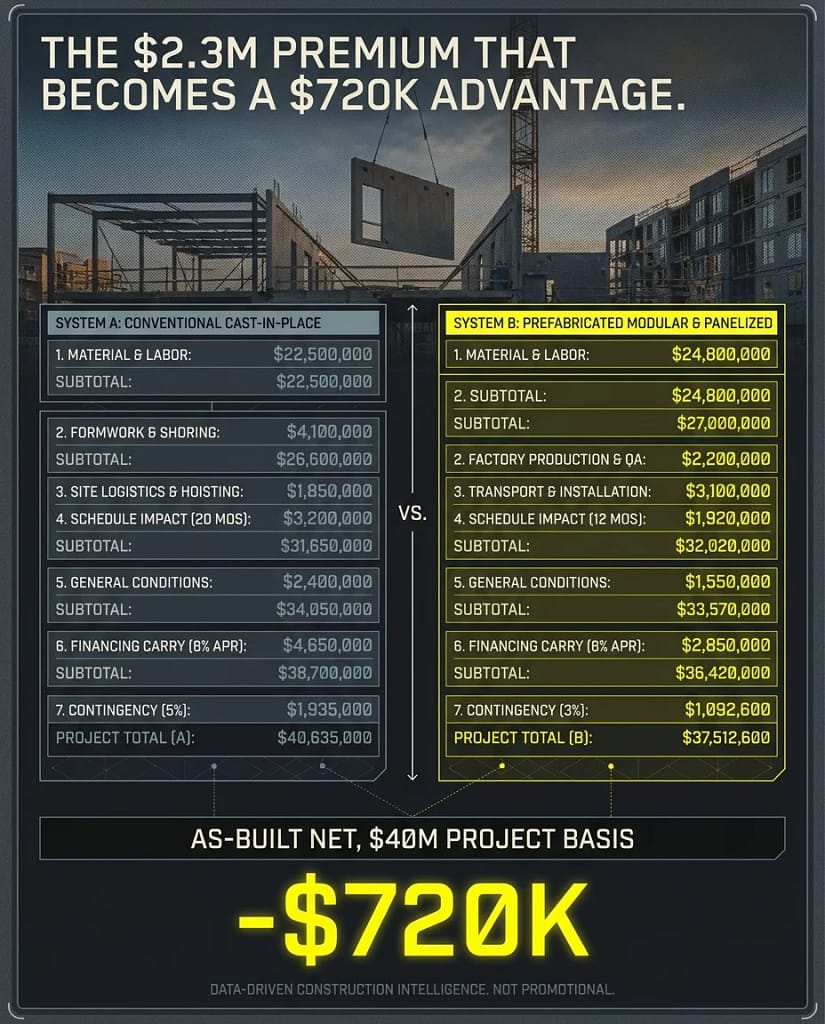
On April 28, 2026, a Calgary multi-family developer sits with two estimates for a 6-storey 84-unit East Village project: cast-in-place $39.4M, precast $41.7M. The $2.3M premium looks expensive — until the pro forma runs all 7 lines below. By the bottom of the spreadsheet, precast is $720K cheaper on the as-built basis. Most developers comparing precast to cast-in-place are looking at one line.
The headline cost-per-square-foot comparison is the wrong question. The right question is what changes on each of the seven lines below when the structural system flips — and which of those changes the developer’s exit cap rate actually rewards. Get all seven right and precast typically nets the developer ahead. Get only one right and the spreadsheet lies.
1. Schedule (the 6-10 week recovery that compounds across the pro forma)
A Calgary developer’s general contractor submits both structural options in March 2026 for the 84-unit East Village project. The cast-in-place scenario quotes a 24-month build with structure-and-dry-in at month 14. The precast scenario quotes an 18-month build with structure-and-dry-in at month 11. Three months earlier to dry-in means three months earlier to interior trades, four months earlier to occupancy permit, and one full leasing season earlier to revenue. That single fact — the structural-finish date — cascades into every other line on the pro forma.
Mid-rise multi-family projects using precast structure typically recover 6-10 weeks of schedule versus cast-in-place equivalent on the structure-and-dry-in critical path, according to Knight’s Companies’ precast-vs-CIP analysis. The mechanism is parallel production: precast panels are fabricated in a controlled plant environment while site foundation work proceeds, then erected at a rate of one to two days per floor versus the typical seven-day cast-in-place deck cycle. CSA A23.4-16 (R2021) — the Canadian standard for precast concrete materials and construction — codifies the quality-control regime that lets plant-cured production proceed in parallel with site work, independent of weather.
Carrying-cost differentials on mid-rise multi-family currently average $250,000 per month in construction-loan interest on a $40M project, per industry survey ranges from multifamily.loans’ 2026 cost guide (validate against current Calgary quotes from your construction lender). NPCA’s “Why Precast Costs Less” cites a 26% labour reduction on the structural-finish stage. Engineering News-Record’s 4Q 2025 cost reports show cast-in-place finisher cost inflation outpacing precast plant cost growth by 4-6% annually — a gap that widens the longer the comparison runs.
On a $40M project, 6 weeks at $250,000 per month equals $375,000 of recovered carry. On a 10-week recovery: $625,000. That is the schedule line alone. The labour line stacks on top. The leasing-season line stacks on top of that. By the time the seven lines have run, the apparent $2.3M precast premium is often net-positive $400,000 to $800,000 on the as-built basis.
And the schedule compression alone changes the builder’s-risk insurance number — which is where the next line gets sharper.
2. Builder’s risk insurance (22-72% premium delta on commercial property)
A Calgary developer requests insurance quotes in April 2026 for two structural options on the same 84-unit project. The broker comes back with a clear pattern: cast-in-place 5-over-1 hybrid quotes 22-72% higher builder’s-risk premium than the precast equivalent on the same coverage limits and same carrier panel, consistent with the CPCI 2016 builders’ risk study cited in Urban Land Magazine’s 2024 update. The differential is structural to how Canadian insurers price combustibility and exposure period.
CPCI’s canonical builders’ risk study quantified the differential: $0.053 per $100 per month for wood-frame versus $0.008 per $100 per month for concrete — a 6.6× rate gap. On a 4-storey $16M mass-timber example, that translated to $158,400 in builder’s risk over 18 months versus $28,800 for the concrete equivalent. Note: cast-in-place IS concrete and qualifies for the favourable rate; the wide differential is largely versus combustible-frame and mass-timber. Concrete-on-concrete (cast-in-place versus precast) shows a smaller per-month rate delta, but precast’s 25% shorter build window reduces total coverage exposure.
Marsh Canada’s 2025 commercial real-estate insurance brief flags that several Canadian insurers have vacated the wood-frame builder’s-risk market entirely. Multi-carrier syndication is now required for mass-timber projects above 4 storeys per broker reporting from Acera Insurance. The market is not opening back up in 2026.
On a $40M Calgary multi-family project, a builder’s-risk premium differential between wood-frame hybrid cast-in-place and full precast runs $300,000 to $500,000 over the build period (industry survey range — validate against current Calgary broker quotes). Even concrete-versus-concrete (cast-in-place versus precast), the 25% shorter precast build window saves $50,000 to $120,000 in coverage period.
And the insurance line is structural — but the construction-loan covenant is where the lender forces the discussion.
3. Construction-loan covenant (MLI Select 2026 stress-test reality)
A Calgary developer in February 2026 closes a $32M CMHC MLI Select construction loan with a 24-month build-out term and a 5-10% cost-overrun reserve. The lender’s stress test models a 5-10% baseline schedule slip per Peakhill Capital’s 2026 outlook. Cast-in-place winter pours (November through March) are the documented top-3 cause of structural-milestone slip in Alberta multi-family per Concrete Alberta and ConstructConnect reporting. That risk lives inside the covenant.
CMHC’s MLI Select February 2025 rule update requires 5+ units, a single title, a single building, with strict construction-loan covenant adherence to draw schedule, per the CMHC MLI Select Underwriting Guide and MPA Magazine’s underwriting brief. Mid-rise cast-in-place projects in Calgary typically carry a higher schedule-slip probability than precast equivalents due to the 59-65 ideal pour-day window per Concrete Alberta and TNA Concrete’s pour-window data. Plant-cured precast removes weather from the schedule-risk model.
LendCity’s 2026 Q2 multi-family rate sheet shows lenders typically allow a 5-10% cost-overrun reserve before a covenant top-up is required; the top-up is paid from owner equity, not loan proceeds. Construction-loan stress tests have tightened in 2026 versus 2024 baseline as MLI Select underwriting hardened post-February 2025.
A covenant top-up of $400,000 to $800,000 is real owner equity called into the construction account that the original pro forma may not have budgeted. Precast’s plant-cured schedule predictability removes weather-driven slip from the covenant risk model — which is the single most expensive line to discover after closing.
And the lender stress test is just one finance constraint — labour availability is the structural one.
4. Labour availability (BuildForce 15,400-worker gap)
A Calgary general contractor scopes a 14-month cast-in-place structural build in March 2026 and discovers the local concrete-finisher crew is booked 11 weeks out at peak season per the Calgary Construction Association’s Q3 2025 release. The crew that is available is junior; productivity runs 70% of senior-crew benchmark. The deck-to-deck cycle stretches from 7 to 9 days. That delay does not show up as a line item on the contractor’s bid — it shows up as a missed schedule milestone seven months later.
BuildForce Canada’s Alberta 2025-2034 forecast projects 43,400 retirements versus 43,600 new entrants, with 59,000 hires required against a 15,400 net recruiting gap, while non-residential employment runs 9% above 2024 levels by 2034. NOC 6481 (concrete finishers) sits at moderate risk of labour shortage per Job Bank Canada’s national outlook — not a designated shortage, but a tight market where senior-crew availability is the binding constraint.
The Calgary Construction Association’s Q3 2025 release reported 5,300 trades vacancies in the Calgary economic region — 23.8% of all regional job vacancies in that quarter. Precast shifts labour from constrained on-site finishing crews (cast-in-place) to less-constrained plant-floor production teams (precast), per PCI MNL-116 and NPCA production-labour data. The crew that pours panels in a Calgary-region plant is not competing for the same calendar as the on-site finishing crew that pours decks.
A 10-15% labour-shortage premium on Calgary on-site finishing labour per Calgary Construction Association reporting adds $40,000 to $80,000 to a 12-pour cast-in-place structural sequence. Precast removes the on-site finishing crew from the critical path almost entirely.
And the labour line connects directly to the embodied-carbon line — because the LEED v5 prerequisite is now mandatory.
5. LEED v5 embodied-carbon prerequisite (mandatory July 1, 2026)
A Calgary developer in May 2026 registers a 96-unit project for LEED v5 certification. The MR (Materials and Resources) Prerequisite — “Quantify and Assess Embodied Carbon” — requires A1-A3 cradle-to-gate quantification for structure, enclosure, and hardscape, including all concrete, structural steel, insulation, aluminum, structural wood, cladding, and glass per the USGBC LEED v5 reference guide. The cast-in-place scenario requires the supplier to provide product-specific Type III EPDs (Environmental Product Declarations); the precast supplier provides the same documentation.
LEED v5 launched on April 28, 2025, with CAGBC registration opened on April 28, 2026; the v4.1 cutoff for new registrations is July 1, 2026, per USGBC and CAGBC transition guidance. The MR (Materials and Resources) credit framework includes up to 6 MR points, with Optimized Product designation requiring a ≥20% Global Warming Potential (GWP) reduction plus ≥5% reductions in two other impact categories. Concrete plus structural steel typically represents 60-80% of a multi-family project’s embodied carbon footprint per USGBC and One Click LCA whole-building LCA data.
Canadian projects pursuing LEED v5 are achieving 15-45% concrete embodied-carbon reductions through low-carbon mixes (slag, fly ash, CO2-injection mineralization technology) per CAGBC v5 transition briefs. Precast can use the same low-carbon mix designs as cast-in-place, plus it benefits from plant-cured efficiency: less waste, optimized mix design per element type, and product-specific EPDs that are typically already in place at the plant level. Cast-in-place EPDs are often built per pour, which adds documentation burden to the design team.
A LEED v5 prerequisite failure delays certification — and in 2026 Calgary, several institutional capital sources require LEED Gold or better for multi-family deal underwriting. A 6-month delay to certification can defer a Class A institutional take-out by a full cycle. The embodied-carbon line is now a financing-eligibility line, not just a sustainability line.
And the embodied-carbon line is mandatory under v5 — but the long-term maintenance cycle is where precast’s structural durability shows up on the operating pro forma.
6. Long-term maintenance cycle (15-20 year recaulk vs continuous CIP envelope upkeep)
A Calgary multi-family operator pulls a maintenance budget in 2031 — five years post-completion — on two adjacent 6-storey buildings built in 2026. One is cast-in-place; the other is precast. The cast-in-place envelope budget shows caulking, patching, sealer renewal, and exterior crack repair on a continuous cycle per PCI Gulf South’s life-cycle cost analysis. The precast envelope budget shows a full exterior recaulk scheduled approximately every 15-20 years. The difference is not in the year-one operating budget — it is in the cumulative maintenance reserve over a 30-year hold.
Precast envelope maintenance typically runs $0.05 to $0.10 per square foot per year averaged across the 15-20 year recaulk cycle per PCI Gulf South’s analysis and MAPA Precast Life Cycle Costs data. Cast-in-place envelope maintenance typically runs $0.15 to $0.30 per square foot per year for caulking, crack repair, and sealer renewal per PCI Designer’s Notebook data (industry survey ranges — validate against actual property-management records on comparable Calgary multi-family assets).
Plant-cured precast achieves more uniform durability than field-cured cast-in-place — the controlled curing environment eliminates the variability that drives differential expansion and surface cracking per PCI MNL-116-21 production-quality standards. CSA A23.4-16 (R2021) production standards mandate uniform curing protocols that exceed what a typical Alberta cast-in-place site can deliver in winter conditions, when ambient-temperature swings and overnight protection routinely affect surface finish quality.
Over a 30-year hold period, a 60,000 sq ft multi-family envelope’s maintenance differential runs $180,000 to $360,000 in precast’s favour — IF the building is held. For institutional take-out at year 7-10, the maintenance differential is incorporated into the buyer’s underwriting NOI (net operating income). That is the line that the next section closes the loop on.
And the maintenance line shows up on the disposition NOI — which is where the exit cap rate connects.
7. Exit cap-rate signal (Class A building-quality differentiation)
A Calgary multi-family developer markets a 96-unit asset for disposition in 2030 — four years post-completion. The buyer’s broker comparable set includes both cast-in-place-frame and precast multi-family of similar vintage in the submarket. The precast building’s marketing materials cite a 15-20 year recaulk cycle, factory-controlled curing, and CSA A23.4-16 (R2021) production standards. The cast-in-place-frame building’s marketing materials cite code-compliance. The buyer’s underwriting model applies a 10-15 basis-point cap-rate compression on the precast asset. That compression is where every other line on the pro forma compounds.
Calgary multi-family cap rates run 5.0-7.0% in 2026 — the widest spread of any major Canadian multi-family market and notably wider than Toronto at 3.8-4.5% or Vancouver at 3.5-4.2% per CBRE Canadian Cap Rates Q1 2026 and Peakhill Capital’s 2026 outlook. Building-class quality — envelope durability, structural resilience, low-maintenance signal — compresses cap rates within that band.
Cushman & Wakefield’s 2025 multi-family report flags that Class A building quality (envelope durability, structural resilience, low-maintenance signal) compresses cap rates 10-25 basis points within the same submarket, per their Calgary Q1 2026 capital markets brief. The precast structural and envelope story is documented evidence for that compression. A buyer’s underwriting team can verify it; an offering memorandum can cite it.
On a $40M completed asset at a 5.5% cap rate, a 10 basis-point compression to 5.4% equals $730,000 of value uplift. On a 25 basis-point compression: $1.83M. The cap-rate line is where all the other lines — schedule, insurance, labour, LEED, maintenance — compound into the disposition price.
Seven lines, one structural decision. The cast-in-place-versus-precast comparison is the right question — but it has to be the full question, not just the hard-cost-per-square-foot headline.
FAQ
Q1: What’s the typical schedule compression precast offers vs cast-in-place on Calgary multi-family?
6-10 weeks recovered on the structure-and-dry-in critical path for mid-rise (3-6 storey) multi-family projects per Knight’s Companies’ precast-vs-cast-in-place analysis. The compression comes from parallel plant production while site foundation work proceeds, plus 1-2 day erection cycles per floor versus 7-day cast-in-place deck cycles. On a $40M project at $250,000 per month construction-loan carry, that translates to $375,000 to $625,000 of recovered carrying cost per multifamily.loans’ 2026 cost guide (validate against current Calgary lender quotes).
Q2: How much does the builder’s-risk insurance premium differ between wood-frame, cast-in-place, and precast?
CPCI’s canonical 2016 study quantified the wood-frame-to-concrete differential at 22-72% on commercial property — wood-frame averaging $0.053 per $100 per month versus concrete at $0.008 per $100 per month per CPCI and Urban Land Magazine’s 2024 update. Cast-in-place-versus-precast (concrete on concrete) shows a smaller per-month rate delta, but precast’s 25% shorter build window reduces total coverage period per Marsh Canada’s 2025 commercial real-estate insurance brief.
Q3: Does precast cost more per square foot than cast-in-place in Calgary?
Hard-cost-per-square-foot, precast typically runs 5-15% above cast-in-place on structural scope only per Knight’s Companies and NPCA cost analysis. Total project cost — including schedule recovery, builder’s-risk delta, labour-shortage premium, and exit cap-rate compression — typically nets precast at or below cast-in-place on the as-built basis for mid-rise multi-family in Calgary per multifamily.loans’ 2026 cost guide and CBRE’s Canadian Cap Rates Q1 2026 (validate against current Calgary quotes).
Q4: Do both precast and cast-in-place qualify for LEED v5 embodied-carbon credits?
Yes — both qualify for LEED v5 MR (Materials and Resources) credits with Type III EPDs per USGBC LEED v5 reference guide. The differentiator is documentation quality: precast plants typically have product-specific EPDs already in place per element type; cast-in-place requires the supplier to provide product-specific or industry-average EPDs for each mix design per CAGBC v5 transition briefs. Concrete plus structural steel typically represents 60-80% of a multi-family project’s embodied carbon per One Click LCA whole-building LCA data.
Q5: What’s the long-term maintenance cost differential between precast and cast-in-place envelopes?
Precast envelopes typically require full exterior recaulk every 15-20 years at $0.05 to $0.10 per square foot per year averaged per PCI Gulf South’s life-cycle cost analysis. Cast-in-place envelopes typically require continuous caulking, patching, sealer renewal, and exterior crack repair at $0.15 to $0.30 per square foot per year per PCI Designer’s Notebook (industry survey ranges — validate against your property-management records). Over a 30-year hold, the differential on a 60,000 sq ft multi-family envelope runs $180,000 to $360,000 in precast’s favour.
Q6: How do Calgary multi-family cap rates compare to other major Canadian markets?
Calgary multi-family cap rates run 5.0-7.0% in 2026 — the widest spread of any major Canadian multi-family market per CBRE Canadian Cap Rates Q1 2026. Toronto runs 3.8-4.5%; Vancouver runs 3.5-4.2% per Peakhill Capital’s 2026 outlook. Within Calgary’s range, building-class quality — envelope durability, structural resilience, low-maintenance signal — compresses cap rates 10-25 basis points within the same submarket per Cushman & Wakefield’s Calgary Q1 2026 capital markets brief.
Sources
- CSA A23.4-16 (R2021) — Precast concrete: materials and construction — https://www.csagroup.org/store/product/A23.4-16/
- Knight’s Companies — Precast vs Poured-in-Place Cost and Schedule — https://www.knightscompanies.com
- NPCA — Why Precast Costs Less — https://precast.org
- CPCI 2016 Builders’ Risk Study (via Urban Land Magazine 2024) — https://urbanland.uli.org/resilience-and-sustainability/how-resilient-construction-can-improve-insurability-and-preserve-housing-supply
- Marsh Canada — 2025 Commercial Real Estate Insurance Brief — https://www.marsh.com
- CMHC MLI Select Underwriting Guide — https://www.cmhc-schl.gc.ca/professionals/project-funding-and-mortgage-financing/mortgage-loan-insurance/mli-select
- LendCity 2026 Q2 Multi-Family Rate Sheet — https://lendcity.ca
- BuildForce Canada Alberta 2025-2034 Construction Forecast — https://www.buildforce.ca
- Calgary Construction Association Q3 2025 Labour Market Release — https://www.calgaryconstruction.com
- USGBC LEED v5 — https://www.usgbc.org/leed/v5
- CAGBC LEED v5 transition briefs — https://www.cagbc.org
- PCI Gulf South Life-Cycle Cost Analysis — https://www.pci.org
- CBRE Canadian Cap Rates Q1 2026 — https://www.cbre.ca
- Cushman & Wakefield Calgary Q1 2026 Capital Markets — https://www.cushmanwakefield.com
About Omega Precast
Omega Precast launched in late 2025 as the precast-concrete arm of the Omega Group, supplying engineered structural and architectural precast for Calgary-region multi-family, commercial, and industrial projects under the production-quality regime defined in CSA A23.4-16 (R2021).
Request a Precast Feasibility Review
Our team can help you assess:
- Schedule compression potential
- Structural system cost comparisons
- MLI Select financing implications
- LEED v5 documentation requirements
- Labour and insurance risk exposure
- Long-term maintenance impacts
- Exit-value considerations
Get a project-specific precast review before finalizing your structural system.