
Last updated: September 23, 2026
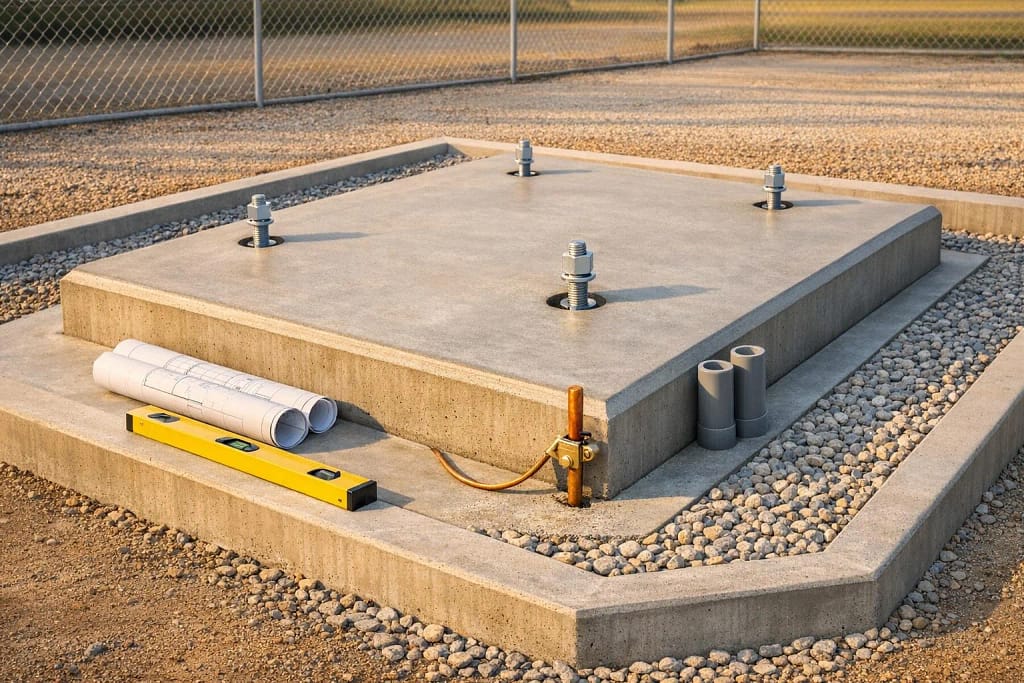
A transformer pad is a structural base with a hole in it. The transformer sits on the pad. The cables come up through the opening. The utility owns the equipment. You own the pad.
That split is where most delays start. The pad is on your scope, the drawing that governs it is on theirs, and the two rarely arrive at the same time.
This page covers what actually sets a precast transformer pad in Alberta: who supplies what, the clearances that fix its location, the opening, the grounding, the grade, and the order information that keeps lead time short.
Who supplies the pad
The customer supplies the concrete base. The utility supplies, installs and terminates the equipment on top of it.
EPCOR’s customer connection guide states it plainly in its responsibility table: the utility will “supply, install, and terminate all padmount equipment,” while the customer completes “concrete bases for any padmount equipment.” FortisAlberta draws a similar line, owning and maintaining distribution facilities up to the transformer and the meter, with the customer responsible for the conduit and service leads below.
The practical reading is short. The pad is a customer-supplied product on a utility-approved detail. Order it as a product, not as a pour.
| Item | Typical responsibility |
|---|---|
| Concrete base | Customer |
| Excavation and granular base | Customer |
| Conduit into the pad opening | Customer |
| Transformer, terminations, connection | Utility |
| Approved base detail and drawing number | Utility |
| Grounding electrodes | Per utility standard, installed on site |
The utility drawing controls the pad
There is no province-wide transformer pad. There is a drawing, and the drawing belongs to the distribution utility serving that site.
EPCOR references a single approved base size for minipad transformers in its 15 kV and 25 kV areas and points to a numbered underground distribution standard for the detail. The number is the deliverable. Get it before anything else.
Alberta layers a code on top of the utility standard. The Alberta Electrical Utility Code, 6th Edition, has been in force since September 1, 2023, alongside the Canadian Electrical Code CSA C22.1-24, effective April 1, 2025. The utility standard implements those codes for its own territory. It does not replace them.
Two consequences follow. First, a pad approved in one service territory is not automatically approved in the next one. Second, a pad ordered from a catalogue without the drawing number is a guess.
Clearances set the location before the pad is sized
Clearance is a site planning number, not a product number. It decides whether the pad fits at all.
The distances are not uniform across Canada, and that is the point worth understanding. EPCOR’s guide requires 3.0 m in front of transformer doors and 2.0 m on the other sides, including driveways. ENWIN, an Ontario distributor, requires 3 m of access clearance at the transformer opening, 1 m on all other sides, and 3 m from property lines. Same equipment class, same working principle, different numbers.
The pattern holds even where the figures differ. The door face gets the largest clearance because a lineman has to swing the doors and work in front of them. The other three sides get less. Anything the utility cannot reach, it will not energize.
| Clearance | EPCOR (Edmonton) | ENWIN (Ontario, for comparison) |
|---|---|---|
| In front of doors | 3.0 m | 3 m |
| Other sides | 2.0 m, including driveways | 1 m |
| Property line | Per easement requirements | 3 m |
Buried services carry their own separation. EPCOR requires 1.0 m to all gas lines, 1.8 m to water lines and curb stop valves, and 2.0 m to valves, hydrants, catch basins, manholes, vaults, sanitary and storm sewer lines and septic systems. On a tight commercial lot those numbers move the pad more often than the transformer footprint does.
Access is a clearance too. EPCOR requires truck access to on-property transformers, with the equipment placed beside an access roadway 4.6 m wide and capable of supporting an 18,000 kg truck. That roadway has to exist at final grade, not just during construction.
The opening, the conduits and the grade
The opening is the part of a transformer pad that gets ordered wrong.
Conduits stub up inside the opening. They are stubbed before the transformer lands, cut to the elevation the utility wants, and left clear. A pad delivered with the opening in the wrong position is scrap, because the opening cannot be relocated after casting. Confirm orientation on the shop drawing, not on site.
Grade is equally fixed. ENWIN requires the finished pad to sit 50 mm to 150 mm above surrounding ground. Concrete above grade sheds water and keeps the cabinet base out of standing snowmelt. Concrete flush with grade collects both.
Alberta adds frost to the equation. A pad set on disturbed backfill with no compacted granular base will move seasonally, and the equipment bolted to it moves with it. Specify the base course, compact it, and set the pad level on it.
| Detail | What to confirm before casting |
|---|---|
| Opening size and position | Utility standard drawing number |
| Pad plan dimensions | Utility standard drawing number |
| Thickness and reinforcement | Approved shop drawing |
| Height above finished grade | 50 mm to 150 mm is a common requirement; confirm locally |
| Granular base | Depth, material and compaction on the civil drawings |
| Lifting inserts | Location and capacity on the shop drawing |
Grounding happens around the pad, not after it
The ground grid goes in before the pad is set. Retrofitting it afterward means excavating beside a live installation.
EPCOR’s design standard calls for transformers and switching cubicles to have four 10-foot copper-clad electrodes, or eight 5-foot electrodes with couplers, with rods at each of the four corners. ENWIN specifies a perimeter trench 300 mm by 300 mm by 900 mm around the foundation for the same purpose. Both details assume the excavation is open when the electrodes go in.
Sequence it in this order. Excavate. Install and compact the granular base. Drive the electrodes. Stub the conduits. Set the pad. Backfill.
The order is not a preference. Each step buries the one before it. Electrodes driven after the pad is set mean hand digging beside a cabinet the utility now owns, and a utility inspector who has already signed off does not come back for free. Get the grounding inspected while the hole is open.
Equipment pads are the same product with a different load
Transformer pads are one member of a family. Switchgear pads, cubicle bases, generator pads, transfer switch pads and HVAC equipment pads are cast the same way and specified the same way.
The variables are consistent across the family:
- Plan dimensions and thickness
- Opening or openings, and their position
- Equipment weight and bolt pattern
- Reinforcement
- Lifting inserts and pick points
- Height above finished grade
Weight is the variable that changes most between them. A distribution transformer, a standby generator and a rooftop condenser put very different loads on the same footprint, and the bolt pattern differs on every one. Send the equipment cut sheet with the order. The pad is sized from the equipment, not the other way around.
Precast suits all of them for one reason. The pad is a repeated element with tight dimensional requirements, and a plant holds those tolerances better than a small isolated field pour in an Alberta shoulder season. The comparison is laid out in full in our guide to precast versus cast-in-place concrete.
Site utility work, municipal distribution and ICI service upgrades all draw on the same product. Our industrial precast solutions and municipal precast solutions pages cover the applications in detail.
Quality: CSA A23.4 and CPCQA
Ask for the plant’s certification before you ask for a price.
Precast plant certification in Canada runs through the Canadian Precast Concrete Quality Assurance program, administered under CSA A23.4 and supplemented by PCI quality control manuals MNL-116 and MNL-117. Certification covers the plant and its processes, not a single delivery.
For a transformer pad, certification is what backs the dimensions. Opening position, overall plan size and embed location are all verified against the approved drawing in a certified plant’s own QC routine. Our pages on precast concrete quality control and CPCQA certification categories explain what each level covers.
Lead time and what to send with the order
Lead time on a transformer pad is rarely driven by production. It is driven by approvals.
The sequence is fixed: utility drawing, then shop drawing, then approval, then casting, then delivery. Every day spent chasing the drawing number is a day the plant cannot start. Send the drawing number with the request for quote and the rest moves.
Send these six items with the order:
- Utility and service territory
- Utility standard drawing number, or the approved detail
- Equipment type, kVA class and manufacturer footprint
- Quantity and required delivery date
- Site address and site access conditions
- Setting method: whether the pad is being set by crane, picker or excavator
Delivery and setting can be quoted with the product. Our delivery and installation service page covers what that includes.
Omega Precast has supplied precast products across Alberta for decades. Send the drawing, get the quote, get the lead time.
FAQ
Who pays for a transformer pad? The customer. Utilities in Alberta generally supply, install and terminate padmount equipment while the customer supplies the concrete base, the excavation and the conduit into it.
How much clearance does a padmount transformer need in Alberta? EPCOR requires 3.0 m in front of the doors and 2.0 m on the other sides, including driveways. Confirm the figures with the utility serving your site, because they differ between territories.
Can a transformer pad sit flush with the ground? No. A common requirement is 50 mm to 150 mm above surrounding grade so water and snowmelt drain away from the cabinet base.
Can the cable opening be cut after the pad is delivered? No. The opening is cast in. Confirm its size and orientation on the shop drawing before the pad is cast.
Does the pad need to be certified? Specify a plant certified under the CPCQA program, administered under CSA A23.4. Certification covers the plant’s processes and the dimensional verification behind the pad.
How long does a precast transformer pad take? Production is short. The approval chain is not. Lead time starts when the utility drawing number and the approved shop drawing are in hand.