
Last updated: October 6, 2026
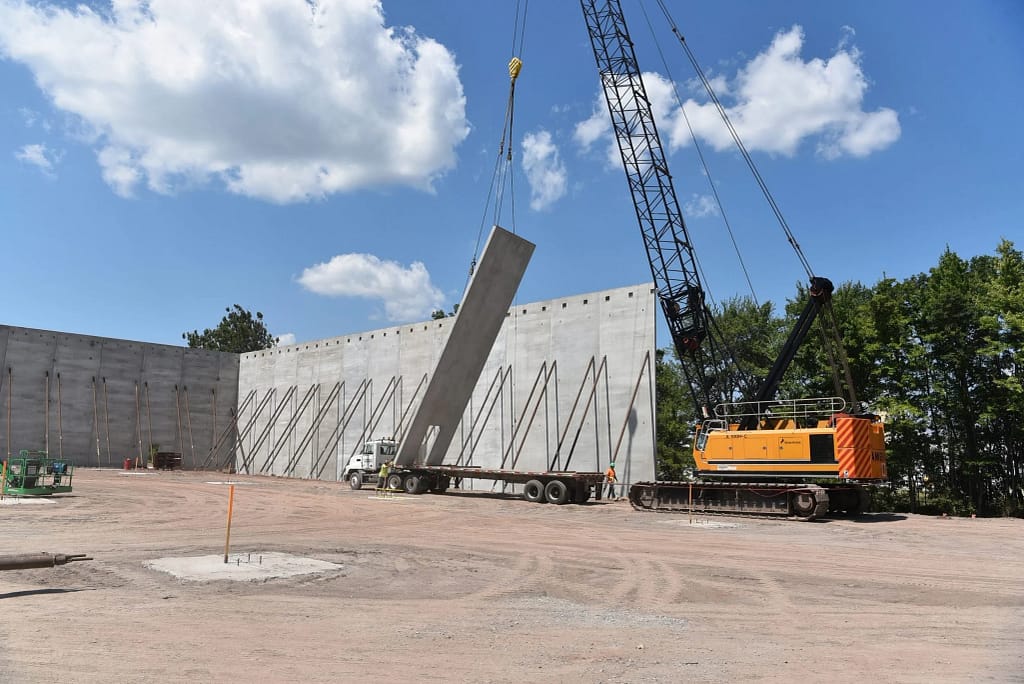
The standard does not stop at the plant gate. CSA A23.4 covers “materials to be used and methods to be followed in the manufacture, transportation, and erection of architectural, structural, and specialty precast concrete products.” Three legs. Erection is the third.
Most precast scopes are closed on the first leg only. The plant sends strength reports and a certificate. The pieces go up. The binder gets nothing about the day the crew set them. Then the structural engineer asks for an erection record and nobody has one.
This article is about the third leg. What gets written down when pieces are set, who writes it, and what the GC keeps.
The code obligation reaches the crew
CSA A23.3 is the concrete design standard. It does not treat erection as somebody else’s problem. CPCQA quotes the clause directly: “All precast concrete elements covered by this standard shall be manufactured and erected in accordance with CSA A23.4.”
Read that twice. Manufactured and erected. One standard governs both. The reference is not advisory. It arrives through the design standard that the building code already points at.
So the question is not whether erection has requirements. It does. The question is which document proves they were met.
| Leg of the scope | What CSA A23.4 governs | Where the records usually sit |
|---|---|---|
| Manufacture | Materials, production, finishes, shop drawings | Plant quality system |
| Transportation | Handling, support points, loading | Carrier and plant dispatch |
| Erection | Methods on site, setting, connection completion | Often nowhere |
The third row is the gap. It is also the row that gets audited when something cracks.
A plant certificate does not cover the crew
This is the most expensive misunderstanding in precast procurement.
CSA A251 qualifies the fabricator. Its own scope says so: “This Standard provides a means for qualifying manufacturers who fabricate architectural and structural precast concrete to the requirements of CSA Standard A23.4.” Manufacturers. The plant.
CPCQA certification works the same way. It certifies a plant, by category. We have written about how those categories work and how to verify a plant yourself. None of it describes the crew that shows up with the crane.
Erector qualification is a separate programme. PCI certifies erectors in three categories:
| Category | Covers |
|---|---|
| S1, Simple Structural Systems | Horizontal decking members such as hollow core slabs on walls, and single-lift wall panels attached to a structure |
| S2, Complex Structural Systems | Everything in S1, plus total precast systems, multi-product structures combining vertical and horizontal members, and single or multistorey loadbearing members |
| A, Architectural Systems | Non-loadbearing cladding and GFRC products, which may be attached to a supporting member |
The categories matter the same way plant categories matter. An S1 erector is not qualified by that certificate for a multistorey loadbearing frame. Check the category against the structure, not against the logo.
PCI requires certified erectors to work to MNL-127, the Erector’s Manual, and MNL-132, Erection Safety for Precast and Prestressed Concrete. Crew audits recur on a semi-annual cycle, and at least one audit in the cycle must come from an independent auditor. Organizations also undergo an annual third-party company audit. PCI states the certification “represents the highest commitment to safety and quality an erector can achieve under the PCI Quality Assurance System.”
More useful than any of that: PCI requires a certified erector to maintain “quality documents, safety and erection procedures, personnel qualification records, project files, and equipment management records.”
That list is the answer to this article’s question. Those are the records. They exist whether or not anyone asks for them. Ask for them.
The erection document set
Below is the set we hand over, and the set a GC should be demanding from any erector. The column that matters is the third one. A document that lands after backfill, after topping, or after occupancy is a document that proved nothing.
| Document | Who issues it | When it must land |
|---|---|---|
| Approved erection drawings | Precaster, stamped and issued for construction | Before mobilization |
| Erection procedure | Erector | Before mobilization |
| Personnel qualification records | Erector | Before mobilization |
| Equipment management records | Erector | Before the first pick |
| Daily erection log | Erector foreman | Day of setting |
| Survey check of bearing surfaces | GC or surveyor | Before pieces land on them |
| Connection completion record | Erector | Before the connection is buried or covered |
| Non-conformance and repair records | Erector, countersigned by precaster | At the time, not at closeout |
| As-built piece layout | Erector against erection drawings | At completion of each elevation or bay |
| Deficiency list with sign-off | GC and erector jointly | At substantial completion of the scope |
Ten rows. Four of them land before anyone picks a piece. That is deliberate. Erection paperwork is mostly a mobilization problem, not a closeout problem.
The four records that get skipped
The daily erection log, the connection completion record, the non-conformance record and the as-built layout are the four that go missing. Each goes missing for the same reason: the moment to create it passes quickly, and nothing physically stops the job if it does.
The daily erection log. Piece marks set, in order, by date. Nothing clever. It is the only document that ties a piece mark on an erection drawing to a position in the finished structure. Without it, a question about one panel becomes a question about every panel.
The connection completion record. Connections get covered. Grout goes in, topping goes over, backfill goes against. Once covered, the only evidence a connection was completed to drawing is a record written before it was covered. The physical sequence of setting, bracing and connecting is a separate subject, and we cover it in our walkthrough of installing a precast panel. The point here is narrower: the record is written at the connection, not at the trailer, and not next week.
The non-conformance and repair record. A chipped corner is routine. An undocumented chipped corner is a dispute. The record states what happened, what was done, and who re-inspected. Our plant already works this way for production; the precast quality control article covers the plant-side version. The site-side version needs the erector’s signature as well as the precaster’s.
The as-built piece layout. One marked-up erection drawing per elevation. It takes minutes on the day and hours in six months.
The bearing surface is the GC’s record, not ours
One row in that table belongs to the general contractor, and it is the row most often left blank: the survey check of bearing surfaces.
Pieces land on something. A footing, a wall, a corbel, a steel seat. Whoever built that something owns its position. The precaster did not pour it. The erector did not pour it. By the time a piece is swinging over it, it is too late to argue about it.
So the record is simple and it is the GC’s to produce. Surveyed elevations and positions of every bearing surface, signed, dated, issued to the erector before mobilization. Tolerance values themselves live on the erection drawings, not in this article; the point is that someone has to measure against them and write down the result.
Two outcomes follow from having that record. If the surfaces are right, the erector cannot later blame the substrate for a setting problem. If the surfaces are wrong, everyone finds out while a grinder or a shim can still fix it, instead of after a piece is seated.
Missing that record converts a half-day survey into a change order. It is the cheapest document on the list and the one with the highest return.
Why the erector’s own file is not enough
A certified erector keeps project files. Good. Those files belong to the erector.
Companies change hands. Crews move. Subcontractors finish a job, close the file and store it to their own retention schedule, not the owner’s. Five years later, when a connection is opened during a renovation, the question goes to the building owner, and the building owner has whatever the GC handed over at closeout.
That is the argument for copying records as they are produced rather than collecting them at the end. A binder assembled at closeout contains what still exists at closeout. A binder assembled weekly contains what existed each week.
It is also the argument for signatures over stamps. A stamp identifies a company that may not exist later. A name and a date identify a person who was standing there.
Common record defects
These are the defects we see when a GC asks us to review an incoming erection package.
| Defect | Why it fails | Fix |
|---|---|---|
| Log lists dates but not piece marks | Cannot tie a piece to a position | Record piece marks from the erection drawing |
| Piece marks without a drawing revision | Marks get reissued between revisions | Record the revision in use that day |
| Connection record written at closeout | Connection already covered | Record at the connection, same day |
| Repair noted, re-inspection not noted | Proves a problem, not a resolution | Countersign after re-inspection |
| Company stamp, no name | No person accountable | Name and signature |
| Grout record with no temperature | Conditions govern the result | Record ambient and surface conditions |
| As-built marked only on the final elevation | Earlier bays undocumented | Mark up at completion of each bay |
Every row above is a five-minute fix on the day and a multi-week fix afterward.
What to check on each record
Short list. Apply it to every page before it goes in the binder.
- A date. Not a month, a date.
- A piece mark that matches the erection drawing revision in use that day.
- The erection drawing revision number itself.
- A name and a signature, not a company stamp alone.
- Weather and temperature where the record concerns grouting or welding.
- A clear statement of conformance, or a clear statement of non-conformance. Not a blank.
A record with a blank field is worse than no record. It documents that someone looked and did not answer.
Who holds the original
Retention gets argued about at the wrong time. Settle it in the subcontract, not at closeout.
| Record | Original held by | Copy to |
|---|---|---|
| Erection drawings | Precaster | GC, consultant |
| Erection procedure | Erector | GC |
| Qualification and equipment records | Erector | GC on request |
| Daily erection log | Erector | GC weekly |
| Connection completion records | GC | Consultant |
| Non-conformance and repair records | Precaster and erector, both | GC, consultant |
| As-built piece layout | GC | Owner at handover |
| Deficiency sign-off | GC | Owner at handover |
Two rules make this work. The GC holds the originals of anything the owner will eventually need. The erector holds the originals of anything about its own people and plant. Everything in the first group gets copied as it is produced, not collected at the end.
Where this article stops
Plant-side quality records (mix data, curing records, strength reports, piece identification and traceability) are a different set with a different owner. They are covered separately in our precast quality control article.
Oversize transport permits and convoy requirements are a different set again, governed by provincial regulation rather than by CSA A23.4.
This article covers the erection leg only, and only its paperwork. It does not set tolerances, and it is not a method statement.
What this does to your schedule
Four documents are due before mobilization. That is the schedule consequence, and it is the reason to raise this at buyout rather than at closeout.
Erection drawings drive it. They are produced from approved shop drawings, and they are the document the erector works from. Nothing on site is faster than that sequence allows. When a GC asks why a set date moved, the answer is usually a drawing revision, not a crane.
Quantity and lead time are quoted off the same drawings. For a product line with a short, repeatable erection sequence the document set is short and the lead time is predictable. Precast stairs are the clearest example. For a multi-product structure, both grow.
Send us the structural drawings and the required set dates. We will return a spec sheet, a shop drawing schedule, a lead time, and the erection document set that comes with the quantity. Decades of Alberta erection records sit behind that list, across hundreds of structures. The list is not theoretical.
FAQ
Does CSA A23.4 apply to erection, or only to the plant? Both. Its scope covers the manufacture, transportation and erection of precast products. CSA A23.3 requires precast elements to be manufactured and erected in accordance with it.
Does a CPCQA-certified plant mean the erection is certified? No. CSA A251 and CPCQA qualify manufacturers. Erector qualification is a separate programme with its own categories and its own audits.
What are the PCI erector categories? S1 for simple structural systems, S2 for complex structural systems including total precast and loadbearing members, and A for architectural non-loadbearing cladding and GFRC.
What is the single most commonly missing record? The connection completion record. Connections get covered quickly, and once covered the record cannot be recreated.
When should erection documentation be specified? At buyout. Four of the ten documents are due before mobilization, so a closeout-stage request arrives too late for them.
Who keeps the as-built piece layout? The GC holds the original and passes a copy to the owner at handover. The erector marks it up against the erection drawings as each elevation is completed.
Can an erection scope be closed without a deficiency sign-off? It can be closed commercially. It cannot be closed cleanly. A jointly signed deficiency list is what separates an accepted scope from an open one.
Sources
- CSA Group, CAN/CSA-A23.4 / A251 product record: https://www.csagroup.org/store/product/CAN-CSA-A23.4-00-A251-00/
- CPCQA, Codes and Standards: https://www.precastcertification.ca/en/codes_standards/
- PCI, Erector Certification: https://www.pci.org/PCI/PCI/PCI-Certification/PCI_Erector_Certification.aspx