
Last updated: September 27, 2026
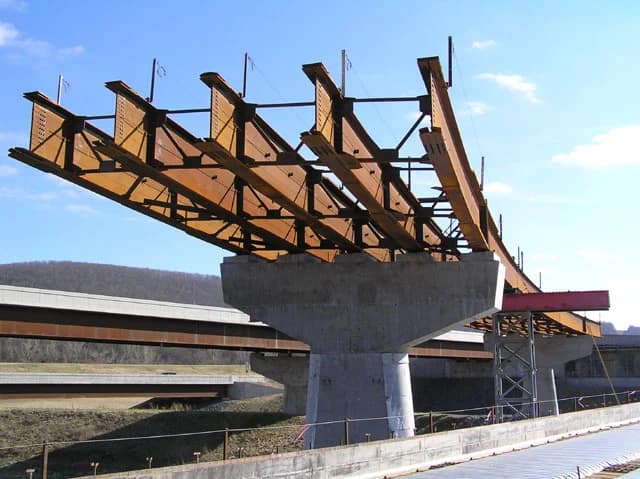
A precast bridge girder is not a catalogue item. Span sets the depth. Depth sets the spacing. The owner’s drawing set decides all three before anyone calls a plant.
Three documents govern the girder. CSA S6 governs the design. Alberta’s Specifications for Bridge Construction, Section 7, governs the fabrication. The province’s standard girder drawings govern the shape.
This page covers the girder itself. Type, depth, span, tolerance, cure, lead time.
Which code governs the design
CSA S6 is the Canadian Highway Bridge Design Code. CSA states it “applies to the design, evaluation and structural rehabilitation design of fixed and movable highway bridges.”
CSA S6:19 is the twelfth edition, published 2019. CSA has since published a newer edition, S6:25.
Which edition governs your bridge is set by the owner’s contract, not by the publication date. Ask before design starts. A mid-project edition change is a redesign, not a revision.
Girder families in Alberta’s standard drawings
Alberta Transportation publishes a drawing set titled Standard and Typical Detail Drawings Precast Girders, dated August 2023. Three shallow girder families carry standard drawings.
| Girder family | Standard drawing range | Notes |
|---|---|---|
| Type SL-510 | S-1723-07 through S-1749-07 | Interior and exterior girder layouts. S-1749-07 is the standard details sheet. Spans listed from 6.10 m to 12.80 m. |
| Type SLW-510 | S-1816-12 through S-1837-12 | Same depth family, separate drawing series. |
| Type SLC 510 and SLC 700 | S-1771-20 through S-1792-20 | Two depths in one series. |
Read the series prefix. S-1723-07 and S-1816-12 are not interchangeable. The trailing number is the drawing year, and the province does not retire the old series just because a new one exists.
Standard drawings are a shortcut on short spans. They are not a shortcut on long ones.
NU girders: depth and reach
Long spans leave the standard shallow families behind. Alberta uses the NU I-girder series for those.
The PCI Journal paper that introduced the series lists eight sizes. The number is the depth in millimetres.
| Girder | Depth |
|---|---|
| NU750 | 750 mm |
| NU900 | 900 mm |
| NU1100 | 1100 mm |
| NU1350 | 1350 mm |
| NU1600 | 1600 mm |
| NU1800 | 1800 mm |
| NU2000 | 2000 mm |
| NU2400 | 2400 mm |
Reach is real. The same paper demonstrates an 1800 mm deep girder spanning 170 ft, which is 51.8 m, in a continuous post-tensioned arrangement. Girder spacing tightens as the span grows. That is the trade: fewer, deeper girders, or more, shallower ones.
Depth is not free. Depth eats structure clearance and headroom under the bridge. Check the clearance envelope before locking the depth.
For the same logic applied to building frames rather than bridges, see our guide to precast beams and columns.
Tolerances the inspector measures
Alberta’s Section 7 spec sets cast-unit tolerances. These are the numbers a bridge inspector brings a tape to.
| Dimension | Tolerance (clause 7.2.5.15) |
|---|---|
| Length | plus or minus 20 mm x length (m) / 50 |
| Width | plus or minus 3 mm |
| Depth | plus or minus 5 mm |
| Camber | plus or minus 20 mm x length (m) / 50 |
| Sweep, NU girders | 1 mm/m |
| Bearing area flatness | 3 mm |
Note the shape of the length and camber limits. They scale with span. A 30 m girder gets 12 mm. A 50 m girder gets 20 mm. The tolerance does not loosen because the girder got harder to make.
Sweep is tighter than the rest, and it is checked twice. Clause 7.3.5 holds erected NU girders to the same 1 mm/m. Other erected girders get 20 mm x length (m) / 50 as deviation from true.
Width at plus or minus 3 mm is the number that surprises people. That is a form tolerance, not a finishing tolerance. It is set in the bed, not fixed on site.
Our quality control walkthrough covers how those checks run inside a plant.
Cure and release: where four days goes
Section 7 sets the cure. Clause 7.2.5.10 caps the temperature rise at 20°C per hour. The holding temperature is not less than 50°C and not more than 60°C. Steam curing runs at 100% relative humidity and a uniform 50°C to 60°C for four days.
Four days is a spec requirement, not a plant preference. It cannot be compressed by paying more.
Release is gated on strength, not on time. Clause 7.2.5.11: “The stressing strand shall not be released until the specified concrete release strength is attained.” Clause 7.2.6.5 requires cylinders tested to prove that release strength, and the value comes off the drawing, not off a standard table.
That matters for scheduling. Two girders of the same shape can have different release strengths on different projects. The bed is occupied until the cylinder breaks high enough.
Strand condition is also specified. Clause 7.2.5.3 requires strand free of corrosion, dirt, grease, rust, oil or other foreign material. Rejected strand is a lost bed day.
Plant certification: CSA A251
Clause 7.2.2 is short and absolute. The manufacturer “shall operate a plant that is certified by the Canadian Standards Association in the appropriate category(ies) according to CSA Standard A251.”
Two words carry the weight. Category and appropriate. A plant certified for one category is not certified for all of them. Ask for the certificate and read the categories before the bid, not after the award.
Certification categories work the same way across precast programs. Our specifier’s guide to CPCQA categories explains how to read one.
What actually sets lead time
Girder lead time is bed time. Nothing else moves the date much.
| Driver | Effect on the date |
|---|---|
| Bed availability | One bed, one girder line at a time. The queue is the schedule. |
| Steam cure cycle | Four days at 50°C to 60°C, per clause 7.2.5.10. Fixed. |
| Release strength on the drawing | Higher release strength means a longer hold before detensioning. |
| Strand pattern change | A new pattern means a bed reset. Reusing a pattern across girders saves days. |
| Shop drawing approval | Fabrication does not start on an unapproved drawing. |
| Haul and permits | Girder length and depth drive the permit, the escort and the route. |
Two decisions shorten the schedule more than anything else. Standardise the girder across the structure so one bed setup produces many units. And get the drawings approved early. We handle the second through shop drawings and BIM.
Handling rules also affect the yard, and therefore the date. Clause 7.2.5.16 requires units handled by accepted lifting devices at designated locations. Clause 7.3.2 requires units kept upright, supported near the ends, on stable foundations. Girders stored wrong get rejected. Storage space is part of lead time.
Delivery is its own sequence. See delivery and installation.
Haul is a design input, not an afterthought
The girder has to leave the plant. Length and depth decide how.
A shallow standard girder at 9 m rides a normal trailer. A 40 m NU girder does not. It needs a permit, a route survey, and in most cases an escort. Overhead structures, turning radii and load-restricted bridges all narrow the route. The route can rule out a girder the designer already picked.
Two consequences follow, and both belong in the early drawing review.
First, the longest girder in the package sets the haul plan for the whole package. One outsized unit can add permit time that the other forty units never needed.
Second, splicing changes the economics. Two shorter segments spliced on site haul easily and cost more to erect. One long girder hauls hard and erects fast. That trade is a project decision, not a plant decision, and it has to be made before the strand pattern is set.
Ask the question at the concept stage: can the girder reach the site. Not: can the girder be made.
Girder count and bed economics
Bed setup is the fixed cost. Girders off that setup are the variable cost.
One girder from a bespoke setup carries the entire setup. Twenty identical girders from the same setup carry one twentieth each. This is why a mixed package of five shapes costs more than a uniform package of the same total length.
Three habits cut the number down.
Keep the depth constant across spans where the design allows it, and vary strand rather than shape. Repeat the exterior girder detail instead of drawing a second variant. And group the girders so that the plant runs a family, not a sequence of one-offs.
For a broader view of how plant production is organised, see precast concrete manufacturing.
Precast girders versus cast-in-place
| Item | Precast girder | Cast-in-place girder |
|---|---|---|
| Where strength is gained | Plant bed, steam cured, 50°C to 60°C | On site, ambient conditions |
| Winter exposure | Controlled | Weather dependent |
| Falsework over the obstacle | None for the girder | Required |
| Schedule risk | Sits in the bed queue | Sits in the weather |
| Tolerance control | Form tolerance, plus or minus 3 mm width | Field formwork |
Precast wins where the crossing is hard to shore. Over water. Over live traffic. Over rail. That is the decision, and it is made before girder type.
Where this page stops
Our precast concrete in infrastructure guide covers the broad case for precast across bridges, tunnels and rail, plus the other bridge elements: abutments, piers, deck panels, barriers.
This page does one part. The girder. Type designation, depth, span reach, the tolerance numbers from Section 7, the cure cycle, the certification clause, the lead time drivers. No overlap on numbers, because the infrastructure guide carries none of these.
If you need the abutment, the pier cap or the deck panel, start there. If you need a girder line priced and scheduled, stay here.
FAQ
Which girder types have Alberta standard drawings? Type SL-510 (drawings S-1723-07 through S-1749-07), Type SLW-510 (S-1816-12 through S-1837-12), and Types SLC 510 and SLC 700 (S-1771-20 through S-1792-20), per Alberta Transportation’s Standard and Typical Detail Drawings Precast Girders, August 2023.
How deep is an NU girder? The series runs NU750, NU900, NU1100, NU1350, NU1600, NU1800, NU2000 and NU2400. The number is the depth in millimetres.
How far can a precast girder span? Far. The PCI Journal paper introducing the NU series demonstrates an 1800 mm girder spanning 170 ft, or 51.8 m, in a continuous post-tensioned arrangement. Actual span depends on the owner’s design, spacing and deck.
What sweep tolerance applies to NU girders? 1 mm/m, both as cast under clause 7.2.5.15 and as erected under clause 7.3.5.
Does the girder have to be made in a certified plant? Yes. Clause 7.2.2 of Alberta’s Section 7 spec requires a plant certified by the Canadian Standards Association in the appropriate categories according to CSA A251.
Why does fabrication take weeks and not days? Steam curing alone is four days at 50°C to 60°C. Detensioning waits on the release strength printed on the drawing, proven by cylinder break. Beds run one girder line at a time.
Can the cure be shortened? No. The four day steam cure and the release strength gate are specification requirements.
What is the fastest way to shorten a girder package? Standardise the girder across the structure and approve shop drawings early. One bed setup producing many identical units beats a mixed package every time.
Next step
Send the span, the deck width, the girder spacing and the clearance envelope. We return the girder type, the standard drawing reference where one applies, the tolerance package, and a bed-based lead time.
Quantity changes the price. Send the full girder count, not one line.
Omega Precast has supplied precast across Alberta for decades, on hundreds of projects. Start at infrastructure solutions, or send the drawings and ask for a quote.
Sources
- Alberta Transportation, Standard and Typical Detail Drawings Precast Girders, August 2023: https://www.alberta.ca/system/files/custom_downloaded_images/trans-bridge-precast-girders-drawings.pdf
- Alberta Transportation, Specifications for Bridge Construction, Section 7: Precast Concrete Units: https://www.transportation.alberta.ca/Content/docType246/Production/05bcs07.pdf
- CSA Group, CSA S6, Canadian Highway Bridge Design Code: https://www.csagroup.org/canadian-highway-bridge-design-code/
- PCI Journal, The NU Precast Prestressed Concrete Bridge I-Girder Series: https://www.pci.org/PCI_Docs/Publications/PCI%20Journal/1994/May-June/The%20NU%20Precast%20Prestressed%20Concrete%20Bridge%20I-Girder%20Series.pdf