
Last updated: August 6, 2026
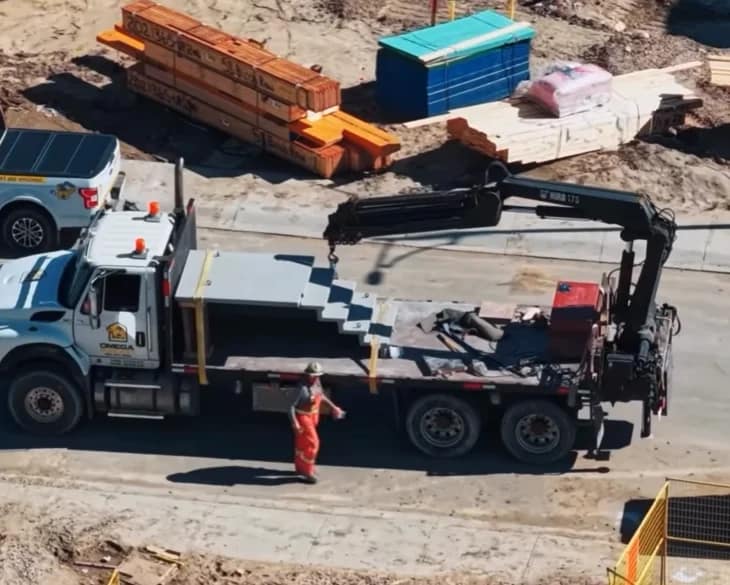
On a typical precast-steps install day in Calgary, a crew of two to three arrives with your unit and a small lifting machine (a boom or picker truck, a telehandler, or a mini-excavator), removes and hauls away the old steps, digs and compacts a granular base, then rigs the unit to its cast-in lifting inserts, takes a slow test lift, walks it into place, and levels it. Most residential precast step units weigh roughly 1,000 to 4,000 lb, and a properly equipped three-person crew can set them in under three hours once the base is ready. A turnkey supplier folds the delivery, the lift, the base prep, and haul-away of your old steps into one quote.
This article is the calm walkthrough nobody gives you. Most “how to install precast steps” pages are written for installers and DIYers, full of rigging and shim talk. This one is written for the homeowner watching from the window who just wants to know what shows up, where it sits, and what “done right” looks like. For pricing and the full cost stack, see our Calgary precast-steps cost guide. This page is about the day itself.
Before the truck arrives: what’s already been decided
By install day, the unit is already cast, cured, and matched to your opening, so the day is about placement, not manufacturing. Precast steps are built and cured in a controlled plant, then delivered finished. That factory cure is a real Calgary advantage: there’s no wet concrete sitting on your lot trying to cure through a cold snap. (Source: factory-cure advantage, Omega’s precast-vs-poured guide; cold-weather context, Omega Knowledge Base.)
Before the day, a good supplier will have confirmed three things: the size and rise of the steps, the access route for the truck and lifting machine, and where the unit will sit relative to your door. If your lot is a tight inner-city infill or a long rural acreage driveway, that access conversation matters more, because it decides where the picker can safely set up. The deeper version of that planning lives in our crane-access guide for rural yards; for a standard city lot, the crew handles it on arrival.
Hour by hour: the install-day sequence
Here’s the order things actually happen. Timing varies with access and the size of the set, but the sequence is consistent.
1. Arrival and setup
A crew of two to three arrives with your precast unit and the lifting equipment. For a residential set, that’s usually a small boom or picker truck, a telehandler, or a mini-excavator with a thumb attachment. A knuckle-boom picker offers roughly 30 ft of reach and rotates a full 360 degrees, which is what lets it reach a doorway from the driveway on an awkward lot.
(Source: lift equipment, Heldenfels (above); reach, HIAB precast delivery, https://www.hiab.com/en-us/application-overview/precast-concrete .) The crew walks the site, confirms where the unit lands, and positions the truck.
2. Removing and hauling away the old steps
If you have existing steps, they come out first. This is also when the crew sees what’s underneath: old footings, loose fill, or a stoop that’s been heaving for years. The old steps leave on the same truck. On a proper turnkey quote, that haul-away is included along with the delivery, the lift, and the base prep, so you’re not left with a pile of broken concrete in the yard.
3. Digging and compacting the base
This is the step that decides whether your steps are still level in five winters. The crew excavates the area, removing topsoil and any loose material, then builds a compacted granular pad.
A typical residential set rests on a base of compacted crushed stone, often around 6 inches deep, built up in lifts and compacted with a plate compactor. Well-graded ¾-inch-minus crushed stone is the preferred material because it locks together and drains, where rounded pea gravel shifts.
4. Rigging and the test lift
With the base ready, the crew rigs the unit to its cast-in lifting inserts using rated slings or chains, then takes a slow test lift to check that it’s balanced before it leaves the truck bed. This is routine, and it’s why a 1-tonne block of concrete moves predictably rather than swinging.
5. Setting and leveling
The unit is walked into position and lowered onto the base. Then the crew levels it in two directions: front-to-back at a slight pitch away from the house so water runs off instead of pooling at your door, and side-to-side dead level so the treads aren’t tilted. Small adjustments are made with shims and by tapping with a rubber mallet.
6. Cleanup and the walkthrough
The crew backfills and grades around the base, tidies the work area, and walks you through the finished set. A good crew leaves the immediate area graded and the steps pitched correctly, not a churned-up patch of yard.
Why the base prep is the whole game in Calgary
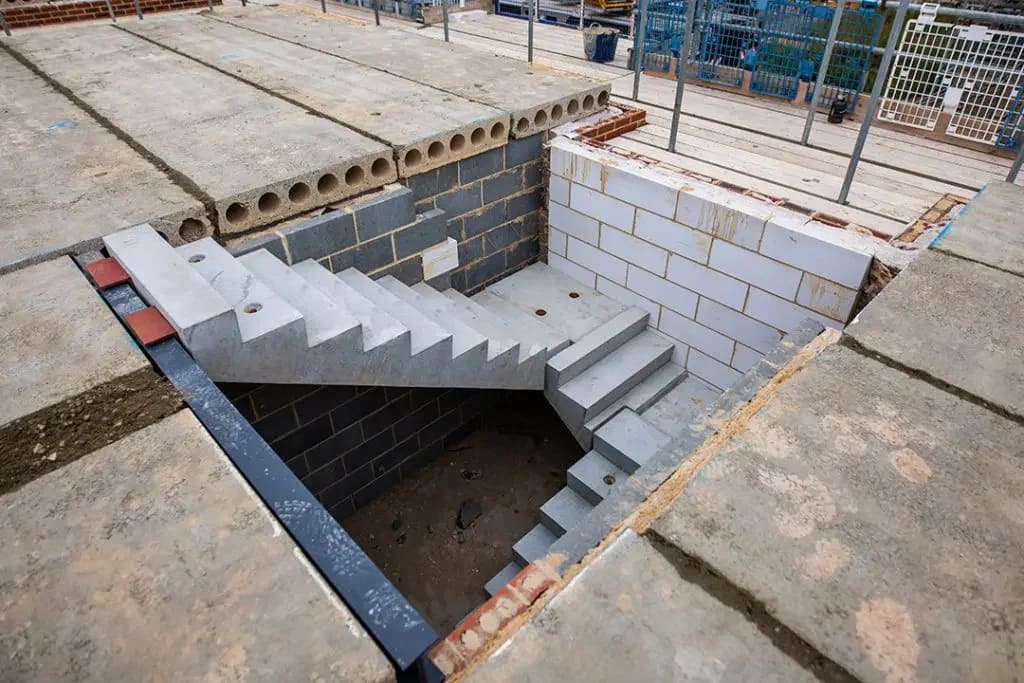
Calgary’s frost depth is about 1.2 m, and the ground goes through roughly 128 freeze-thaw cycles a year, so a base that doesn’t reach below frost will heave. When the freezing front moves into frost-susceptible soil that holds water, it forms ice lenses that lift whatever sits on top. The same physics that makes “concrete stoops at entry doors go up and down in winter” is what a cheap drop-it-on-the-dirt install gets wrong.
The compacted base, dug below frost or to undisturbed soil, plus the mass of the precast unit itself, is what defeats that. It’s also why the excavation on install day is deeper here than the guides written for milder climates assume.
How long the crew is on site
A 10-step set is typically a 4-to-6-hour job; a 20-step set runs about a full day. Access and crane positioning are the biggest variables. A clean city lot with a short reach is at the fast end; a long rural driveway, a tight gate, or a spot the truck can’t easily reach pushes it longer.
The point worth holding onto: once the base is ready, the actual lift and set is quick. A three-person crew can place the unit in under three hours after the base is built. Most of the day, when there is a “most of the day,” is base prep and access, not the lift.
What a turnkey quote should include
So nothing surprises you on the invoice, here’s what a complete precast-steps quote typically bundles:
- Delivery of the finished unit to your site
- The lift (the boom truck, picker, telehandler, or excavator)
- Site and base preparation (excavation and the compacted granular pad)
- Installation and leveling
- Haul-away of your old steps
If any of these is quoted separately, that’s worth knowing before the day, not after. Ask exactly what’s included so the price you’re told is the price you pay.
FAQ
What happens on the day my precast steps are installed? A crew of two to three arrives with your unit and a small boom or picker truck, removes and hauls away the old steps, digs and compacts a granular base, rigs the unit to its cast-in lifting inserts, takes a slow test lift, sets it, and levels it. Once the base is ready, the set itself often takes under three hours.
How does a 1-tonne precast step get to my house? A small boom or picker truck, a telehandler, or a mini-excavator lifts it using the cast-in lifting inserts built into the unit. A knuckle-boom picker reaches roughly 30 ft and rotates 360 degrees, so it can place the steps at your door from the driveway. Residential units run about 1,000 to 4,000 lb.
How long does a precast-steps install take? A 10-step set is typically 4 to 6 hours; a 20-step set is about a full day. Access and where the lifting truck can set up are the biggest variables. The actual lift and leveling is quick once the base is built.
Do you remove my old steps? A turnkey quote should include haul-away of your old steps along with delivery, the lift, base prep, and install. Ask exactly what’s bundled, because a complete quote means the broken concrete leaves on the same truck rather than sitting in your yard.
What base do my new steps sit on? A compacted ¾-inch crushed-stone pad, often around 6 inches deep, dug below Calgary’s 1.2 m frost line or down to undisturbed soil. That compacted base, plus the weight of the unit, is what stops the steps from heaving in winter. It’s the most important part of the install.
Will the install make a mess of my yard? The excavation and compaction disturb the area right around the steps. A good crew grades and tidies that area afterward and pitches the steps slightly away from the house for drainage. Ask your supplier about site cleanup so you know what the finished area will look like.
Can precast steps be installed in winter? Often yes. Because precast units are cast and cured in a plant and delivered finished, there’s no wet concrete curing on your lot through a cold snap. The crew still has to reach undisturbed or below-frost soil for the base, but the granular base and set can proceed in cold weather more readily than a fresh pour.
Planning New Precast Steps?
A successful installation starts well before the truck arrives. At Omega, we manufacture precast steps, deliver them to your property, prepare the granular base, remove your old steps, complete the lift, and leave your entrance level and ready to use.
If you’re replacing damaged concrete steps or planning a new entrance, request a free quote today. We’ll help you determine the correct size, confirm site access, explain exactly what’s included in the installation, and provide upfront pricing with no surprise charges.