
Last updated: August 5, 2026
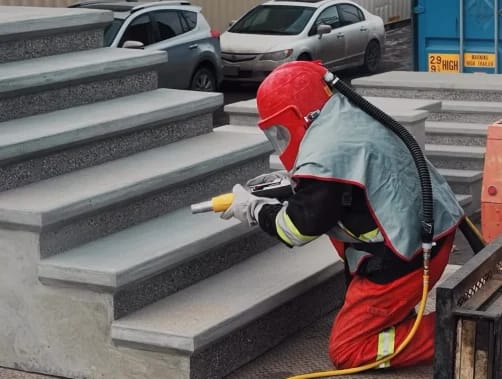
Precast concrete steps in Calgary run roughly $150–250 per step for standard units and $250–400 for custom, so a typical 10-step set lands around $1,500–4,000 in materials before delivery, crane, site prep, and permits. Validate against current Calgary quotes. They outlast poured and wood because factory-cast mass on a proper granular base resists the frost heave that lifts weaker entries.
Those bands are a starting point, not a fixed quote. Alberta pricing tends to sit about 5–10% below the national average, and the final number depends on step count, finish, colour, and how hard your site is to reach with a boom truck. Below, we break down what drives the cost, and then the part that matters more over 30 years: why a precast unit stays put while a poured or wood stair works loose.
1. What you actually pay for
A precast step’s price reflects the unit itself and the work to place it. The material band above covers the cast concrete. On top of that, plan for delivery, a crane or boom truck (a full step unit weighs on the order of a tonne), any site prep for the base, and a City permit if your project needs one.
Standard units in a common width and rise sit at the lower end. Custom widths, deeper treads, wraparound returns, or an integral colour push you toward the upper band. As a rough anchor, a 10-step set in standard configuration lands somewhere around $1,500–4,000 in materials. Treat every figure here as a market band to confirm against a current Calgary quote, since concrete input costs and freight move over time.
2. Finishes and colour, and what each one costs you later
Finish is a safety and maintenance decision before it is a look. A broom finish is the slip-resistant default for an entry that sees ice; exposed aggregate and sandblast are the textured alternatives. Whichever you choose, a defined nosing and scored grip lines give a foot something to register in winter.
Colour is integral iron-oxide pigment (ASTM C979), batched into the mix rather than coated on. Pigment is capped at about 10% of cement weight, and colour saturates around 6%, so past that point you are adding cost without adding tone. Earth tones read best and age most gracefully. A “true black” cures to a deep charcoal rather than a jet black, and efflorescence, the white mineral bloom concrete can develop, shows worst on dark surfaces. A penetrating sealer protects the colour and slows that bloom. None of this changes the base price much, but it changes how the step looks in year five.
Price is only one part of choosing a precast staircase. The finish you specify determines winter traction, long-term appearance, and maintenance requirements. Before deciding between broom, exposed aggregate, or sandblast, read our guide on Precast Concrete Steps in Calgary: 5 Slip-Resistant Finishes & Colours That Last to compare grip, colour durability, and finish options for Calgary’s freeze-thaw climate.
3. Why steps heave in Calgary, and why mass wins
This is the real durability story. Calgary sits on frost-susceptible clay and silt, with a frost depth around 1.2 m and roughly 128 freeze-thaw cycles a year. Two things attack an entry stair. Frost heave forms ice lenses in the soil that push upward. Adfreeze is soil freezing to the sides of the stair and dragging it up as the ground lifts. A step on a poor base gets jacked, racked, and left out of level.
Mass and a correct base are what defeat both. A heavy precast unit resists being lifted, and a base detailed to reduce adfreeze, set on a compacted granular pad rather than bare clay, gives the frost less to grab. A light or shallow-footed stair has neither advantage. That is why the same winter that tilts a wood stoop leaves a properly based precast set sitting flat.
4. Precast vs poured vs wood
The three common ways to build an entry stair diverge most in how they cure and how they age.
| Factor | Precast concrete | Poured-in-place concrete | Wood |
|---|---|---|---|
| Cure conditions | Cast at the yard under controlled temperature and moisture | Cured on site, exposed to Calgary weather during the critical early days | No cure; fasteners and framing settle over time |
| Frost/adfreeze resistance | High: mass on a granular base resists lift | Depends entirely on footing depth and base prep | Low: light frame racks and lifts |
| Consistency | Batch-controlled to CSA A23.4-16 (R2021) | Varies with weather and crew on pour day | Varies with lumber and build |
| Install | Set as a finished unit in ~4–6 hours for a 10-step set | Form, pour, wait, strip, finish over days | Fast to build, faster to loosen |
| Typical service life | Decades with a proper base | Decades if the base is right; cracks if it is not | Shorter; rots, warps, and needs refinishing |
| Winter footing | Broom finish plus scored grip and a defined nosing | Finish quality varies | Slick and slippery when iced |
The honest point of comparison: a plant-cast step is made to the same standard as a good site pour, not to a stronger one. The advantage is not exotic concrete. It is that the yard controls temperature and moisture during the cure, so you are not gambling the strength of the early days on the weather that week.
5. What the standard actually guarantees
Omega Precast casts to CSA A23.4-16 (R2021), the Canadian standard for precast concrete materials and construction. Reading a standard number on a spec sheet is worth understanding: it means the unit was produced to a defined, auditable process for mix, reinforcement, and finishing, rather than to whatever conditions happened to exist on a given pour day.
It does not mean the concrete is stronger than a well-executed site pour. It means it is consistent. For a homeowner comparing options, that consistency is the quiet value, because the failures you want to avoid, low early strength, uneven cure, a stair placed before it was ready, are the ones a controlled cast is built to prevent.
Want to understand the engineering behind the standards referenced in this article? The CSA Group publishes CSA A23.4, Canada’s governing standard for precast concrete construction, while the National Precast Concrete Association (NPCA) offers technical resources on precast manufacturing, durability, installation, and quality control. Together, they explain why factory-controlled production produces consistent concrete quality and why proper base preparation matters just as much as the step itself for long-term performance.
6. Install day and what it needs from your site
A finished step unit is heavy, on the order of a tonne, so placement uses a crane or boom truck rather than muscle. That drives two of your line items: the equipment, and the access. A tight backyard, overhead wires, or a long reach over the house adds time and cost; a clear driveway approach keeps it simple.
The upside is speed. A 10-step set typically installs in about 4–6 hours, and the base is the part that earns the years. A compacted granular pad, detailed to shed frost and reduce adfreeze, is what turns a heavy unit into a stair that is still level after a decade of Calgary winters. Spend the attention there.
FAQ
How much do precast concrete steps cost in Calgary? Roughly $150–250 per step for standard units and $250–400 for custom, so a 10-step set is about $1,500–4,000 in materials. That is before delivery, crane, site prep, and any permit. Alberta pricing tends to run about 5–10% below the national average. These are market bands; confirm against a current quote.
Are precast steps stronger than poured concrete? Not stronger, the same standard. Both are made to CSA A23.4-16 (R2021). The difference is that precast is cast under controlled temperature and moisture at the yard, so the early cure is consistent rather than dependent on the weather on pour day.
Why do concrete steps heave in Calgary? Frost-susceptible clay and silt form ice lenses that push up (frost heave), and soil can freeze to the sides of a stair and drag it up (adfreeze). With a frost depth near 1.2 m and about 128 freeze-thaw cycles a year, a stair on a poor base gets lifted out of level.
How do precast steps avoid heaving? Mass plus a proper base. A heavy unit resists being lifted, and a base set on a compacted granular pad and detailed to reduce adfreeze gives the frost less to grip. The base is as important as the step itself.
How long does installation take? A 10-step set typically installs in about 4–6 hours. Because a unit weighs on the order of a tonne, placement needs a crane or boom truck, so site access affects both time and cost.
What finish is safest for a winter entry? A broom finish is the slip-resistant default, paired with scored grip lines and a defined nosing. Exposed aggregate and sandblast are textured alternatives. Integral iron-oxide colour is optional and best kept to earth tones, with a penetrating sealer to protect it.
Get a quote
Ready to Price Your New Precast Steps?
CTA Copy
Whether you’re replacing aging wood steps, upgrading a poured entry, or finishing a new home, we’ll help you choose the right stair size, finish, and installation approach before work begins.
Omega Precast supplies custom precast concrete steps built for Calgary’s climate, including:
- Standard and custom-width stair units
- Slip-resistant broom, sandblast, and exposed-aggregate finishes
- Integral colour options that won’t peel or flake
- Proper granular-base recommendations to minimize frost heave
- Crane or boom-truck placement
- Fast scheduling throughout Calgary and surrounding communities
- Coordination with Omega Ready Mix and Omega 2000 Cribbing for complete installation support
Send us your approximate step count, width, photos of the entry, and any access constraints, and we’ll provide a project-specific estimate, explain any required site preparation, and recommend the finish best suited to your property.
Contact Omega Precast today for a no-obligation quote and expert advice on selecting precast steps built to stay level through decades of Calgary winters.