
Last updated: July 17, 2026
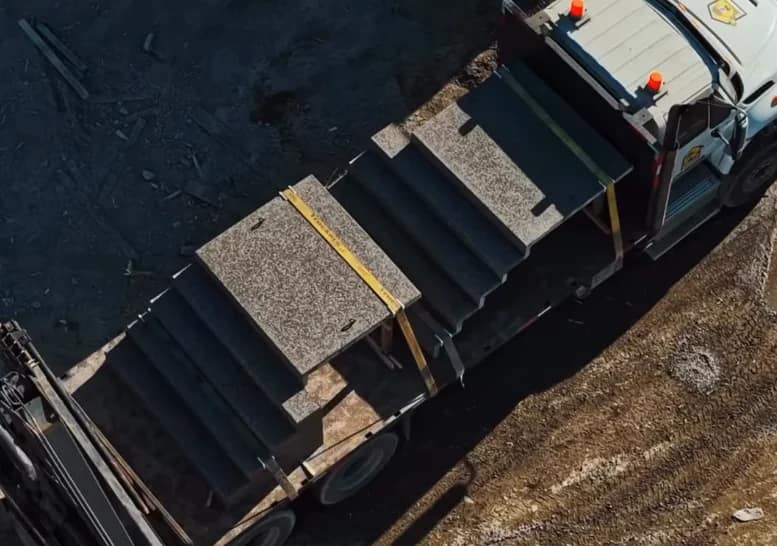
Precast concrete steps come in about five finishes: broom, exposed aggregate, sandblast, sand texture, and molded stone, plus integral iron-oxide colour in earth tones. Pick the finish for winter grip first and the colour second, then seal it so both last. Here’s how each option actually behaves.
If you are shopping precast steps for a Calgary or acreage entry, you are really making two decisions that pull against each other: the finish that keeps you upright in February, and the colour that still looks right in five years. This guide walks through both, in the order that keeps you safe. Everything here is scoped to precast concrete steps and stairs. The same logic carries over to window wells and septic tanks, but the numbers below are about steps.
1. The five finishes, grippiest to smoothest
A precast step is cast in a mold, so the finish is decided at the plant, not scratched into wet concrete on your driveway. That is an advantage: the texture is consistent tread to tread, and the slip-resistant options are engineered in rather than improvised. Here are the five you will typically be offered for residential steps, ranked from most grip to least.
Broom finish. A fine, linear texture dragged across the surface while the concrete is still plastic. It is the slip-resistant default for treads, and for good reason: those tiny ridges give a shoe or a boot something to bite into, wet or dry. If you do nothing else, ask for a broom finish on the walking surface.
Exposed aggregate. A surface retarder is applied, then the top paste is washed away to reveal the stone underneath. The exposed pebbles read as a decorative, speckled surface, and they are grippy, because the rounded stone breaks up a sheet of water or ice. It is a strong choice for a tread that also needs to look like more than a plain grey slab.
Sandblast. The cured surface is abraded with an abrasive stream, which opens up the paste and lightens the tone. It leaves a matte, uniform texture with moderate grip: less aggressive than broom or exposed aggregate, more textured than a smooth cast face.
Sand texture. A fine, sandy surface texture, sitting between a sandblast and a smoother cast face. It is a middle option: some tooth underfoot, a quieter look.
Molded stone. A form-liner cast into the sides and risers that mimics stacked stone or a textured face. This is a cosmetic finish for the vertical surfaces, the parts you look at rather than the parts you step on. Molded stone belongs on the sides and risers; keep a broom or exposed-aggregate finish on the treads themselves.
The pattern to notice: the two grippiest finishes, broom and exposed aggregate, are also the two most common tread specifications. Sandblast and sand texture trade some grip for a smoother look, and molded stone is a face treatment, not a walking surface. You can combine them; molded-stone sides with broom-finished treads is a common, sensible pairing.
2. Colour: what precast can and can’t do
Precast concrete is coloured with integral iron-oxide pigment: the pigment is mixed through the whole batch, not painted on top, so the colour goes all the way through and does not wear off the surface. Iron oxides are UV-stable and permanent, which is why they are the standard for exterior concrete that has to sit in the sun for decades. Per the National Precast Concrete Association’s guidance on colouring precast, iron-oxide pigments are the workhorse for exactly this reason.
The palette that behaves is the natural one: earth tones. Greys, charcoals, tans, reds, and browns are what iron oxide does well, and what stays looking intentional as the concrete ages. That is the range to shop within.
Two honest limits are worth knowing before you fall in love with a sample card:
Grey cement mutes the colour. The pigment is competing with the base colour of the cement itself, which is grey. So the cured step reads softer and greyer than the bright chip on the sample. That is normal; it is the sample card being optimistic, not the pigment failing. If a colour looks perfect on the card, expect the real step a shade quieter. (We cover why in more detail in Why coloured precast concrete looks different from the sample.)
“True black” isn’t really black. Ask for black and the cured concrete tends to settle into a deep charcoal, and under some light it can lean slightly purple. There is no chemistry that gives you a jet, saturated black in integral-coloured concrete. The honest expectation is “deep charcoal,” and that is a handsome result if you go in expecting it.
There is also a ceiling on how much colour you can add. Pigment is dosed as a percentage of the cement weight, and per ASTM C979 the practical maximum is around 10 percent, with the colour effectively saturating near 6 percent. Past that point you are adding pigment without adding colour, and diluting the paste that binds the concrete. So a good producer will not simply keep dumping in pigment to chase a deeper tone; the depth you can get is capped by the material, not by willingness.
Note that the richer architectural finishes you may have seen on commercial buildings (acid-etch, polished faces, deep form-liner reliefs) belong to the wider precast world of wall panels and facades. For residential steps, the finishes in section 1 plus integral earth-tone colour are the toolkit.
3. Safety first: nosing, grip, and a Calgary winter
Slip resistance is the first design driver for a step, ahead of colour and ahead of style. That is not a slogan; it is the order you should make decisions in, because a beautiful step you are afraid to use in January is a failed step.
A well-made precast step is designed for grip in three ways:
The tread finish. Covered above: broom or exposed aggregate on the walking surface. This is the single biggest lever on how the step feels underfoot in wet or icy conditions.
A defined nosing. The nosing is the front edge of the tread. A crisp, defined nosing gives your foot a clear, consistent edge to register against on the way up and down, which matters most when you cannot see the edge clearly under snow or in low winter light.
Scored grip lines. Shallow lines scored across the step edge add extra bite right where your foot lands, at the leading edge of the tread. They are a small detail that does real work in a Calgary winter.
Calgary’s freeze-thaw cycling is the reason all of this matters more here than in a milder climate. A Chinook can melt the snow on your steps at noon and refreeze it by evening, so the same surface can be wet, then glazed, in a single day. A finish chosen for grip, a defined nosing, and scored lines are what keep that surface usable through that cycle. This is also why the treads earn a textured finish even if you would have preferred something smoother for looks: on an entry step in this climate, grip wins.
One material note that supports the safety case: precast steps are manufactured to CSA A23.4-16 (R2021), the Canadian standard for precast concrete materials and construction. For a buyer, the value of a standard is consistency. The concrete, the reinforcement, and the production are held to a defined benchmark rather than left to chance, so the step you install behaves like the step that was designed. Ask your producer whether their steps are made to CSA A23.4-16 (R2021), and confirm who verifies their plant.
4. Making it last: sealing, efflorescence, and the footing
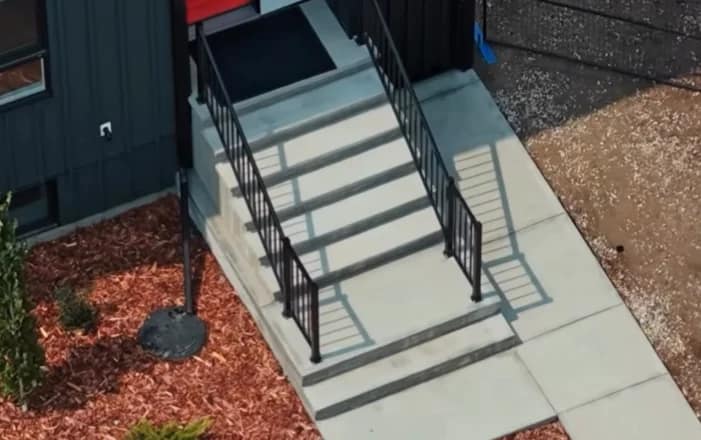
Two things determine whether your steps still look good in five years: how you manage efflorescence, and whether you seal the colour. Both are worth understanding before you buy.
Efflorescence is the white, powdery salt bloom that can appear on concrete as moisture moves through it and carries dissolved salts to the surface. It is cosmetic, not structural, but it shows worst on exactly the surfaces buyers care about most: dark and coloured concrete, where a white haze stands out against a charcoal or deep-red step. The good news is that it is largely a production-side problem to control. A low water-to-cement ratio, proper curing, and supplementary materials such as fly ash all reduce how much efflorescence a step will throw. So how a producer controls efflorescence on coloured units is a question to ask them, more than a chore you manage yourself.
Sealing is the step most people skip, and it is the one that most protects a coloured finish. Most coloured concrete is left unsealed. A UV-resistant penetrating sealer does two jobs: it helps protect the surface, and it renews and deepens the colour, bringing back the richness that a dry, weathered surface loses. Penetrating is the word that matters, because it soaks in rather than forming a slick film on top, so it does not undo the grip you chose in section 1. For a coloured step you want to keep looking sharp, a periodic reseal is the single highest-value bit of maintenance.
The footing is the part nobody sees and the part that decides whether the whole assembly stays put. Precast steps sit on a footing that is in contact with the ground, and much of Alberta’s soil carries sulphates that attack ordinary concrete over time. The answer for anything in ground contact is sulphate-resistant cement, specifically the Type HS (high-sulphate-resistant) family. When you are talking to a producer about steps for an Alberta site, confirm that ground-contact concrete is specified with sulphate resistance in mind. It is invisible on day one and decisive over the life of the steps.
5. Matching finish and colour to your entry
With the safety and durability decisions settled, the last step is matching the look to your house. Here the order finally relaxes: you have already locked in a grippy tread and a sealable earth-tone colour, so you are choosing among good options rather than trading away safety.
A few pairings that work:
Warm brick or stucco. Tan, warm grey, or a muted red step picks up the warmth without fighting it. Exposed aggregate on the tread reads as upscale and textured, and a molded-stone riser echoes stone accents elsewhere on the facade.
Cool grey or modern black-and-white. A charcoal step (remember: “black” cures toward deep charcoal) with a clean broom finish suits a contemporary entry. Keep the molded stone off if the look is minimalist; a plain, well-cast face is the right call there.
Acreage and rural entries. Durability and grip carry more weight than fashion on a rural approach that sees mud, gravel, and hard winters. Broom or exposed aggregate on the tread, an earth tone that hides dust and salt residue between cleanings, and a properly sulphate-specified footing are the priorities.
Whatever the pairing, get a sample in your own light before you commit, and view it dry and wet, because the colour shifts between the two and you will live with both. Remember that the sample will read a touch brighter than the finished step because of the grey cement, so lean slightly warmer or deeper than the card if you are on the fence. Then plan to seal it, and plan to reseal it, so the colour you chose is the colour you keep.
Your finish and colour choices have far less impact on price than step size, installation, site access, and foundation preparation. Our guide to precast concrete step pricing in Calgary explains where the real costs come from.
FAQ
Q1: What finishes do precast concrete steps come in? Residential precast steps typically come in about five finishes: broom (a fine linear texture and the slip-resistant default for treads), exposed aggregate (surface retarder plus a wash that reveals the stone, also grippy), sandblast (an abraded matte surface that lightens the tone), sand texture (a fine sandy texture), and molded stone (a form-liner face for the sides and risers). Treads are usually broom or exposed aggregate; molded stone is a cosmetic finish for the vertical surfaces.
Q2: Are precast concrete steps slippery in winter? They do not have to be. Slip resistance is the first design driver: a broom or exposed-aggregate finish on the tread, a defined nosing at the front edge, and scored grip lines together give your foot bite in wet and icy conditions. Calgary’s freeze-thaw and Chinook cycling can glaze a surface in a single day, so choosing the tread finish for grip rather than looks is what keeps the steps usable through winter.
Q3: What colours do precast concrete steps come in, and do they fade? Precast steps are coloured with integral iron-oxide pigment mixed through the whole batch, so the colour goes all the way through and does not wear off. Iron oxides are UV-stable and permanent, and the palette that behaves is earth tones: greys, charcoals, tans, reds, and browns. They do not fade the way a surface stain would, though a dry, weathered surface can look muted until it is resealed.
Q4: Why does my precast step look greyer than the colour sample? Because the pigment is competing with grey cement. Integral colour is dosed as a percentage of cement weight, and the grey base mutes it, so the cured step reads softer and greyer than the bright chip on the sample card. Colour also saturates: per ASTM C979 pigment maxes out around 10 percent of cement weight and effectively saturates near 6 percent, so past a point more pigment does not deepen the colour. Expect the real step a shade quieter than the sample, and lean slightly warmer or deeper when choosing.
Q5: Can I get true black precast steps? Not a jet, saturated black. Ask for black and integral-coloured concrete cures toward a deep charcoal, and under some light it can lean slightly purple. That is a material limit, not a production shortcut, because there is no pigment that gives fully saturated black through the concrete. Deep charcoal is the honest expectation, and it is a strong, modern result when you go in knowing that.
Q6: Do precast concrete steps need to be sealed? Most coloured concrete is left unsealed, but sealing is the highest-value maintenance for a coloured step. A UV-resistant penetrating sealer helps protect the surface and renews the colour, restoring richness that a weathered surface loses; because it penetrates rather than forming a film, it does not reduce the grip of the tread finish. Sealing also helps with efflorescence, the white salt bloom that shows worst on dark and coloured surfaces.
Sources
- CSA A23.4-16 (R2021) — Precast concrete: materials and construction (CSA Group) — https://www.csagroup.org/store/
- PCI — Architectural finishes: colors, forms, and textures — https://www.pci.org/PCI/Design_Resources/Architectural_Resources/Finishes_-_Colors__Forms__and_Textures.aspx
- National Precast Concrete Association — Coloring Precast Concrete — https://precast.org/blog/coloring-precast-concrete-2/
- ASTM C979/C979M — Standard Specification for Pigments for Integrally Colored Concrete — https://www.astm.org/c0979_c0979m-16.html
About Omega Precast
Omega Precast launched late 2025 as the precast arm of the Omega Group, supplying residential and acreage precast concrete steps, window wells, and septic tanks across the Calgary region. We build to Canadian standards and speak plainly about what the material can and cannot do, so you buy the right step for your entry the first time.
Choose the Right Step Once—Then Install It for Decades
The best-looking precast step is the one that’s still safe, stable, and attractive after years of Calgary winters.
We’ll help you choose the right tread finish for winter grip, the right integral colour for your home’s exterior, and the right installation method for your site—without overselling finishes that don’t add real value.
Whether you’re replacing aging wood steps, upgrading a front entrance, or building a new acreage home, we’ll walk you through the options, explain the trade-offs, and provide a clear quote before production begins.
Ready to upgrade your front entry? Contact Omega Precast for advice, colour samples, pricing, and a no-obligation quote on precast concrete steps built for Calgary’s climate.