
Last updated: August 10, 2026
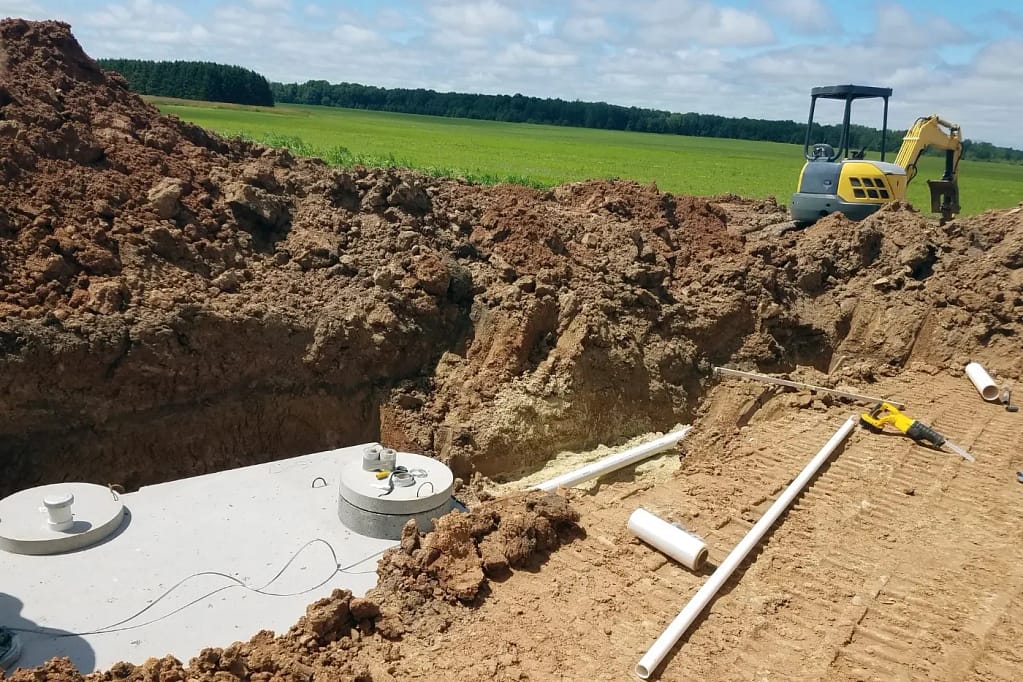
A concrete septic tank on an Alberta acreage needs a pump-out roughly every 3 to 5 years, before accumulated sludge reaches about one-third of the tank’s depth. The single most important habit is protecting the treatment field: keep grease, chemicals, and non-flushables out of the system, and keep vehicles and heavy loads off the field. Do both, and the system lasts decades.
If your property has no municipal sewer main at the property line, your wastewater is handled on-site. That is the reality for most acreages around Rocky View, Foothills, Springbank, Bearspaw, De Winton, and Bragg Creek. A septic system is not a maintenance-free appliance, but it is close, provided you understand two things: the tank, and the treatment field. This guide walks through both, in the order they matter.
1. Know What You Own Before You Maintain It
A typical private sewage system has two working parts. The tank receives everything from the house, holds it, and lets solids settle to the bottom as sludge while grease and lighter material float to the top as scum. Bacteria break down a portion, and the clarified liquid in the middle flows out to the treatment field, where soil finishes the job.
Prefabricated concrete tanks are certified to CSA B66, the standard for prefabricated septic and holding tanks. Concrete is the material of choice on acreages for one physical reason: mass. When soils saturate in spring or the water table rises, a lightweight poly or fibreglass tank can float and shift, breaking connections. A concrete tank stays put because it is heavy. The honest trade-off is that same weight at install: a concrete tank needs crane or boom-truck placement and reasonable site access. In high-water-table conditions, that trade is worth making.
Choosing the right tank is the first maintenance decision. If you’re building a new acreage system or replacing an aging tank, the material, certification, capacity, and installation requirements matter far more than the finish or colour. Read our guide to precast septic tanks for an acreage: 3 specs that matter more than colour to see what to check before ordering.
2. Pump the Tank on Schedule, Not on Surprise
Pumping removes the settled sludge and floating scum the bacteria cannot digest. Skip it, and solids eventually carry over into the treatment field, which is the expensive part to replace.
- Typical interval: every 3 to 5 years. Large households or smaller tanks lean toward the shorter end.
- Heavier use: every 2 to 3 years. A full house year-round moves more water and solids.
- The real trigger is depth, not the calendar. Pump before sludge reaches roughly one-third of the tank’s depth. A pumper can measure this for you.
- Budget roughly $300 to $500 per service (a market range; validate against current Calgary-area quotes, CAD). Access difficulty and tank size move the number.
Keep a simple record of each pump-out date and what the technician noted about sludge level. Two or three data points tell you your household’s true interval far better than any general rule.
3. Protect the Treatment Field: This Is the Whole Game
The tank can be pumped. The treatment field cannot be pumped clean, and replacing one is the costly failure most owners are trying to avoid. Everything below is about keeping the field working.
Keep this out of the system:
- Grease and cooking fats, which congeal and blind the field.
- Harsh chemicals, solvents, paint, and large volumes of bleach that kill the bacteria doing the work.
- “Flushable” wipes, feminine products, paper towel, dental floss, cat litter, and coffee grounds. Only human waste and toilet paper belong in the tank.
- Excess water in short bursts. Space out laundry loads rather than running six on a Saturday.
Keep this off the field:
- Vehicles, trailers, and equipment. Traffic compacts the soil and crushes the distribution piping.
- Heavy loads, sheds, decks, and hardscaping built over the field.
- Deep-rooted trees and shrubs, whose roots seek out and clog the lines.
A treatment field is a living filter. It fails from smothering (grease and solids), poisoning (chemicals), drowning (too much water), or crushing (traffic). Avoid those four, and it does its job quietly for decades.
4. Watch for the Early Warning Signs
Septic problems announce themselves before they become emergencies. Learn the signals and you can act while a pump-out still solves it.
| Warning sign | What it often means | What to do |
|---|---|---|
| Slow drains throughout the house | Tank may be full; solids nearing the outlet | Book a pump-out and inspection |
| Sewage or sulphur odours indoors or in the yard | Venting issue or a saturated field | Call a certified professional |
| Soggy, unusually green patches over the field | Effluent surfacing; field overloaded or failing | Stop adding water; call a pro promptly |
| Gurgling toilets or backups | Blockage or a tank at capacity | Do not force it; get it inspected |
| It has simply been 5+ years | Sludge likely past the one-third mark | Schedule a pump-out |
One slow drain is usually a household plumbing issue. Slow drains everywhere at once point to the tank. Odours plus wet spots over the field are the combination that warrants a call, not a wait.
5. Know When to Handle It and When to Call a Certified Pro
Owner tasks are the everyday habits: what goes down the drain, spacing water use, keeping traffic off the field, and booking pump-outs on schedule. You do not open, enter, or dig into a septic tank. The gases inside are dangerous, and the work is regulated.
Alberta private sewage work sits under the Alberta Private Sewage Systems Standard of Practice. A certified private-sewage designer or installer is required for the design, siting, and any repair or replacement, along with a site evaluation and permit. Call one when you see field symptoms, when you are planning any new build near the system, or when it is time to assess a system you inherited with the property. Sizing itself scales with the home’s bedroom count as a proxy for daily load, and the certified designer sets it from the Standard of Practice rather than a fixed formula.
For context, the baseline setbacks a designer confirms (your county may be stricter): the tank sits at least 3 m from buildings and 1.5 m from the property line; the treatment field at least 5 m and 3 m respectively; and a water well at least 30 m from the tank and 90 m from the field. If your soils are high in sulphates, tanks are specified with Type HS cement to resist attack.
FAQ
How often should I pump my septic tank in Alberta? Every 3 to 5 years for most households, and every 2 to 3 years for large households or smaller tanks. The precise trigger is when sludge reaches about one-third of the tank’s depth, which a pumper can measure during service.
What does a septic pump-out cost near Calgary? Roughly $300 to $500 per service as a market range in CAD. Validate against current Calgary-area quotes, since tank size and site access affect the price. Treat it as routine maintenance, not an emergency expense.
Why is a concrete tank recommended over poly on an acreage? Mass. When soils saturate or the water table rises, a lightweight poly or fibreglass tank can float and shift. A concrete tank’s weight keeps it in place. The honest trade-off is a heavier install requiring crane placement and site access.
What should never go into a septic system? Grease and cooking fats, harsh chemicals and solvents, and non-flushables like wipes, paper towel, floss, and cat litter. Only human waste and toilet paper belong in the tank. These are the things that smother or poison the treatment field.
What are the signs my septic system is failing? Slow drains throughout the house, sewage or sulphur odours, and soggy or unusually green patches over the treatment field, especially in combination. Gurgling toilets and backups also point to a full tank or blockage. Call a certified professional when field symptoms appear.
Do I need a permit and a professional to install or repair a septic system? Yes. A site evaluation, a permit, and a certified private-sewage designer or installer are required under the Alberta Private Sewage Systems Standard of Practice. Owners handle daily care and scheduling; design, siting, and repair are regulated work.
Get a Quote or Ask a Question
Planning a new acreage build, replacing an aging tank, or want a concrete tank sized correctly the first time? Omega Precast supplies residential precast septic tanks certified to CSA B66 for properties with no municipal sewer. Reach out for fast scheduling and a straight answer on what your site needs.
Part of the vertically-integrated Omega Group. Omega Precast casts the tank at the yard; when your project also needs footings or a foundation, Omega 2000 Cribbing places and finishes the concrete, and Omega Ready Mix supplies the mix. For related reading, see our guide to residential precast steps and window wells.
Get the Right Septic Tank for Your Acreage
Planning a new septic system, replacing an aging tank, or buying an acreage with an existing system?
Omega Precast supplies CSA B66-certified residential precast concrete septic tanks designed for Alberta acreage applications. Concrete’s weight helps keep the tank stable in saturated soils and high-water-table conditions, while proper sizing and installation help protect the treatment field for the long term.
Tell us your property location, home size or bedroom count, and site-access conditions, and we’ll help you determine what tank size and installation approach to discuss with your certified private-sewage professional.
Contact Omega Precast for a septic tank quote or to discuss your acreage project.