
Last updated: August 7, 2026
For Alberta builds, precast concrete offers fire resistance, durability, thermal mass, and low maintenance, while steel framing is lighter and fast for long spans. Precast often wins on lifecycle cost, sound, and durability; steel suits certain industrial geometries. The best choice depends on structure type, budget, and performance goals.
Staring at plans for a new industrial building near Airport Road or a multi-family project in East Village? Choosing between precast concrete and steel framing is one of the biggest structural decisions you’ll make. It’s a debate about upfront budget versus long-term resilience right here in Alberta’s demanding climate. This guide cuts through the noise, comparing real costs, durability against our freeze-thaw cycles, and what each system means for your Calgary project timeline. We’ll ground the theory in local reality, referencing insights from Calgary’s own OmegaPrecast, to help you invest wisely.
Introduction to Precast Concrete and Steel Framing
Before we dive into costs and durability charts, let’s clarify what we’re actually comparing. Both systems are modern, engineered solutions for building frames, but they come from entirely different philosophies. Understanding their core nature is key to seeing why one might be better for a Deer Run warehouse than for a downtown office tower.
It’s not just about picking a material. You’re choosing a construction process, a supply chain, and a long-term performance profile for your asset. Getting this foundation right affects everything from your financing schedule to maintenance budgets a decade from now.
What is Precast Concrete?
Precast concrete involves casting structural elements—like walls, columns, beams, and double tees—in a controlled factory environment. These pieces are then trucked to the site and assembled with cranes, like a giant, ultra-strong Lego set. The concrete is cured under ideal conditions, resulting in exceptionally high and consistent strength.
Think of it as bringing a finished, hardened component to your site, rather than pouring a wet mix that needs time and weather cooperation to gain strength. This method is a staple for fast-track commercial projects across Alberta, from distribution centres in Balzac to school additions in established communities.
What is Steel Framing?
Steel framing uses fabricated steel sections—I-beams, columns, and joists—that are bolted or welded together on-site to create the building’s skeleton. It’s known for its high strength-to-weight ratio, allowing for long spans and open floor plans. The framework goes up quickly, but it then requires additional systems for walls, floors, and fireproofing.
In Calgary, you see steel’s signature in clear-span structures like airplane hangars, recreational facilities, and the flexible office spaces popping up in Quarry Park. Its appeal lies in design adaptability and speed of initial erection.
Cost Comparison
“How much will it cost?” is always the first question. With these two systems, the answer is famously “it depends,” but we can break down the dependencies clearly. The initial sticker price is only one part of the story; the true cost picture includes speed, long-term upkeep, and how Alberta’s unique factors tilt the scales.
Key takeaway: The cheaper system at the quote stage isn’t always the cheaper system over the building’s lifetime.
Initial Construction Costs
For basic structural shells, steel framing often has a lower initial material cost per tonne than precast concrete. However, this direct comparison is misleading. You must factor in all associated costs: fireproofing for steel, insulation for precast, and the different foundation requirements.
Steel is lighter, which can mean less expensive foundations. Precast elements are heavier, sometimes requiring more robust foundation work. When you add up the complete structural package—materials, fabrication, and installation—the initial costs for mid-rise commercial buildings in Alberta are frequently within 10-15% of each other, with local market fluctuations playing a big role.
Long-Term Cost Savings and ROI
This is where the narrative shifts. Precast concrete begins to pull ahead on total cost of ownership due to its inherent durability and minimal maintenance. Its thermal mass can significantly reduce heating and cooling costs in Alberta’s climate, a saving that compounds yearly.
Steel structures require ongoing investment in corrosion protection, especially near Calgary’s roads where winter de-icing salts are prevalent. While modern coatings are excellent, they have a finite service life and represent a future capital expenditure that precast concrete largely avoids.
Cost Differences by Structural Elements
The cost advantage swings based on what you’re building. For long-span, column-free spaces like a warehouse, steel’s efficiency often makes it the lower-cost choice. For structures requiring many repetitive elements, like a multi-level parking garage or an apartment building, precast’s speed of erection and integrated finishes can be more economical.
Precast walls often arrive with finished exterior surfaces (brick, stone, or architectural finishes), eliminating a separate trades sequence. In a steel building, you still need to add cladding, which adds time, labour, and another layer of cost coordination.
Impact of Regional Factors in Alberta (e.g., Winter Construction)
Alberta’s short construction season and harsh winters add a major cost variable. Winter concreting on-site is expensive and risky, requiring heated enclosures and special mixes. Since precast is manufactured indoors year-round, it largely eliminates winter premiums for the superstructure.
Steel erection can continue in cold weather, but productivity drops, and worker safety concerns increase. Furthermore, fluctuating regional demand for steel can cause volatile material pricing and availability, a factor that a local precast provider like OmegaPrecast helps mitigate through scheduled production.
Durability and Strength
Durability isn’t an abstract concept in Alberta; it’s about surviving 30°C summer days followed by -30°C winter nights, moisture, and corrosive environments. Both materials are strong, but they defend against time and the elements in fundamentally different ways.
You’re not just building for today’s occupancy permit. You’re building for decades of reliable service with minimal intervention, protecting your investment long after the construction loan is paid off.
Strength and Load-Bearing Capacity
Both materials offer exceptional strength. Precast concrete excels in compressive strength—it’s fantastic at handling heavy, constant loads like those in a storage facility. Its mass also provides superior resistance to vibration and impact.
Steel’s advantage is its tensile strength and ductility. It can bend without breaking, which is a critical safety feature in seismic design. For buildings where dynamic loads or extreme flexibility are concerns, steel is often the engineered choice. For most commercial and industrial applications in Calgary, both systems are more than strong enough when designed correctly.
Resistance to Weathering, Rust, and Corrosion
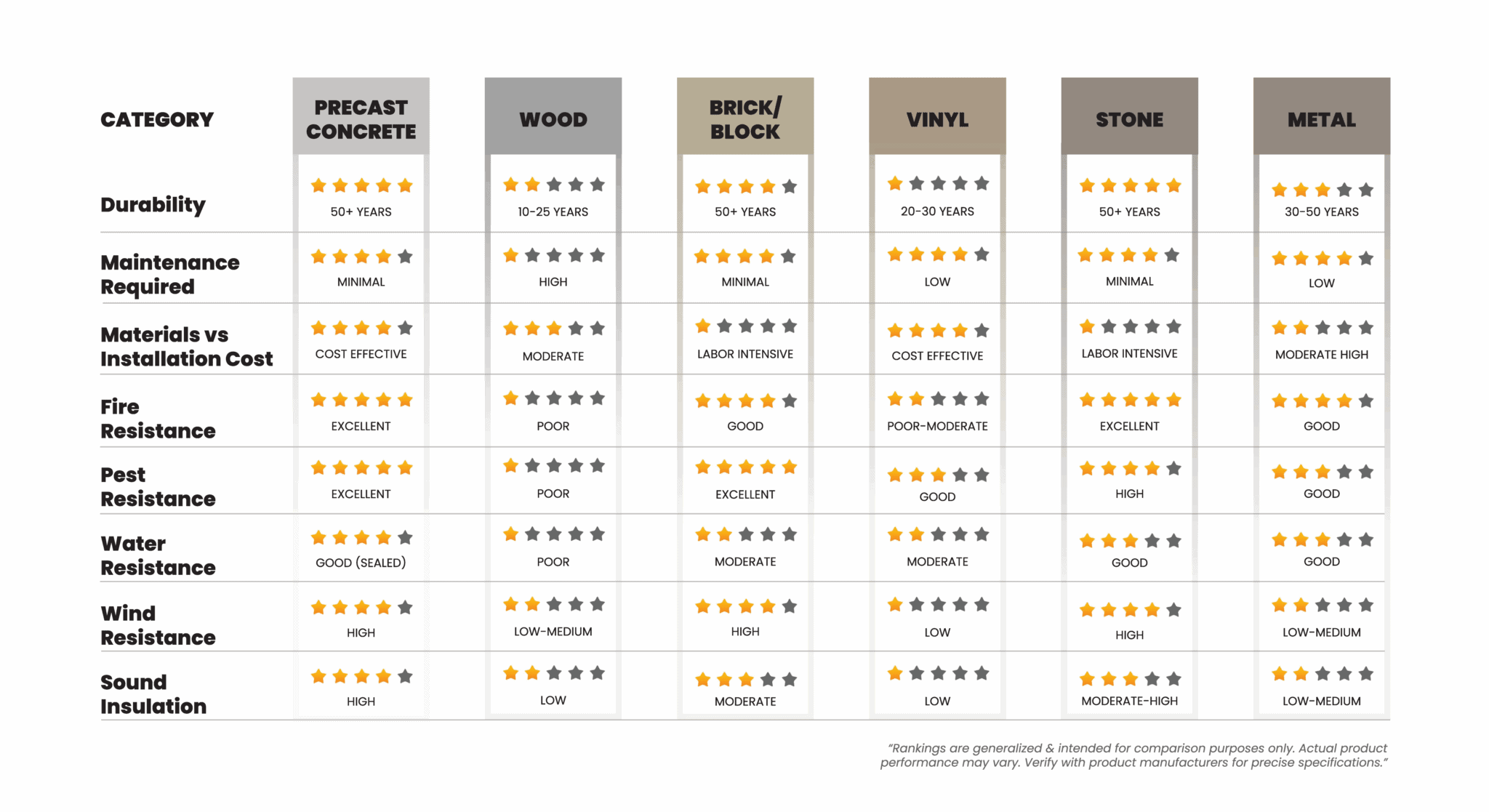
This is a decisive category. Precast concrete is inherently fireproof and, with proper mix design and cover, highly resistant to corrosion from moisture and chlorides. It won’t rust, rot, or combust. This makes it ideal for parking structures, water treatment plants, or agricultural buildings exposed to moisture and chemicals.
Steel must be protected. Galvanizing and high-quality paint systems are effective, but they are a coating on the substrate. If that coating is scratched or compromised during construction or maintenance, the steel beneath can begin to corrode. In Calgary’s freeze-thaw cycle, water ingress into tiny gaps can accelerate this process.
Maintenance Requirements
Precast concrete is largely maintenance-free for the structural frame. Occasional sealing of joints may be required, but the concrete itself does not need painting or protective re-coating. This translates to lower operational costs and less building downtime.
A steel frame requires a planned maintenance schedule to inspect and renew protective coatings over its lifespan. In aggressive environments (like a road salt storage building or a coastal area), this maintenance is not just recommended; it’s essential for structural longevity.
Bold takeaway: Precast concrete offers a passive, inherent durability that steel achieves through active, ongoing maintenance programs.

Construction Speed and Timeline
Time is money, especially when carrying construction financing or needing a revenue-generating asset operational by a specific date. The speed story here is about *when* in the timeline you gain time, not just the total days on site.
Erection and Assembly Time
Steel erection is famously fast. The skeleton of a building can rise in a matter of days or weeks. However, this is just the first act. Once the steel is up, the subsequent trades—decking, concrete floors, cladding, fireproofing—must follow, which adds sequential time.
Precast erection is also rapid. Large wall and floor panels are set in place by crane, and the building enclosure happens almost simultaneously with the structure going up. This “fast-forward” through the early enclosure phase is a critical schedule advantage.
Offsite Prefabrication Benefits
This is the core of precast’s schedule reliability. While the site is being prepared and foundations poured, the precast components are being manufactured concurrently in a factory, unaffected by rain, snow, or cold. This parallel path can shave weeks or even months off the overall project timeline.
Steel is also fabricated off-site, but the on-site assembly sequence and dependency on weather for follow-on work (like pouring concrete slabs on metal deck) don’t offer the same level of parallel tasking and weather protection.
Onsite Construction Efficiency
With precast, a single trade delivers the structure and often the building envelope. This reduces coordination complexity, on-site labour congestion, and the risk of delays due to trade sequencing conflicts. It creates a cleaner, more efficient site.
Steel requires tight coordination between erectors, decking crews, concrete placers, and cladding installers. Any delay in one trade ripples through the schedule. For projects in dense urban areas like Bridgeland, where site space is limited, precast’s efficiency can be a major logistical benefit.
Advantages of Precast Concrete
Faster Project Completion
As noted, the combination of offsite fabrication and rapid enclosure leads to earlier weathertightness. This allows interior trades (mechanical, electrical, drywall) to start work sooner, accelerating the entire project path to completion and occupancy. For a developer, this means earlier rental income or sale.
Cost-Effectiveness Over Time
The lower lifetime maintenance, energy savings from thermal mass, and superior durability make precast a financially wise long-term investment. You pay a slight potential premium upfront to buy down decades of operational expenses and capital renewals.
Sustainability and Environmental Benefits
Precast concrete has a high recycled content (fly ash, slag), and its thermal mass reduces energy consumption. At end-of-life, concrete can be crushed and recycled as aggregate for road base. The controlled factory production also minimizes material waste compared to on-site casting.
For a permanent, low-maintenance asset, precast concrete is hard to beat on total lifecycle value.
Advantages of Steel Framing
Lighter Weight and Design Flexibility
Steel’s strength allows for longer spans without intermediate columns, creating vast, flexible interior spaces. This is perfect for arenas, large retail spaces, or buildings where future interior reconfiguration is anticipated. Its lighter weight also makes it advantageous for rooftop additions on existing structures.
Shorter Overall Build Durations
For certain project types, particularly simpler, single-story warehouses, the speed of steel erection can lead to a shorter total construction period. When the design is finalized late or changes are expected, steel fabrication can sometimes adapt more quickly in the later stages.
Embodied Carbon Reduction
Modern steel is highly recycled and recyclable. While the initial production is energy-intensive, using recycled steel significantly reduces its embodied carbon footprint. At end-of-life, a steel frame can be efficiently disassembled and the material recycled anew, supporting a circular economy model.
Disadvantages and Challenges
No system is perfect. An honest assessment requires looking at the potential downsides, so you can plan for them or decide they are deal-breakers for your specific project.
Precast Concrete Drawbacks
The primary challenge is lead time and early design commitment. Precise engineering and shop drawings must be completed well before production starts, locking in design decisions earlier than with steel. Transportation logistics for large panels also require careful route planning, especially for sites with tight access in older Calgary neighbourhoods.
Modifications on-site are extremely difficult. If a component doesn’t fit or a last-minute design change is required, it’s a major issue, as a new piece must be cast in the plant.
Steel Framing Drawbacks
The main long-term challenge is corrosion protection and fireproofing. Steel loses strength rapidly in a fire, so it must be protected with spray-applied fireproofing or encasement, adding cost and complexity. In corrosive environments, the maintenance liability is a permanent consideration.
Steel can also be susceptible to buckling under extreme heat and requires careful detailing to manage thermal expansion and contraction, which can be pronounced in our climate.
Alberta-Specific Considerations
National data is useful, but your building isn’t going in a generic location. It’s going in Alberta, with our unique soil, climate, and market. These local factors should heavily influence your decision.
Climate and Winter Construction Impacts
Alberta’s freeze-thaw cycles are brutal on building materials. Precast concrete, when designed with proper air-entrainment and low water-cement ratios, is engineered to withstand these cycles with minimal damage. Steel’s vulnerability is not to freezing, but to the moisture and corrosive salts that accompany our winters.
The ability to manufacture precast indoors, regardless of whether it’s -30°C outside in Sundance, provides a massive schedule certainty that is highly valued by Alberta developers needing to meet strict completion dates.
Local Material Costs and Availability
Steel is a globally traded commodity. Its price can be volatile, subject to international tariffs, trade policies, and demand surges. This can introduce budget uncertainty for projects with long lead times.
Precast concrete relies on locally sourced aggregates and cement, insulating it from some global market swings. Working with a local producer like OmegaPrecast also ensures supply chain accountability and reduces transportation costs and carbon from long-distance shipping.
Building in Alberta means planning for our reality; the right material choice embraces that reality as a strength.
Case Studies and Comparative Analysis
Let’s move from theory to applied practice. How do these comparisons play out in real Alberta projects? While every project is unique, patterns emerge that are highly instructive.
Real-World Cost Summaries
A recent comparative analysis for a 50,000 sq ft warehouse in the Calgary region showed the total installed cost of a precast system was approximately 8% higher than a basic steel building system at tender. However, the precast model included a finished, insulated wall system, whereas the steel quote required separate cladding and insulation.
When equivalent finishes were priced, the cost gap closed to under 3%. Factoring in a 2-month earlier completion date (due to winter construction) with precast, the financing savings and earlier revenue made the precast option the lower net-present-cost option.
Performance in Residential and Commercial Projects
For multi-family residential projects, precast concrete party floors and walls provide superior sound and fire separation, a major selling point for condos and apartments. This integrated performance is a value-add that steel-framed buildings must achieve with additional, layered assemblies.
In commercial office buildings, steel allows for easier future modifications for mechanical services and tenant improvements. For spec buildings where maximum tenant flexibility is the prime goal, this can be a deciding factor.
Which is Better for Your Project?
So, who wins? The answer, frustratingly and accurately, is: it depends on your priorities. But we can make that dependency crystal clear so you can decide with confidence.
Factors to Consider for Decision-Making
Ask yourself these key questions. Is your top priority the lowest possible initial cost, or the lowest lifetime cost? How critical is an accelerated, weather-independent schedule? Is the building in a highly corrosive environment (e.g., near a water feature or industrial area)?
For long-term holdings like municipal buildings, schools, or your own corporate headquarters where you’ll be the owner-operator for decades, the durability and low maintenance of precast concrete typically delivers superior value. For speculative warehousing or buildings where you plan to sell within 10 years, the lower upfront cost of steel might align better with your investment model.
FAQ
Let’s tackle some of the most common questions we hear from Alberta contractors and developers weighing this exact choice.
Which is more expensive, steel or precast concrete?
For the basic structural skeleton, steel is often less expensive. For the complete building envelope delivered to a weathertight state, the costs are frequently very close, within a 5-15% range in Alberta. The true expense gap emerges over time, with precast’s minimal maintenance often making it the more cost-effective choice over a 30-year lifespan.
Always compare bids that are for equivalent scopes—a precast bid with finished walls versus a steel bid with just the frame and decking is not an apples-to-apples comparison.
How does Alberta’s winter affect the choice between steel and precast?
Winter heavily favours precast concrete for schedule reliability. Precast manufacturing happens indoors year-round, so your superstructure isn’t delayed by cold snaps. Steel can be erected in winter, but productivity drops, and critical follow-on work like pouring concrete slabs becomes expensive and complex, often requiring heated enclosures.
If your project must break ground in the fall, precast offers a much more predictable path to spring completion.
Is steel or concrete better for seismic zones?
Both can be designed for seismic resistance. Steel’s ductility—its ability to bend and deform without sudden failure—is a natural advantage in earthquake engineering. Modern precast concrete systems use special ductile connections to achieve similar performance.
For high seismic zones, the choice becomes more nuanced and depends on the specific structural engineering solution. In Calgary’s seismic region, both systems are perfectly capable when designed by a qualified engineer.
Can you combine steel and precast concrete in one building?
Absolutely. Hybrid systems are common and can be highly efficient. A typical example is using a steel frame for the long-span areas (like a gymnasium or atrium) and precast concrete for the repetitive, enclosed areas (like office wings or hotel rooms).
This lets you leverage the strengths of each material where they matter most. Discussing a hybrid approach with your structural engineer and a local expert like OmegaPrecast can often yield an optimized, cost-effective design.
Our Verdict
| Factor | Precast Concrete | Steel Framing |
|---|---|---|
| Cost | Higher initial, lower lifetime | Lower initial, higher lifetime (maintenance) |
| Durability | Exceptional; passive resistance | High; requires active protection |
| Best For | Long-term holdings, fast schedules, harsh environments | Spec builds, maximum span/design flexibility, quick skeleton |
| Calgary Climate Suitability | Excellent (immune to freeze-thaw in factory, low maintenance) | Good (but vulnerable to corrosion from moisture/salts) |
| Maintenance Required | Very Low | Moderate to High (coatings, fireproofing) |
The head-to-head comparison reveals a clear pattern. For the majority of commercial, industrial, and multi-family projects in Alberta where the owner plans to hold the asset, precast concrete is the superior choice. Its combination of schedule certainty, inherent durability against our climate, and low lifetime cost delivers the best return on investment.
Steel framing remains a fantastic solution for projects where ultimate design flexibility, very long spans, or a fast initial frame are the undisputed top priorities. For a warehouse you might sell in five years, it’s a solid option.
Ready to see how precast concrete can bring schedule certainty and lasting value to your next Calgary project? The team at OmegaPrecast brings local expertise to every drawing, helping you navigate this critical decision with confidence. Reach out for a project-specific analysis today.