
Last updated: August 5, 2026
On install day, an Omega Precast foundation goes in fast: finished precast walls arrive by truck, a crane lifts each panel onto the prepared footing, crews align and brace them, then connections are secured and joints sealed. A typical home foundation is set in hours rather than days, weather permitting.
The single most common question we get from a homeowner whose builder has scheduled precast walls — even from owner-builders running the project themselves — is some version of this one.
“What does the day actually look like?”
The marketing language says “set in a day”. That is technically true and meaningfully incomplete. A crane day on a Calgary precast foundation has a beginning, a middle, and an end. There is staging the day before. There is a weather check the morning of. There is a delivery sequence that has to be right. There is a brace cycle that happens overnight. There is a joint-sealing pass that closes the wall before backfill. There are weather thresholds that will stop the work if you cross them — sustained wind above roughly 24 to 30 km/h shuts down most precast wall lifts in this city, regardless of season.
If you are about to schedule your foundation pour with us, or you are a builder running a precast crew for the first time, the rest of this is for you. This is the honest walk-through that we do on the phone with every new client before their day on the calendar.

The week before: what we are doing while you are sleeping
You will not see most of the work that goes into a smooth crane day. Most of it happens at our plant in Calgary in the weeks before the panels ship.
The build sequence at the plant looks like this:
- Your project’s shop drawings — stamped by a P.Eng. licensed in Alberta — go to the form crew. Each panel is custom to the project. Every door opening, window opening, beam pocket, service penetration, and embedded lift point is drawn before any steel is tied.
- Reinforcement (rebar and where applicable welded wire mesh) is tied into the form, with the embedded plates that will receive the welded-plate connections on site and the cast-in inserts that will receive the bracing.
- The plant pours your project’s panels using a 35 MPa high-strength concrete mix at the 56-day spec point per CSA A23.1:24, with the discharge timed to the 2-hour CSA A23.1 discharge limit (with the 90-minute retest protocol when the load runs long).
- Panels cure in factory conditions under controlled humidity and temperature. Once compressive strength is verified, panels are stored vertically on dunnage and moved to the loading bay.
- A pre-ship inspection runs every panel against the shop drawing. Hairline shrinkage cracks (cosmetic, within tolerance, structurally inconsequential) are noted. Anything outside tolerance is repaired per ACI/PCI protocols at the plant — or, if structurally significant, the panel is remanufactured. Panels with structural defects do not leave the plant.
- The dispatch desk locks in the truck schedule, the crane schedule, the install crew, and the site logistics with the builder and our site lead.
By the time the trucks pull out of our yard, the wall is already cured, already verified, already engineered into position on the page. The crane day is the visible portion of work that started weeks ago.
The day before: site staging and the weather call
Twenty-four hours before crane day, two things happen in parallel.
At the site, the builder or the GC’s site super confirms:
- Footings are poured, cured, and at specified strength.
- Top of footing is clean, level within tolerance, and the layout lines are crisp.
- Access route is clear for the trucks and the crane. Overhead utility clearances are confirmed. (Wires above the swing path are the single most common reason a crane day gets paused.)
- Staging area is ready for panel offload. Typically a flat, stable, level pad adjacent to the foundation, sized to receive the A-frame trailers and allow the crane to walk between trailer and footing.
- Any neighbouring buildings, fences, or trees on tight infill lots are identified and clearance is verified.
- The site super has the panel placement plan and the panel sequence from us.
At our plant, our dispatch lead and our install crew lead are doing the morning-of weather check on tomorrow’s forecast — wind speed, gust forecast, precipitation, and ambient temperature. If the forecast is borderline, we make the call by end of day. We will reschedule a crane day rather than fight wind we shouldn’t be lifting in. The cost of a re-schedule is a fraction of the cost of an incident.
The wind threshold is real. Crane lifts on residential precast panels are typically halted when sustained winds exceed roughly 24 to 30 km/h. Gusts above that range — even if average wind is lower — will pause the lift. This isn’t a marketing-soft “safety first” line. The panels are large, the swing radius is significant, and wind on a vertical panel hung from a crane is an unstable load. We do not lift in wind.
The cold itself rarely stops us. Calgary’s cold-weather concrete trigger lands at September 30 — after which any cast-in-place pour has to use cold-weather concreting protocols — but our panels are already cured before they hit your site. We can set in October, November, December, February. Wind is the variable, not temperature.
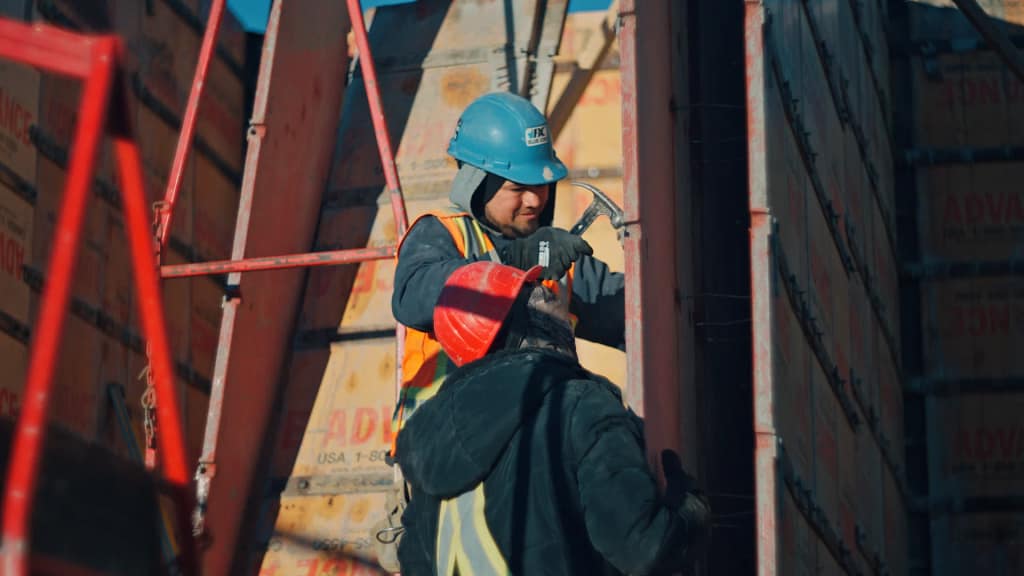
Crane day morning: arrival, setup, and the toolbox talk
A typical residential install crew on a precast foundation:
- A site lead from our team.
- Two install hands: one running the rigging and the corner connections, one running the brace cycle and the laser-level pass.
- The crane operator and a swamper.
- The truck driver(s) bringing panels in.
That is four to five people on site, plus the crane. Compared to the eight to twelve people you would see on a cast-in-place residential wall (formwork crew, pour crew, finisher, vibration crew, stripping crew over multiple days), a precast crew is small and tight.
Setup runs in this order:
- The crane sites on its set-up pad. A standard residential job uses a hydraulic boom crane in the 30 to 70-ton class depending on panel weight and reach. Pad stability is checked. Outriggers go down. The boom extends.
- The first trailer of panels backs into the staging position. A-frame transport racks hold the panels vertically at a slight angle, secured at the top with chains or straps.
- The install crew runs a toolbox talk — typically five to ten minutes — covering the lift sequence, the swing path, the brace cycle, the wind threshold, the panel-by-panel placement, and any project-specific call-outs.
- The site lead and the crane operator agree on the hand signals or radio call-outs.
By mid-morning of crane day on a smooth project, the first panel is hooked.
Setting the panels: how the wall actually goes up
This is the part that, if you are the homeowner, you will probably want to watch. It is satisfying.
The panel comes off the truck on the cast-in lift inserts engineered for the panel’s weight and geometry. The crane operator brings it slowly into position above the footing.
The install crew is in two places. One pair is at the panel as it lowers, hands on the panel guides, walking it the last few inches into final position on the footing. The other pair is at the adjacent panel (if this is panel number two or later in the sequence), ready to receive the joint.
The panel is set on engineered shims at the footing-to-panel connection. It is held by the crane while the install crew runs the laser to check plumb, level, and square. If the panel needs nudging, it gets nudged.
When plumb is verified, adjustable steel braces are bolted to the panel and anchored to the slab or footing. Braces are typically positioned on the interior side at corners and at intermediate locations along long panels. The braces hold the panel against wind and incidental load until the welded-plate connections to adjacent panels are complete.
The crane releases the lift point. The crew moves to the joint.
At every panel-to-panel joint, the welded plate connections are made. Steel embed plates that were cast into the panel at the plant align across the joint; a loose plate sits between them; the crew welds the assembly with appropriate weld procedures. At corners, the geometry locks the perimeter into a continuous structural diaphragm.
The joint between panels is then sealed with a triple-bead high-performance polyurethane joint sealant, with backer rod where the joint width requires it. The wall is now structurally locked and beginning to weatherproof.
The crane swings back to the next panel. The cycle repeats.
For a standard single-family rectangular foundation, the panel count is typically between 8 and 16 wall panels depending on size and complexity. The full wall set, brace, and joint pass usually completes within the working day. For a walk-out lot with stepped grade and more complex geometry, the count rises and the day stretches; for a larger multi-family row with repeated identical panels (which our plant is well-set-up for), the per-panel rhythm gets fast.
What happens overnight: the brace cycle
When the crane leaves at end of day, the wall is standing on its footings, locked at corners and joints, and held vertical by adjustable steel braces.
Overnight is when the bracing does its work. The joint sealant cures (typical polyurethane sealant in Alberta conditions reaches a skin-over time within hours and structural cure within 24 hours). The welded connections settle. The system as a whole moves from “set today” to “ready for the next phase”.
This is also the period during which the site lead checks the site one more time before leaving. Braces are confirmed. Joint coverage is confirmed. The waterproofing crew is scheduled for the next morning if they aren’t already on standby.
If the next day’s weather is going to be ugly, the wall is fine. Snow on a braced precast wall is a non-event. Rain is a non-event. The wall is in its design configuration; the only thing remaining is the exterior waterproofing pass and the backfill.
Day two: waterproofing and the backfill prep
The day after the wall is set, two things happen.
Exterior waterproofing. Calgary’s clay soil is unkind to foundation walls (expansion, shrinkage, freeze-thaw cycling, hydrostatic pressure on lower elevations of the lot), and the only durable answer is an engineered waterproofing assembly on the exterior face. The waterproofing crew applies the membrane system specified for the project — typically a sprayed or rolled polymer-modified membrane or a self-adhered sheet membrane, depending on the spec — over the entire below-grade exterior face of the wall and continuing onto the footing per the detail.
A drainage course is installed over the membrane to protect it during backfill: typically a dimpled drainage board, often with a filter fabric on the soil side, and a perforated weeping tile at the footing tied into the storm system or sump.
This step is non-negotiable for Calgary. Neither precast nor poured nor ICF foundations are exempt from it. Our parent Omega 2000 Cribbing crew has been running this same waterproofing discipline on Calgary cast-in-place residential foundations since 1988; the manufacturing of the wall has moved indoors but the soil has not.
Backfill readiness. Once the waterproofing has skinned over (typical timing is hours, not days, depending on the membrane), the backfill crew can come in. Compaction lifts go in on the spec, the protection board stays in place to prevent membrane damage during equipment passes, and the site is graded to the design drainage.
The braces stay on through this phase until the wall is fully backfilled and the framing crew is ready to start. Removing the braces too early on a partially backfilled wall is the kind of mistake good site supers don’t make.
What can go wrong, and what we do about it
We are honest with new clients about the failure modes. They are rare on a properly run project and they are real on a poorly run one.
Wind delay. As above. A windy week can push your set by one to three days. We re-schedule rather than fight it. Our parent ready-mix plant has the same protocol: discharge windows are real, and so are wind thresholds.
Footing-out-of-tolerance. If the footing was poured outside the tolerance the panel was engineered for, we either shim the panel to true and re-engineer the connection, or — in rare cases — pause the set and have the footing remediated before continuing. This is why the day-before site walk matters.
Transport damage to a panel. The most common cause of cosmetic damage to a precast panel is improper support during transport. Panels are engineered to be transported vertically on A-frame racks; flat transport subjects them to bending loads they aren’t designed for. Our trucking protocol — and the rigging protocol used by every reputable precast hauler in Alberta — uses vertical A-frame transport with secured straps. If a panel arrives with a chip or a hairline crack outside tolerance, we will repair in place per ACI / PCI protocols if structurally acceptable, or we will not install that panel and the next truck will bring a replacement. Our quality program does not let a damaged panel into your foundation.
Crane access surprises. Tight infill lots in Calgary’s mature inner-city neighbourhoods sometimes present access constraints that weren’t obvious on the satellite photo: low utility wires, narrow lane access, soft ground in the staging area. We do a site visit before we quote on tight infill projects for exactly this reason.
Cold-weather logistics. Below roughly -25 °C, the polyurethane sealant cure slows materially, and the crew working conditions become a safety concern. We have set walls in cold conditions and we will continue to. We will also re-schedule if a cold-snap-plus-wind day rolls in. Calgary’s January and February include both kinds of weeks.
The pattern across all of these: a precast install is a planned event with a small surface area for surprises. The discipline is upstream — at the plant, in the dispatch, on the site walk — and the install day is, on a properly-run project, almost boring. Boring is the goal.
The homeowner’s view: what to do, and what not to do
If you are a homeowner whose builder has scheduled an Omega Precast install, here is the short version of what to expect and what your role is.
Yes, you can come watch. Crane days are visually impressive. If you ask your builder for the timing, most are happy to have you on site for the lift, especially the first few panels.
Stay clear of the swing path and the staging area. This is a high-load crane operation with steel rigging, large panels, and a small working footprint. The site lead will tell you where to stand. Stand there.
You do not need to be on site. Some homeowners want to watch every minute. Others come for an hour. Either is fine. The install crew works the same way regardless.
Bring a thermos in winter. This is Calgary. The wind chill is real even on a calm-wind day.
Take photos. It is the only day in your home’s life when the foundation is hanging from a crane.
A note on the crew and the Omega Group standard
Omega Precast is the newest brand in the Omega Group of companies — our plant launched in late 2025 — but the people on site are not new to Calgary residential foundation work. The install discipline carries forward from Omega 2000 Cribbing’s nearly four decades of Calgary residential cribbing experience (since 1988), and the concrete itself is supplied through Omega Ready Mix, the family’s batch plant that opened in 2023. When you book a precast install with us, you are working with the same family of crews and the same standard.
For a young brand, that continuity matters. The Calgary cribbing crew that built this plant already knew exactly which details Calgary clay punishes and which ones the National Building Code tolerates. The precast moved the manufacturing indoors. The standard hasn’t changed.
FAQ
How long does a typical install take? For a single-family rectangular foundation, the wall set itself usually takes one working day. Add a day for waterproofing and backfill prep. The wall is ready for framing within roughly 48 to 72 hours of crane day.
What is the wind threshold? Crane lifts on residential precast panels are typically halted when sustained winds exceed roughly 24 to 30 km/h. We make the call in real time based on the operator’s read of the site and the forecast.
Can you set in winter? Yes. The panels are already cured at our plant. The cold itself doesn’t stop the set; wind does, and so does extreme cold below roughly -25 °C if it stops the joint sealant from curing.
Do I need to be on site? No. Your builder will be on site. You can come watch the lift if you want.
What happens if a panel is damaged in transport? If the damage is cosmetic and within ACI/PCI repair tolerance, the panel is repaired in place at the plant before shipping or on site by our crew. If the damage is structurally significant, the panel does not install. A replacement panel is manufactured and the schedule is updated. Quality is not negotiated on the truck.
What about the joints — do they leak? Not when they are detailed and sealed properly. The triple-bead polyurethane sealant we use at every panel-to-panel joint, behind a properly applied exterior waterproofing membrane, is the same detail Alberta precasters have used for decades. Joint failures, where they occur, are detail failures (cheap sealant, wrong backer rod, skipped exterior membrane). They are not inherent to the system.
How much does the day cost compared to a poured wall? The per-day cost of the crane and crew is higher than the per-day cost of a forming crew on a cast-in-place wall. The schedule compression more than offsets it: typical residential precast foundations save 6 to 9 days on the project schedule vs cast-in-place, which translates to real money in financing, site overhead, and project management on every Calgary build.
Book your install
Planning a precast foundation in Calgary?
Talk to the Omega Precast team before your crane day is on the calendar. We’ll walk through your lot access, staging plan, weather contingencies, and install schedule with your builder or site super — before the trucks leave the yard.
📞 403-217-4888
✉️ info@omegaprecast.ca
From crane logistics to waterproofing and backfill prep, we’ll make sure your install day runs the way it should: safe, efficient, and ready for framing within days.
If you have a project coming up and you want to talk through the install logistics specifically — the lot access, the staging plan, the schedule fit, the weather contingency — call us.
We will tell you what your crane day looks like, where the friction points are, and what we need from your site super before the trucks leave the yard. Calgary residential foundation work is not a magic trick. It is a discipline. We have been running this discipline through Omega 2000 Cribbing since 1988, through Omega Ready Mix since 2023, and through Omega Precast since late 2025. Same family. Same standard. Same Calgary.
Citations and references:
- Canadian Precast Concrete Quality Assurance (CPCQA) — precastcertification.ca
- CSA A23.1:24 Concrete materials and methods of concrete construction
- CSA A23.4 Precast concrete — Materials and construction
- PCI MNL-116-21 Quality Control Manual for Plants and Production of Structural Precast Concrete Products
- National Precast Concrete Association (NPCA) — residential precast install timeline, panel transport best practices
- Concrete Alberta Cold Weather Concrete Practices technical bulletin
- City of Calgary Roads Specs cold-weather concrete cutoff (September 30)
- JLConline / Fine Homebuilding — precast foundation install field reports
Omega Precast is a sister brand of Omega 2000 Cribbing (Calgary, 1988) and Omega Ready Mix (Calgary, 2023). The Calgary precast plant launched in late 2025.