
Last updated: October 5, 2026
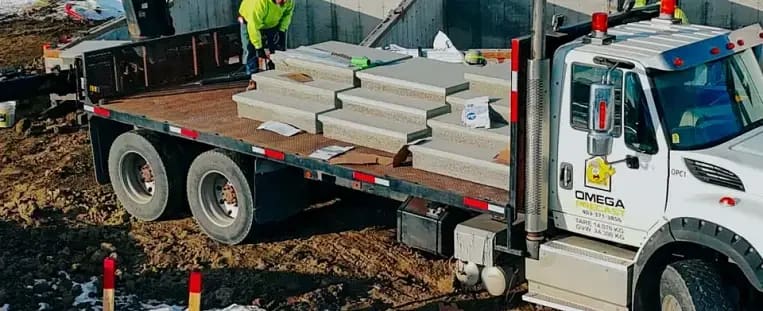
A precast unit wider than 2.6 metres cannot travel an Alberta highway on legal dimensions. It moves on an overdimensional permit. The permit is not a formality. It adds signs, lights, escort vehicles and blackout periods, and those conditions set your delivery window before the crane is ever booked.
This article covers dimension only. Weight is a separate permit, a separate calculation and a separate conversation. Height and length matter too, but width is the number that drives the convoy.
The legal envelope
These are the limits in the Commercial Vehicle Dimension and Weight Regulation. Exceed any one of them and you need a permit.
| Dimension | Legal maximum |
|---|---|
| Width | 2.6 metres |
| Height, measured from the road surface | 4.15 metres |
| Length, truck tractor and semi-trailer | 23 metres |
| Length, truck tractor with semi-trailer and full trailer | 26 metres |
The regulation is an office consolidation current as of April 1, 2025. Read the limits as hard numbers. The load counts, not the trailer. A unit sitting proud of the deck is measured where it is widest and where it is highest.
Two consequences follow from that, and both are routinely missed at the drawing stage.
The first is that trailer choice can move a unit across a threshold. A low-deck trailer buys height. It usually costs width, because the deck sits between the wheels rather than above them. A unit that clears legal height on one trailer can breach a width step on another.
The second is that projections count. Lifting loops, embed plates, bracing brackets and packing timbers are part of the measured dimension while they are on the load. A unit cast at 2.55 metres wide with hardware standing out on both faces is not a legal-width load. Strip what can be stripped, and declare what cannot.
Three widths change the job
Width does not escalate smoothly. It steps. Each step adds equipment, and two of the steps add vehicles and calendar restrictions.
| Load width | What the move requires |
|---|---|
| Over 2.6 metres | Flags by day. Warning lights at night or in adverse weather. |
| Over 3.05 metres | Add two dimensional signs, one front, one at the extreme rear. |
| Over 3.35 metres | Add one or more flashing lamps. |
| Over 3.85 metres | Add escort vehicles. No travel from 3 p.m. to midnight Friday or the day before a statutory holiday. No travel Sunday or a statutory holiday. |
The 3.85 metre line is the one that changes a schedule. Below it, a wide unit is a truck with flags. Above it, the move becomes a convoy with its own blackout calendar.
Escort counts then depend on the road.
| Load width | Two-lane highway | Multi-lane highway |
|---|---|---|
| Over 3.85 up to 4.45 metres | Pilot vehicle | No escort required |
| Over 4.45 up to 5.5 metres | Pilot and trail vehicle | Trail vehicle |
| Over 5.5 metres | Pilot and trail vehicle | Pilot and trail vehicle |
Read the table twice. A unit at 5 metres wide needs two escort vehicles on a two-lane road and one on a divided highway. The same unit, the same trailer, the same driver. The road decides.
That matters in practice. A rural site reached by secondary highway costs more escorts than an industrial lot off a divided arterial, for the identical piece.
What an escort actually has to do
Permit holders discover these rules late. They are in the regulation, not on the permit face.
- Two-way radio contact between the escort and the load must be maintained at all times.
- A pilot vehicle runs ahead at a distance of 300 to 1000 metres.
- A trail vehicle follows at a distance of 100 to 300 metres.
- An escort vehicle must not tow a trailer or carry a load that hides its own required equipment.
Each escort carries a minimum kit: three approved warning devices, three warning flags for traffic marking, one warning flag per crew member for flagging, one reflective vest per crew member, one flashlight per crew member.
Escorts are a labour line, not an equipment line. Two escort vehicles mean two drivers for the length of the haul, plus the dead time of returning them.
The spacing rules have a practical effect on routing. A pilot vehicle running well ahead of the load has to be able to see far enough forward to warn of an oncoming conflict and to stop traffic if it must. Tight curves, crested hills and short sight lines make that job harder, and a carrier may route around them rather than through them. The shortest route is not always the permitted one.
Length behaves differently from width. It rarely adds escorts, but it decides whether the trailer can physically reach the pour. A combination near the legal length limit needs swing room at every turn onto the site, and it needs somewhere to stop that is not a live lane. Residential infill lots and tight industrial yards are where long loads fail, and they fail at the last hundred metres rather than on the highway.
The hard ceiling is 7.3 metres
This is the number that kills designs, and almost nobody specifying precast knows it.
Alberta Transportation holds a policy that limits the width of new structures, tanks, buildings and modules moved on public roadways to 7.3 metres, or 24 feet. The notice is blunt about the consequence. Since October 1, 1998, the province has not permitted the movement of new units exceeding that dimension.
The City of Calgary applies the same 24-foot line to its own annual overdimensional permits, which is useful corroboration that the figure is live and not a historical artifact.
So the width question has three answers, not one.
| Unit width | Status |
|---|---|
| Up to 2.6 metres | Moves on legal dimensions |
| Over 2.6 up to 7.3 metres | Moves on an overdimensional permit, with escalating conditions |
| Over 7.3 metres | Not permitted as a new unit |
Design to the third row first. A tank, vault or panel drawn at 8 metres wide is not a difficult delivery. It is a unit that does not ship. The fix is upstream: split the element, change the orientation, or change the connection detail so two narrower pieces do the work of one wide one.
That is a drawing-stage decision. It is cheap in a drawing and expensive in a yard.
The ceiling also explains a pattern buyers notice without being told the reason. Standard product ranges cluster below certain widths. That is the transport envelope showing through the catalogue. A unit drawn to ship inside legal width moves on any day, on any road, with no escort and no blackout period.
Height, and the corridor built for it
Legal height is 4.15 metres from the road surface. Above that, overhead obstructions govern: power lines, telephone lines, bridges and sign structures.
Alberta built a route network for exactly this problem. The High Load Corridor is a set of designated highways where overhead utility lines have been raised to accommodate loads up to 9 metres high unless noted otherwise. Permit fees on the corridor recover the cost of raising those lines.
For precast this matters when units ship standing rather than flat. A tall wall panel laid flat is a width problem. The same panel upright is a height problem. Those are different permits, different routes and different costs, and the choice is usually made in the shop.
Tell us which way a unit can be shipped and which way it must be set. Sometimes the shipping orientation forces a different lifting arrangement, and that is better known before casting.
The indivisible load test
Not every oversize load gets a permit. The permit system exists to move commodities which are non-divisible, deemed impractical to divide, or uneconomical to transport at legal dimensions.
Precast passes that test easily, and that is a genuine advantage of the product. A monolithic tank cannot be cut in half for the highway and reassembled on site without becoming a different, weaker thing. A one-piece unit is indivisible by definition.
Cast-in-place has no permit problem because the material arrives in a drum. It pays for that convenience in formwork, cure time and weather exposure. Our comparison of precast against cast-in-place sets out that trade in full. The transport permit is one of the real costs on the precast side of the ledger. It is also one of the most predictable, which is why it belongs in the quote rather than in a change order.
How the permit is issued
Single-trip and multi-trip permits are issued by the province.
- Most permits are applied for through TRAVIS Web, either directly or through an accredited agent. Agents charge a service fee that varies.
- Not every permit type is available online. Some must go to the Central Permit Office.
- The Central Permit Office is reachable at 1-800-662-7138.
- Permit fees are set by regulation, not quoted case by case.
The permit attaches conditions beyond the regulation’s baseline. Routing, timing and seasonal constraints can all appear on the permit face. The carrier must follow the permit as well as the regulation. When the two differ, the permit governs the specific move.
Plan the lead time around the permit, not the casting. Casting schedules are ours to manage. Permit conditions and escort availability sit outside the yard.
What we need to quote a wide unit
Send these five items and a wide-load quote comes back with a delivery window attached rather than a disclaimer.
| Item | Why it decides the price |
|---|---|
| Finished unit width, height and length | Sets the permit tier and the escort count |
| Shipping orientation | Decides whether this is a width move or a height move |
| Delivery address and approach route | Two-lane or multi-lane changes the escort count |
| Required set date | Blackout periods remove Fridays after 3 p.m., Sundays and statutory holidays |
| Site access and crane position | Decides whether the trailer can be unloaded where it stops |
Quantities change the arithmetic. Several units on one permit tier move cheaper per piece than one unit on a higher tier. Tell us the full count and we will tell you where the tier breaks fall.
For products that routinely run wide, start with the precast septic tanks range, which is where the 24-foot policy language about tanks bites hardest. Narrower products such as precast stairs usually ship inside legal width and carry none of this.
Where this article stops
This covers getting the unit to the property line. It does not cover the lift.
Crane positioning, rigging, staging, bracing and connection sequence are a separate discipline with separate requirements, and they are set out in our guide to installing precast concrete panels. Site safety requirements for hoisting are governed by occupational health and safety rules, not by transport regulation.
Municipal road permits are also separate. A provincial permit covers provincial highways. Travel on city or county roads can require that municipality’s own approval, and the trailer has to satisfy both.
FAQ
How wide can a load be in Alberta without a permit? 2.6 metres. At 2.6 metres or less, and within the height and length limits, a precast load travels on legal dimensions with no permit.
At what width does a precast load need a pilot vehicle? Over 3.85 metres on a two-lane highway. On a multi-lane highway a trail vehicle is required over 3.85 metres and a pilot vehicle is added over 5.5 metres.
What is the widest precast unit that can be moved in Alberta? 7.3 metres, or 24 feet. Alberta Transportation policy does not permit the movement of new structures, tanks, buildings or modules wider than that, and has not since October 1, 1998.
Can an overdimensional load travel on a weekend? Loads over 3.85 metres wide cannot travel Sunday or a statutory holiday, and cannot travel from 3 p.m. to midnight on a Friday or the day before a statutory holiday. Saturday travel is not blocked by those rules.
How high can a load be before height becomes the problem? 4.15 metres is the legal limit from the road surface. The High Load Corridor accommodates loads up to 9 metres high on designated highways unless noted otherwise.
Who applies for the permit, the supplier or the buyer? The carrier moving the load holds the permit. Confirm in writing whose scope includes the permit and the escorts before the delivery date is promised, because that line is where wide-load budgets usually go wrong.
Does a provincial permit cover city streets? Not necessarily. Municipal roads can require separate municipal approval in addition to the provincial permit.
Need a wide unit delivered?
Send the drawing and the delivery address. We will confirm the permit tier, the escort requirement and a realistic set date, and we will flag any dimension that pushes the unit toward the 24-foot ceiling while it is still a drawing. Request a spec sheet, a shop drawing or a quantity quote and we will price the piece and the move together.
Sources
- Commercial Vehicle Dimension and Weight Regulation, AR 315/2002, Alberta King’s Printer office consolidation current as of April 1, 2025: https://kings-printer.alberta.ca/documents/regs/2002_315.pdf
- Government of Alberta, Commercial vehicle oversize and overweight permits: https://www.alberta.ca/commercial-vehicle-oversize-and-overweight-permits
- Alberta Transportation, Notice to Manufacturers of Oversized Commodities: https://open.alberta.ca/publications/notice-to-manufactures-transportation
- Government of Alberta, High Load Corridor: https://www.alberta.ca/high-load-corridor