
Last updated: October 14, 2026
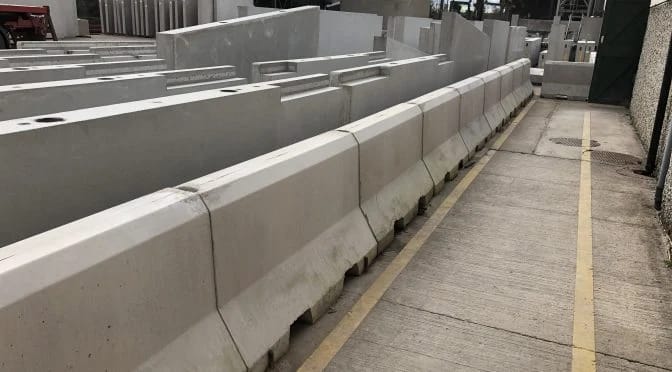
Alberta accepts two precast traffic barrier shapes. Both are rated TL-3. The number that changes most on a drawing is not the shape or the height — it is deflection, and deflection is decided by how the run is anchored, not by what the unit weighs.
This is the ordering guide. Shapes, heights, deflection, restrictions, the concrete spec, and what a plant needs from you to return a quantity price and a lead time.
The short answer: two shapes, one test level
Alberta’s Roadside Design Guide is direct about what is approved. Single Slope and F-Shape precast barriers are “the systems currently approved for use in Alberta” (H5.5.7). Both are treated as TL-3 systems (H5.3), and Table H5.12 applies TL-3 to all listed heights and shapes.
Precast barrier is primarily a work-zone system. The guide describes it as a “movable, segmented, barrier system” used most commonly in work zones to protect motorists and workers (H5.1). It is also permitted as a permanent roadside or median barrier — but conditionally, “if designed and maintained appropriately” (H5.1).
The permanent case has a stated logic. The guide points to precast where a TL-3 barrier is acceptable and the barrier will need to move again soon: anticipated construction within the next few years, a median crossover, a lane shift (H5.5.7). Permanent precast is a scheduling decision, not a cost shortcut.
Height, length, and the base under the run
Table H5.14 sets the installation geometry.
| Item | Alberta requirement |
| Installation height, top of barrier | 810 mm |
| Design tolerance on installation height | No restriction |
| Minimum run length | 45 m |
| Placement | Flat shoulders, or slopes 10:1 or flatter |
| Approved shapes | Single Slope, F-Shape |
| Test level | TL-3 |
The 45 m minimum is the line that catches short installations. A 20 m screen of barrier across a hazard is not a barrier system under this table; it is an obstacle with a crash-tested joint detail. Lengthen the run or choose a different system.
Bedding comes from the construction specification rather than the design guide. Specification 4.2 requires a compacted gravel or sand bedding of at least 50 mm (4.2.4.2), and precast sections “shall be placed on a prepared base, to the line and grade specified” (4.2.4.10). Barrier is measured and paid along its length, in linear metres to the nearest 0.1 metre (4.2.6.4.2) — which is also the unit to quote in.
Deflection is an anchoring decision
This is the table worth taking to the design meeting.
| Condition | Design deflection |
| Unanchored | 1.8 m |
| Anchored | 75 mm to 900 mm, depending on anchoring method |
| Embedded 50 mm into pavement | Minimum design deflection achieved |
| Roadside and median tables, full range | 0.075 m to 1.8 m |
An unanchored run moves 1.8 m. That is the figure to design the work space from, and it is the figure that gets forgotten when a lane closure is laid out to the centimetre. Anchoring collapses it to somewhere between 75 mm and 900 mm, and the method decides where in that band you land. Alberta’s standard drawing CB6 4.2M 16, referenced in Appendix B4 of the guide, carries the anchoring options.
Embedment does two jobs. The guide requires precast barriers to be “embedded 50 mm into the pavement to ensure minimum design deflection” for median applications (H5.3), and permits the same for permanent installations (H5.5.7). It also improves the line: embedding “will give a smoother line, reducing the chances of snagging at a joint” (H5.5.7).
One classification detail matters for the engineer of record. Table H5.1 treats the system as semi-rigid on the roadside; Table H5.2 treats it as rigid in the median, and adds the 50 mm embedment requirement there. Same unit, two classifications, depending on where it goes.
Every joint between units has to be crash tested (Tables H5.1 and H5.2). The joint is part of the tested system. A field-improvised connection voids the rating.
Where precast traffic barrier is not allowed
Three restrictions, stated plainly in H5.5.7 and Table H5.14.
- Tight curves. Do not install on horizontal curves with a radius of less than 45 m.
- Flood-prone highway. Do not use as a permanent installation where potential flooding of the highway may occur.
- Steep ground. Placement is limited to flat shoulders or slopes 10:1 or flatter.
The curve radius and the 45 m minimum run share a number, and that is a useful coincidence to remember: below 45 m, precast barrier is usually the wrong answer twice.
The date that overrides the guide
Alberta’s Roadside Design Guide adopted the performance requirements of NCHRP Report 350 (H5.1), and its end-treatment options are written against that standard. The procurement rule has since moved.
Under the AASHTO–FHWA Joint Implementation Agreement for MASH 2016, temporary work zone devices “manufactured after December 31, 2019, must have been successfully tested to the 2016 edition of MASH.” Bridge rails, transitions and other longitudinal barriers — including permanently installed portable barriers — carry the same December 31, 2019 date for new permanent installations and full replacements. Cast-in-place concrete barriers were earlier, at December 31, 2017.
Existing hardware is not condemned by those dates. Work zone devices manufactured on or before the deadline and tested to NCHRP Report 350, or to the 2009 edition of MASH, “may continue to be used throughout their normal service lives.” Agencies are encouraged to upgrade when a device is damaged beyond repair or when policy requires it.
Two practical consequences. New units ordered today should be quoted against a MASH 2016 tested design. An older rental fleet on a project is not automatically non-compliant, but its test pedigree and manufacture date are documents somebody will ask for.
The concrete spec on the unit
Specification 4.2 sets what goes into a precast F-type barrier curb.
| Item | Requirement (Spec 4.2) |
| Concrete class | Class B under Specification 5.5 |
| Air content | 6% minimum, unless the Consultant directs otherwise |
| Compressive strength, precast F-type barrier curb | 40 MPa at 28 days |
| Reinforcing bar | CSA G30.12-M; epoxy coated for F-type barrier curbs |
| Wire fabric | CSA G30.5 |
| Surface tolerance | 3 m straightedge; irregularities over 6 mm in 3 m corrected before final finishing |
| Finished section | True to cross-section, line and grade (4.2.4.12) |
The epoxy coating requirement is the one that most often gets priced out of a bid and then argued back in. For barrier curb it is not optional in this specification.
Plant conditions are where these numbers are actually met. A barrier cast indoors to a fixed form and cured under control does not inherit the weather risk of a slip-formed run, which is the general argument for plant-cast elements set out by CPCI: “Each operation in the manufacturing process provides an opportunity for inspection and quality control.” The certification categories that sit behind that are worth reading if you are writing the spec — see our specifier’s guide to CPCQA categories and our note on precast concrete quality control.
End treatments and transitions
An exposed barrier end is a hazard. The guide treats it as one.
For temporary installations, the Sand Barrel Cushion System is listed as an NCHRP 350 TL-3 end treatment. For permanent installations, precast may use the same end treatments as cast-in-place or extruded concrete barrier, “provided that the precast concrete barrier is sufficiently anchored” to meet the proprietary end treatment’s requirements (H5.5.7). Flared and tapered-down ends sit outside NCHRP 350 and are restricted to posted speeds of 60 km/h or less.
Among the NCHRP 350 TL-3 crash cushions the guide names, selection runs on traffic volume: TRACC and CAT-350 are preferred at AADT of 50,000 vehicles per day or below, QuadGuard above it.
Transitions are narrow. Precast concrete barrier “may only be transitioned directly to semi-rigid and other rigid barrier systems” (H5.5.7). There is no direct tie to a flexible system.
Ordering: what the plant needs
Send these and a quantity price and lead time come back. Leave them out and the quote is a placeholder.
- Run length in linear metres, and whether the 45 m minimum is met on every separate run.
- Shape: Single Slope or F-Shape.
- Temporary or permanent, and whether the run will be lifted and relocated.
- Anchored or unanchored, with the anchoring method if known, and the deflection the design can tolerate.
- Alignment: tangent, or curve radius if curved.
- End treatment at each end, and the barrier system at each transition.
- Pickup method and access: crane or picker, haul width, and whether the plant delivers to a staging area or to the line.
- Governing specification for the project, and the owner’s test-level and MASH documentation requirement.
Barrier runs are standard shapes, which is why lead times are shorter than for structural elements. CPCI makes the same point about local plant production of standard shapes and sizes. Volume still moves the date — a 2 km median run is a production schedule, not an order off a shelf.
Where this article stops
This covers precast barrier as a supplied product under Alberta’s roadside design and construction specifications. It does not size the barrier against a specific hazard, run a warrant, or select a system for a given clear zone — Section H3.2.3.1 of the guide holds the selection and median warrants, and those are the engineer of record’s calls. It does not cover bridge barrier design under the bridge code, cast-in-place or slip-formed barrier, or the traffic control plan the work zone sits inside. For the wider product set on road and civil work, see our overview of precast concrete in infrastructure, and for another Alberta road-furniture spec written the same way, our precast trench drain class and spec guide.
FAQ
Which precast barrier shapes can I specify in Alberta? Single Slope and F-Shape. The Roadside Design Guide names those two as the systems currently approved for use in Alberta, and both are treated as TL-3.
How far does a precast barrier move when it is hit? Design deflection is 1.8 m unanchored. Anchored, it is 75 mm to 900 mm depending on the anchoring method. Median applications require 50 mm embedment into the pavement to achieve minimum design deflection.
What is the minimum length of a precast barrier run? 45 m, per Table H5.14. Shorter runs fall outside the table.
Can precast barrier be used permanently? Yes, conditionally — where a TL-3 barrier is acceptable and the barrier is expected to be moved again in the near future, such as anticipated construction, a median crossover or a lane shift. It is excluded as a permanent installation where highway flooding is possible.
Do barriers bought today have to be MASH tested? Temporary work zone devices manufactured after December 31, 2019 must have been successfully tested to MASH 2016. Devices made on or before that date and tested to NCHRP Report 350 may be used through their normal service lives.
What strength is a precast barrier curb cast to? Specification 4.2 requires 40 MPa at 28 days for precast F-type barrier curbs, Class B concrete with 6% minimum air, and epoxy-coated reinforcing bar.
How is barrier measured for payment? Along its length, in linear metres to the nearest 0.1 metre.
Send the drawing and the run length
Give us the linear metres, the shape, the anchoring condition and the end treatments. We will come back with unit pricing by quantity, a production slot and a delivery sequence that matches how the run gets installed.
Start with our precast solutions by sector to see where barrier sits alongside the rest of the civil product set, then send the drawing.
Sources
- Alberta Transportation, Roadside Design Guide, Chapter H5 — Roadside and Median Barrier Systems — https://www.transportation.alberta.ca/Content/docType233/Production/H5-Roadside-and-Median-Barrier-Systems.pdf
- AASHTO and FHWA, Joint Implementation Agreement for Manual for Assessing Safety Hardware (MASH) 2016 — https://transportation.org/design/wp-content/uploads/sites/31/2023/04/MASH-Implementation-Agreement-Final.pdf
- Alberta Transportation, Specification 4.2 — Concrete Curbs, Sidewalks, Medians and Barriers — https://www.transportation.alberta.ca/content/doctype245/production/4-002-02.pdf
- Canadian Precast/Prestressed Concrete Institute, Precast Solutions — Infrastructure — https://www.cpci.ca/en/precast_solutions/products_systems/infrastructure