
Last updated: September 24, 2026
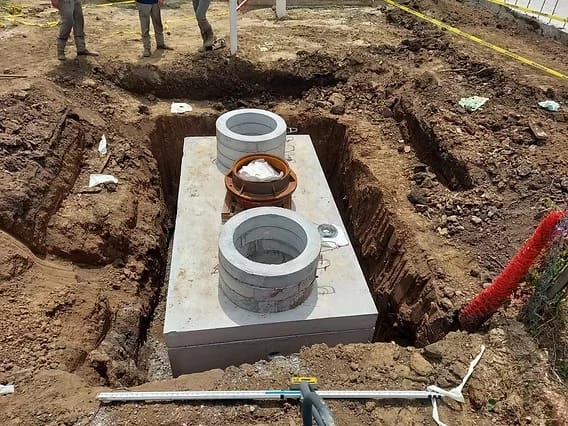
Your drain size does not size the separator. Retention time does.
That is the line most specification packages get wrong. A shop installs a four-inch floor drain, orders a tank that looks big enough, and fails its first compliance inspection. The tank was never the problem. The math was.
This page covers what an Alberta oil-water separator has to do, how the volume is set, what the precast unit has to carry in the ground, and how long it takes to get one.
What a Precast Oil-Water Separator Does
It slows water down until oil floats and grit sinks.
That is the whole mechanism. Gravity separation. Oil rises because it is lighter than water. Sand and grit drop out because they are heavier. Clean water leaves through the final chamber. The separator holds everything else.
Three things come out of the waste stream:
- Floating hydrocarbons — fuel, motor oil, hydraulic fluid.
- Settled solids — sand, road grit, brake dust, wash-bay silt.
- Flammable liquids — kept out of the municipal sewer entirely.
Gravity separators are effective on free oil droplets. They are not effective on emulsified oil. The separation depends on droplet rise velocity, and a fine emulsified droplet does not rise fast enough to reach the surface inside the tank’s detention window. It leaves with the effluent. Detergents make this worse, not better. A wash bay running aggressive surfactants will emulsify oil that a plain-water bay would have released, and the separator will pass it downstream while looking perfectly healthy at the lid.
Specify the chemistry and the separator together. A separator chosen without knowing what gets sprayed in the bay is a guess in a concrete box.
When Alberta Requires One
Alberta Municipal Affairs is direct about the occupancies. The province’s plumbing STANDATA on garage interceptors names service stations, paint shops, workshops and car wash facilities. Any floor drain that can receive sand, grit or hydrocarbons needs interception before the sewer.
| Facility type | What the separator sees | Typical driver |
|---|---|---|
| Service station, repair bay | Motor oil, fuel drips, brake dust | Plumbing code, municipal bylaw |
| Vehicle and equipment wash bay | Emulsified oil, heavy silt, detergent | High solids volume, wash water rate |
| Fleet and transit garage | Hydraulic fluid, diesel, road grit | Continuous drainage load |
| Parkade floor drains | Winter road salt, oil drip, sediment | Sediment volume, seasonal surge |
| Shop and paint facility | Solvent, sludge, wash-down water | Occupancy listed in STANDATA |
| Fuel handling and bulk storage | Spill containment volume | Spill event, not daily flow |
The minimum compartment size in that bulletin is 600 mm by 600 mm inside dimensions for service stations, paint shops and workshops. Car washes require more. That minimum is a floor, not a design. Nobody meets a real wash-bay load with a 600 mm box.
Retention Time Sets the Volume
Here is the number that actually sizes the tank.
The City of Calgary’s automotive wastewater compliance requirements specify an interceptor designed to prevent hydrocarbons, flammable liquids and total suspended solids from entering the wastewater system, with a minimum two-hour retention time. Two hours of flow has to sit in the tank.
So the sizing chain runs in one direction:
- Total the drainage fixtures and wash equipment feeding the separator.
- Establish peak flow in litres per minute, not average flow.
- Multiply peak flow by the required retention period.
- Add storage for accumulated sludge and floating oil.
- Round up to the next manufactured tank size.
Step four is the one that gets skipped. A tank sized to exactly two hours of clear volume is undersized the day it is commissioned, because the day it is commissioned it starts filling with sludge it is not allowed to discharge.
Peak flow is also not the sum of nameplate ratings. A four-bay shop does not run four pressure washers simultaneously. A transit garage might. Diversity assumptions belong in the submittal, in writing, so the reviewing authority sees the same math you did.
One more input decides the number: whether the drainage is continuous or intermittent. A repair bay drains in bursts — a hose down, then nothing for an hour. A wash tunnel runs steadily through a shift. Same nominal flow rating, very different tank. Intermittent loads can be levelled with a holding chamber ahead of the separator. Continuous loads cannot, so the separator itself absorbs the whole duty and the volume goes up accordingly.
Write the governing bylaw clause on the drawing. Retention periods differ between municipalities, and a tank sized to the wrong jurisdiction is a tank that gets replaced.
The Cleanout Thresholds That Shrink Working Volume
Alberta operators work to accumulation limits, not calendar dates.
The Alberta Capital Region Wastewater Commission fact sheet on sumps and separators sets the thresholds in the final stage — the chamber where effluent leaves for the sewer. Calgary’s automotive requirements set the same pair with an absolute depth cap added.
| Accumulation | Limit in final stage | Effect on design |
|---|---|---|
| Settled solids | 25% of wetted height (Calgary: lesser of 15 cm or 25%) | Deduct from usable volume |
| Floating oil and grease | 5% of wetted height (Calgary: lesser of 5 cm or 5%) | Deduct from usable volume |
| Spill of 2 L or more entering the sump | Clean out before discharging again | Emergency capacity, not routine |
| Full vacuum cleanout | Annually at minimum | Access and hauler clearance |
Read the table as a subtraction. Roughly 30% of the final stage’s wetted height is reserved for material the operator is not allowed to accumulate past. Size the tank so the two-hour retention volume still exists at the moment the cleanout trigger is reached. Otherwise the separator is compliant only when it is empty.
Records are part of the spec. Calgary requires written maintenance, cleaning and inspection records retained for two years. The ACRWC fact sheet sets the same two-year retention and asks for maintenance dates, quantities removed, service company and receiving facility. Build the access to suit a vacuum truck, not a flashlight.
Separator, Interceptor, Grease Trap — Not Interchangeable
Specifiers mix these up constantly. They are different products under different standards.
| Device | Captures | Standard basis | Where it belongs |
|---|---|---|---|
| Oil-water separator | Free hydrocarbons, grit | Plumbing code, municipal bylaw | Shops, wash bays, fleet, fuel |
| Sand and oil interceptor | Grit first, oil second | Alberta STANDATA occupancies | Garages with heavy sediment |
| Grease interceptor | Fats, oils, grease of food origin | CSA-B481 series | Kitchens, food preparation |
| Oil-grit separator (stormwater) | Sediment, surface oil sheen | Municipal drainage bylaw | Parking lots, site runoff |
The grease line matters because the requirement wording looks similar. EPCOR’s code of practice under Bylaw 20865 applies to premises with commercial or institutional food preparation, requires CSA-B481 certification, and triggers cleaning when accumulation exceeds 25% of liquid volume capacity. A CSA-B481 grease unit does not satisfy an automotive hydrocarbon requirement. A hydrocarbon separator does not satisfy a kitchen requirement. Two devices, two submittals.
Stormwater is a third path again. Surface drainage from a lot is a drainage-bylaw question, not a wastewater-bylaw question, and the bypass arrangement for storm flows has to be drawn — not assumed.
What the Precast Unit Carries
The tank is a structure before it is a treatment device.
| Element | Requirement |
|---|---|
| Structure | Designed for surcharge, wheel loads and lateral earth pressure at the specified burial depth |
| Watertightness | Vacuum or water test before shipment; no measurable loss |
| Joints | Preformed flexible sealant, joint gap held tight, compressed within the sealant’s range |
| Access | Risers to grade over every chamber requiring service |
| Covers | Rated for the traffic over them; cast iron or equivalent where vehicles cross |
| Buoyancy | Anti-flotation design where groundwater is present |
| Finish | Baffles, inlet tee, outlet tee and sampling point cast or set in the plant |
Two of these fail in the field more than the rest.
Buoyancy. An empty tank in wet ground floats. In poor soil conditions the structure must be designed to resist flotation, which usually means a ballast collar or an anti-flotation slab. Decide this from the geotechnical report, before fabrication, not after the tank lifts.
Covers. A separator under a wash-bay approach sees loaded vehicles. The STANDATA bulletin calls for a cleanout cover protected from vehicular damage — ductile iron, minimum load rating 7,499 lbs, or equivalent. Specify the actual vehicle, not the word “traffic.”
Plant quality is checkable. Ask for the producer’s certification category before award. Our guide to CPCQA certification categories explains what each category covers, and how precast is manufactured covers the plant controls behind a watertight tank.
Installation and Access
Set it. Connect it. Backfill it. Test it.
The sequence is short but the tolerances are not forgiving:
- Bedding. Level, compacted granular base. A tank set on uneven bedding cracks at the base slab, not at the joint.
- Invert elevations. Inlet above outlet by the design drop. Get this from the shop drawing, not from the site.
- Risers to grade. Every chamber needing service gets one. A buried access lid is an access lid nobody uses.
- Backfill. Uniform lifts, both sides at once. Uneven backfill racks the tank.
- Sampling point. Downstream of the final chamber, reachable from grade.
Access governs the site layout more than people expect. A vacuum truck has to reach every lid. Plan the parking, the bollards and the landscaping around that, or the annual cleanout becomes an annual argument.
Long-term behaviour is predictable if the tank is serviced on threshold rather than on habit. Maintenance of precast structures covers the inspection routine that keeps joints and risers sound over decades of service.
Lead Time and What We Need to Quote
Separator tanks are made to the project, not pulled off a rack. A quote moves fastest when the request arrives with the inputs already settled.
| We need | Why |
|---|---|
| Peak flow rate in L/min | Sets retention volume |
| Governing municipality and bylaw | Sets retention period and discharge limits |
| Fixture and equipment schedule | Confirms diversity assumptions |
| Burial depth to invert | Sets wall and slab design |
| Traffic over the tank | Sets cover and top slab rating |
| Groundwater elevation | Determines anti-flotation requirement |
| Site access for delivery and crane | Sets rigging and delivery sequencing |
Send those seven and you get a quantity price and a delivery window. Send a floor plan alone and you get questions.
We have supplied underground tanks across Alberta for decades — hundreds of structures set for industrial, municipal and commercial sites. Larger quantities price better than singles. Say so up front if a second phase is coming.
Request a spec sheet, a shop drawing or a quantity quote through our industrial precast solutions page. Related tank products, including watertight underground vessels, are covered under precast septic tanks.
FAQ
Does a two-hour retention time apply everywhere in Alberta? No. It is set by the municipality. Calgary’s automotive compliance requirements state a minimum two-hour retention time. Confirm the figure with the authority having jurisdiction before sizing, because the retention period is the single input that drives tank volume.
Can one separator serve a shop and a wash bay? Sometimes. Combine only if the peak flows are additive in the calculation and the detergent chemistry from the wash bay will not emulsify the shop’s oil. Where the chemistry conflicts, two separate units outperform one large one.
What size interceptor does a small service station need? The Alberta STANDATA minimum compartment is 600 mm by 600 mm inside dimensions for service stations, paint shops and workshops. Actual size comes from peak flow times retention time plus sludge and oil storage. The minimum is rarely the answer.
How often does it need cleaning? On threshold, not on schedule. Clean when settled solids reach 25% of wetted height in the final stage or floating oil reaches 5%, whichever comes first. A full vacuum cleanout is required annually at minimum under Calgary’s automotive requirements.
Precast or cast-in-place for a separator? Precast. The tank is tested for watertightness in the plant before it ships, the baffles and tees are set under plant conditions, and the unit is installed in a single day. A cast-in-place equivalent is tested after it is in the ground, where a repair costs a rebuild.
Does the separator handle stormwater too? Not by default. Storm flow is a drainage-bylaw item and usually needs a bypass or a separate oil-grit separator. Draw the bypass on the drawing. Do not leave it to the installer.