
Last updated: July 21, 2026
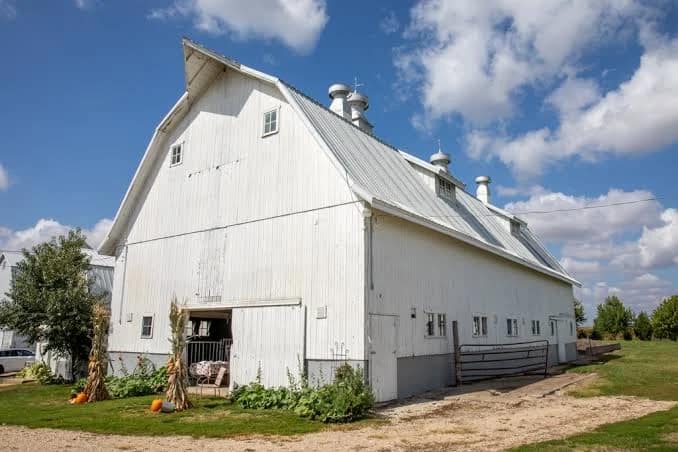
Dairy and livestock barns are among the harshest environments a building faces. They stay wet from washdown and animal respiration, and manure gives off ammonia and hydrogen-sulphide gases plus organic acids that attack building materials. Wood rots, and steel corrodes fast: ammonia-driven corrosion inside barns can advance several times faster than normal atmospheric corrosion. Concrete is the durable, washable, repairable answer, and the Canadian standard CSA A23.1 defines a dedicated “A-class” agricultural exposure for it.
Structural concrete exposed to manure and silage gases is specified at up to 35 MPa with a water-to-cement ratio as low as 0.40 (class A-1), and the most severe class, A-XL, calls for 50 MPa. The honest caveat the standard itself states is that no concrete is entirely acid-proof in severe exposure, so real durability comes from the right A-class mix, adequate reinforcement cover, and good drainage. That combination is exactly what a precast plant is built to deliver, batch after batch.
This article is about the mechanism, not the price. The question here is narrower and more technical: what actually happens to a building inside a dairy, and why does concrete, specified correctly, hold up when other materials give out? One clarification first. Omega Precast supplies solid concrete elements, not a composite or insulated panel system; the durability numbers here are for solid concrete.
What makes a dairy barn so hard on a building?
A milking or housing barn is a chemistry problem dressed up as a building. Three things gang up on the structure at once.
Moisture, all the time. Between animal waste and the washdown that keeps the barn livable, the surfaces stay wet. As one engineering source puts it, “Between the animal wastes and the cleaning that keeps the barn livable, the environment stays wet.”
(Source: Beton Consulting Engineers, “Agricultural concrete can be durable,” https://www.betonconsultingeng.com/agricultural-concrete-durability/ .)
A wet surface is the precondition for nearly every failure mode that follows. Wood that never dries rots. Steel that stays damp corrodes. Concrete that is porous lets fluids in.
Aggressive gases. Manure generates ammonia and hydrogen sulphide. A peer-reviewed review of farm-environment corrosion found that animal manure contains “sulfates, nitrates, chlorides, hydrogen sulfide, and ammonia,” and that ammonia-driven corrosion inside barns “can advance several times faster than typical atmospheric corrosion.”
(Source: “Durability Issues and Corrosion of Structural Materials and Systems in Farm Environment,” Applied Sciences (MDPI), 2020, 10(3):990, https://www.mdpi.com/2076-3417/10/3/990 .)
That is the number worth sitting with. Steel in a barn does not corrode at the rate it would on an exposed fence. It corrodes several times faster.
Organic acids in the waste itself. The manure is mildly acidic, and those organic acids react with the cement paste in concrete. A study of cement pastes exposed to manure acids found the acids react with cement-paste hydrates, raising porosity and reducing strength over time.
(Source: “Attack of cement pastes exposed to organic acids in manure,” ScienceDirect, https://www.sciencedirect.com/science/article/abs/pii/S0958946505000752 .)
So the barn is wet, gassy, and mildly acidic, continuously. That combination is why “build it out of wood and re-do it later” became the default, and why producers who plan to keep the barn for decades keep moving to concrete.
The honest part: concrete is not acid-proof
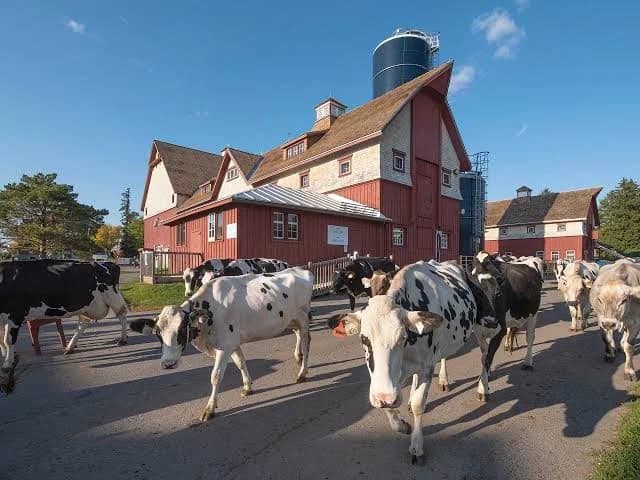
Here is the line a hype page will not give you. The CSA A23.1 standard, which governs concrete materials in Canada, states plainly:
“No hydraulic cement concrete will be entirely resistant in severe acid exposures. The resistance… is largely dependent on its resistance to penetration of fluids.”
(Source: CSA A23.1:24, Table 1 note, as reproduced by Concrete Ontario / RMCAO, “Classes of Exposure” TS03, © 2025, https://www.rmcao.org/wp-content/uploads/2025/01/TS03-Classes-of-Exposure-2025-1.pdf .)
Read that second sentence again, because it is the whole strategy. Concrete does not win the barn by being acid-proof. Nothing is. It wins by being hard for fluids to penetrate. A dense, low-water concrete with the right reinforcement cover keeps the aggressive moisture from getting deep enough to do structural damage, and the surface that does wear is washable and repairable rather than rotted through. So the durability question is not “is concrete immune?” It is “is the concrete specified tightly enough, and detailed well enough, to resist penetration in this exposure?” That is an engineering answer, and Canada has written it down.
If you’re writing tender documents or reviewing engineering drawings, our Drop-In CSA A23.4 Spec Language for Calgary Precast article provides ready-to-use specification language based on current Canadian standards.
The CSA A-class: the agricultural exposure spec
CSA A23.1 has a family of exposure classes written specifically for agricultural, municipal, and industrial concrete exposed to human or animal wastes, the “A” classes. They cover manure and silage gases, and the harshest cover vapour over manure pits and continuous submersion in effluent. Here is the current table.
| Class | Where it applies (abridged) | Max w/cm | Min strength | Air category |
|---|---|---|---|---|
| A-XL | Structural, manure/silage gases (higher durability than A-1/A-2) | 0.40 | 50 MPa @ 56 d | 1 |
| A-1 | Structural, vapour over manure pits/silos, pig slats | 0.40 | 35 MPa @ 56 d | 1 |
| A-2 | Structural, manure/silage gases and liquids (exterior tanks, silos, bunkers, slabs) | 0.45 | 32 MPa @ 28 d | 1 |
| A-3 | Structural, continuously submerged in effluent (gutter walls, forcemains) | 0.50 | 30 MPa @ 28 d | 1 |
| A-4 | Non-structural, moderate manure/silage, no freeze-thaw (interior slabs on ground) | 0.55 | 25 MPa @ 28 d | 2 |
(Source: CSA A23.1:24, Tables 1 and 2, as reproduced by Concrete Ontario / RMCAO, TS03 © 2025, URL above.)
The pattern matters more than any single row. The worse the exposure, the lower the allowed water-to-cement ratio and the higher the strength. That is the standard codifying exactly the “resist fluid penetration” logic from the caveat above: a tight, low-water mix is the engineered answer to an acidic, wet environment. A manure-pit beam is not the same concrete as an interior slab, and the standard knows it.
One more detail the standard flags: classes A-1 through A-4 and A-XL “could be subjected to sulphate exposure” and must also meet the relevant S-class. We will come back to why that matters in Calgary.
Cover is the other half of durability
A good mix is necessary but not sufficient. The reinforcing steel inside the concrete needs enough cover, the depth of concrete between the steel and the surface, to keep the aggressive moisture away from the bar. The Canadian Farm Builders Association guidance calls for generous cover in severe manure-gas exposure: up to 75 mm cast against earth and 60 mm on beams, slabs, and walls, against the 20 to 40 mm typical of non-exposed concrete.
(Source: Canadian Farm Builders Association, “Guidelines for Concrete Specifications,” https://cfba.ca/pdf/CFBA-Concrete.pdf . Note: this document references the older CSA A23.1-2000 class numbering; use it for the cover depths and application examples, and anchor the class names and strengths to the current CSA A23.1:24 A-class table above.)
So the durability recipe has two ingredients, not one: a dense, low-water A-class mix, plus deep reinforcement cover. Mix without cover leaves the steel exposed to corrosion through a sound but thin shell. Cover without mix leaves a porous body the fluids walk straight through. You need both, and a barn specifier should call for both.
Why precast suits this environment
This is where the manufacturing method earns its place. A barn-grade A-class mix is demanding: low water content, the right air entrainment, often supplementary cementing materials, and consistent placement. The MDPI review notes that ag-concrete deterioration “can be mitigated by… modified concrete containing sulfur, fly ash, silica fume, and nanoparticles such as silica,” and high-performance concrete using slag with portland, controlled curing, and void-minimizing proportioning resists the farm environment.
Those are factory strengths. A precast plant batches to a controlled mix design, places and consolidates under shop conditions, and cures in a managed environment, then does it again the same way for the next unit. That repeatability is the point. The hard part of barn concrete is not knowing the spec; it is hitting it consistently, panel after panel, in weather that does not cooperate on a job site. A factory-controlled process is built to deliver the A-class mix the same way every time.
To be clear about scope: Omega Precast is a Calgary solid-concrete precast manufacturer that launched in late 2025 and is entering the agricultural category. We frame our value as the capability to supply solid precast elements built to the right A-class and sulphate spec, not a count of barns already poured. The concrete-dairy category itself is well established in Western Canada — the regional precast-agriculture sector has built robotic and conventional dairy barns at scale since around 2000, on the structural reality that traditional building materials tend to deteriorate when exposed to high levels of ammonia and moisture.
(Source: MDPI 2020 farm-environment corrosion review, URL above; Concrete Alberta agricultural-category overview.)
The Calgary twist: A-class and S-2 at once
Calgary adds a second exposure to the barn problem. Local ground is commonly S-2, a severe sulphate condition, which calls for sulphate-resistant cementing materials (Type HS, HSb, or HSe) at a low water-to-cement ratio. And as the CSA note above warns, A-class agricultural elements may also be subject to sulphate exposure. Put those together and a Calgary dairy slab or manure-pit wall is frequently specified for both the A-class agricultural exposure and the S-2 sulphate exposure at the same time.
(Sources: CSA A23.1:24 exposure-class notes via RMCAO TS03, URL above; Omega Calgary Concrete Knowledge Base, S-2/Type HS.)
There is a freeze-thaw layer too. Calgary sees roughly 128 freeze-thaw cycles a year, and a wet barn floor faces that cycling at perimeters and openings. The good news is that the A-class spec already requires air entrainment (Category 1 for the structural classes), which is the same defence freeze-thaw demands. One air-entrained, low-water, sulphate-resistant mix can answer manure exposure, sulphate ground, and Chinook freeze-thaw together.
FAQ
Why are dairy barns built with concrete? Constant moisture from washdown and respiration, plus ammonia and hydrogen-sulphide gases and organic acids from manure, destroy wood and corrode steel. Concrete is the durable, washable, repairable answer, and it can be specified precisely for the exposure.
Does ammonia damage concrete? Manure acids and gases can attack under-specified concrete, and CSA itself states that no concrete is entirely acid-proof in severe exposure. Durability comes from a dense, low-water A-class mix, adequate reinforcement cover, and good drainage that resist fluid penetration.
What concrete spec do you use for a manure pit or dairy barn? The CSA A23.1:24 A-class: A-1 is 35 MPa at a 0.40 water-to-cement ratio for severe gas exposure, up to A-XL at 50 MPa; A-4 is 25 MPa for interior slabs on ground. Match the class to the element.
How much concrete cover do barn structures need? Up to 75 mm cast against earth and 60 mm on beams, slabs, and walls for severe manure-gas exposure, per Canadian Farm Builders Association guidance, against 20 to 40 mm for non-exposed concrete.
Does a Calgary dairy barn need sulphate-resistant concrete too? Often yes. Calgary ground is commonly S-2, and CSA notes that A-class agricultural elements may also face sulphate exposure, so a Calgary barn element is frequently specified for the A-class and S-2 (Type HS, HSb, or HSe) together.
Why is precast a good fit for the barn environment? The barn-grade A-class mix is demanding to hit consistently. A precast plant batches, places, and cures under controlled shop conditions and repeats it for every unit, so the spec is met the same way each time.
Is concrete fully acid-proof, then? No, and the standard says so. The win is resistance to fluid penetration, not immunity. A tight A-class mix plus deep cover plus drainage keeps the aggressive moisture from reaching structural depth, and the surface that wears is repairable rather than rotted.
Specify Agricultural Precast with Confidence
Agricultural buildings demand more than ordinary concrete. Dairy barns, manure pits, feed-storage structures, and livestock facilities require mixes designed for continuous moisture, manure exposure, sulphate soils, and freeze-thaw conditions—all while meeting the durability requirements of CSA A23.1 and CSA A23.4.
Omega Precast manufactures solid precast concrete components designed to be produced to the specified exposure class, strength, reinforcement cover, and sulphate-resistance requirements for each project. Whether you’re designing a new dairy facility, replacing deteriorated concrete, or planning an agricultural expansion, we’ll work with your engineer to ensure the precast solution matches the project’s structural specification.
Planning an agricultural concrete project in Alberta? Contact Omega Precast to discuss precast components manufactured to your engineer’s CSA specifications for long-term durability.