
Last updated: August 4, 2026
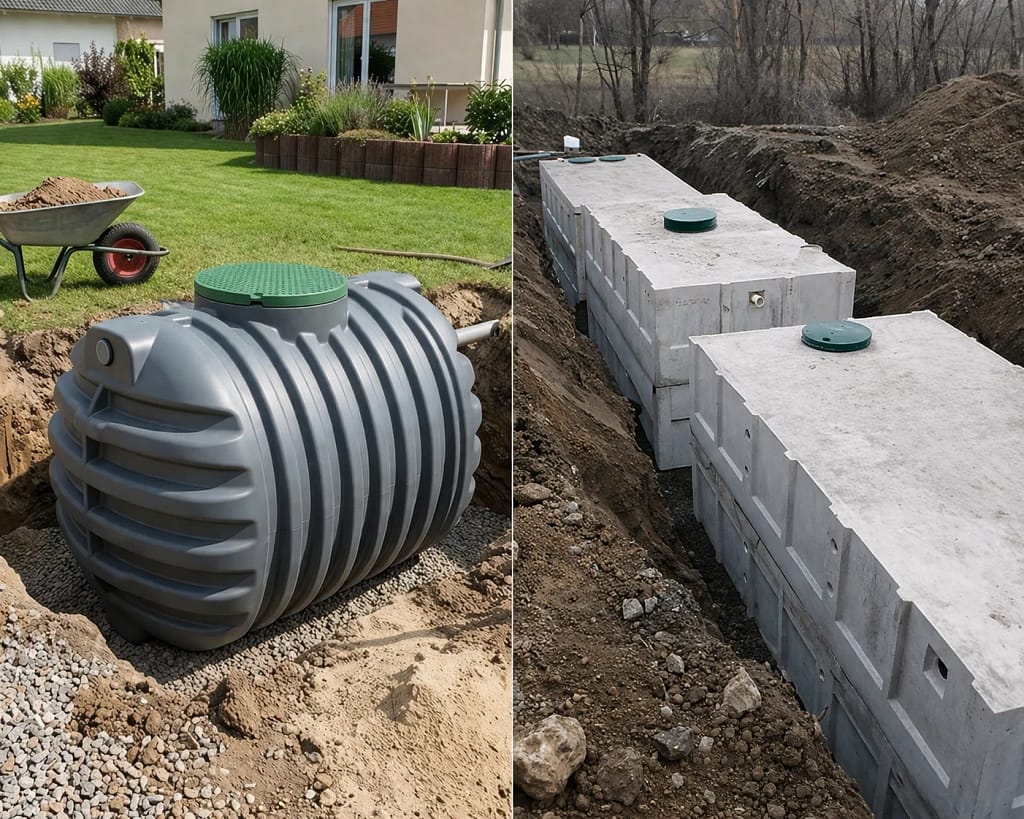
On an Alberta acreage, the septic tank you bury once should outlast the mortgage. Concrete and poly tanks are both legal — but they behave very differently in the ground over forty years. Here are the five differences that actually decide it: lifespan, floating, watertightness, the standard each must meet, and what happens at the water table.
If you are building or buying west of Calgary — Bearspaw, Springbank, Bragg Creek, out toward Cochrane or down past Okotoks — you are almost certainly on a private sewage system, not city sewer. The tank is the part you never see again once the backfill goes in. That is exactly why it is worth getting right the first time. Below, we walk the five real decision points, in plain language, with the standards that govern each one.
1. Lifespan: how long a precast concrete tank lasts versus poly
The first question almost everyone asks is the right one: how long will it last? A well-made precast concrete septic tank has a service life on the order of forty to sixty years when it is properly designed, installed, and maintained. That is the kind of timeline that lets you bury a tank once and not think about it again for the life of the home. Concrete is a high-mass, rigid material; it does not flex with every load cycle, and it is not affected by sunlight or the temperature swings that punish materials above ground.
Poly and plastic tanks are a different story. They are lighter, they ship easily, and they go in fast — those are real advantages on the day of the install. Over the long run, though, a lighter, flexible tank lives a different life in the ground. Plastic can be more sensitive to handling damage, to backfill that was not placed and compacted carefully, and to the loads that press in on a buried tank season after season. None of that makes poly illegal or unusable — both materials are permitted in Alberta — but if your planning horizon is “outlast the mortgage,” the durability conversation generally favours the heavier, rigid option.
There is a maintenance truth underneath all of this that applies to either material: a septic tank is not a fill-it-and-forget-it appliance. It needs periodic pumping and inspection regardless of what it is made from. The difference is that concrete’s longevity gives you a longer runway before the tank itself — as opposed to the system around it — becomes the thing you are replacing.
For an acreage owner who plans to be in the home for decades, or who is building to sell into a market where buyers ask hard questions, lifespan is rarely a close call. It is the single biggest reason concrete remains the default choice for a permanent rural home.
2. Floating: weight, water tables, and why a light tank needs anchoring
Here is the difference most people have never heard of until it happens to a neighbour: septic tanks can float. An empty or partly empty tank is essentially a sealed box of air sitting in the ground. When the surrounding soil saturates — spring melt, a wet season, a high water table — the water wants to push that box back up to the surface, the same way a beach ball pops up when you let go of it underwater. This is buoyancy, and it is a genuine failure mode for a buried tank.
What resists it is mass. A precast concrete septic tank is heavy — heavy enough that, in most acreage soil conditions, its own dead weight keeps it planted where you put it. That weight is not a side effect; it is one of the quiet engineering advantages of the material. The tank fights the upward push simply by being too heavy to lift.
A lightweight poly or plastic tank does not have that built-in ballast. In areas with a high or seasonal water table — which describes plenty of land around Calgary and across rural Alberta — a light tank generally has to be anchored against flotation. That can mean a concrete anti-buoyancy slab, strapping, a deadman, or another engineered hold-down detail. Done correctly, it works. But it is an extra step, an extra component, and one more thing that has to be installed exactly right, because a tank that floats can crack lines, break seals, and heave the ground above it.
This is also why your site matters as much as your tank. Bury depth, the seasonal high-water mark, and the soil’s drainage all feed into the flotation calculation. A reputable installer assesses the water table for your specific lot before deciding what hold-down — if any — your system needs. With concrete, the honest answer is often “the tank’s own weight handles it.” With poly, anchoring is frequently part of the package, and you want that in the design from the start, not discovered after the first wet spring.
3. Watertightness: how a precast tank is tested before it leaves the yard
A septic tank has two jobs at the boundary: keep sewage in, and keep groundwater out. If it leaks outward, you are contaminating your own soil and possibly your well. If groundwater leaks inward, it floods the tank, overloads the field, and wrecks the treatment process. Watertightness is not a nice-to-have — it is the whole point of the vessel.
This is where the factory step matters. A quality precast concrete septic tank is tested for watertightness before it ever leaves the yard. Under ASTM C1227, the governing specification for precast concrete septic tanks, tanks are checked for leaks using a vacuum test, a water (hydrostatic) test, or an air-pressure test — verified at the plant, not assumed in the field. You are getting a vessel that has already proven it holds before it is loaded on the truck.
That factory verification is a real advantage of buying a manufactured precast tank over relying on something assembled or sealed entirely on site. The seams between sections, the joints around the inlet and outlet, and the lid connections are the places watertightness is won or lost, and ASTM C1227 addresses how those are designed and sealed so the tank performs as a sealed unit.
Poly tanks are typically molded as a single piece, which gives them an inherent seam advantage in one sense — fewer joints to seal. The trade-offs show up elsewhere on this list, in mass and durability. The point for watertightness specifically is this: with a properly manufactured precast concrete tank, the seal is engineered into the product and confirmed by a test you can ask about. When you are comparing options, ask the supplier directly how each tank’s watertightness is verified, and whether that verification happens at the plant or is left to the installer.
Factory quality control is one of precast concrete’s biggest advantages. The same controlled manufacturing process used to produce watertight septic tanks is also why architectural precast relies on approved mockups, consistent concrete mixes, and plant quality assurance. Learn more in Architectural Finish Control: Matrix, Aggregate, and Mockups.
4. The standard: ASTM C1227, what a precast septic tank must meet
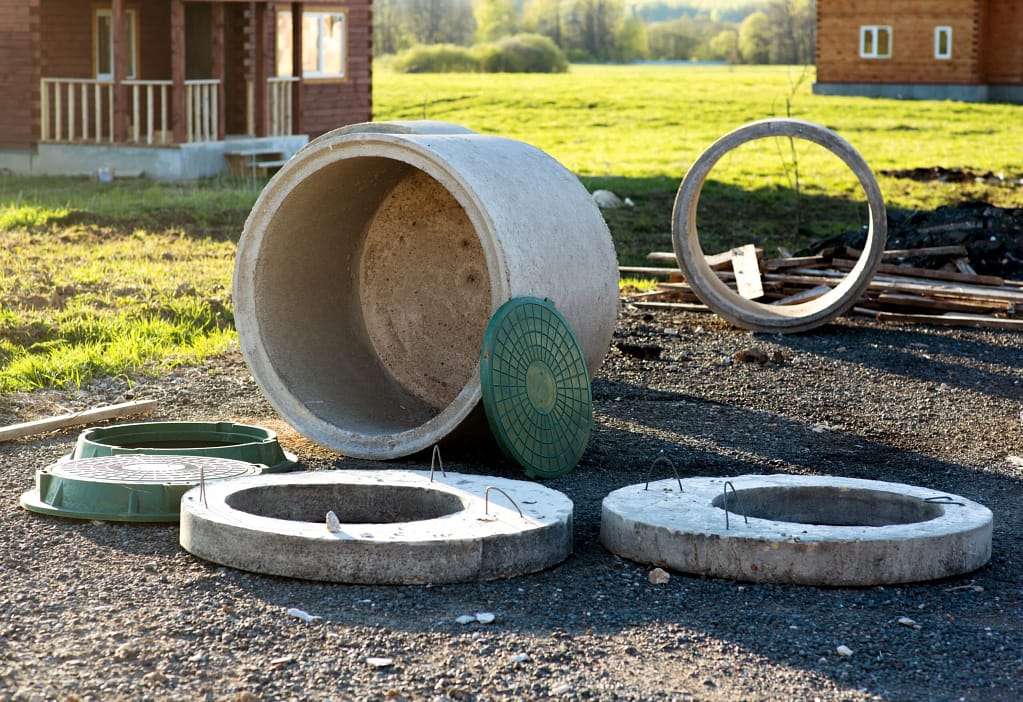
If you remember one specification from this whole article, make it this one: ASTM C1227, Standard Specification for Precast Concrete Septic Tanks. It is the document that separates a properly engineered tank from a concrete box, and it governs the design, manufacturing, and performance of precast concrete septic tanks — both monolithic (poured as one piece) and sectional (assembled from sections).
ASTM C1227 covers the things that actually determine whether a tank survives forty years in the ground. It addresses the concrete itself — strength and mix proportions appropriate for a durable, watertight buried structure — along with the reinforcing steel that gives the tank its structural integrity. It addresses loading: whether a tank is rated for traffic (a vehicle could pass over it) or non-traffic, which changes how it has to be built. And it addresses the in-ground realities we have already walked through — watertightness testing, resistance to buoyancy at the water table, and bury-depth considerations.
The concrete in a precast septic tank is no afterthought. These tanks are built with high-strength, low-permeability concrete and properly placed reinforcing so the vessel resists cracking under earth and water loads and stays watertight over its service life. That combination — dense concrete, sound reinforcement, verified seals — is what the standard is protecting. For the materials-and-construction side of precast work, CSA A23.4-16 (R2021) is the Canadian reference that governs precast concrete materials and manufacturing practice, and it sits alongside ASTM C1227 in how a reputable yard produces tanks.
The practical takeaway for you as a buyer: ask whether the tank you are quoted is manufactured to ASTM C1227. It is a fair, specific question, and a serious supplier will answer it without hesitation. A tank built to the standard is one you can defend to a building official, an installer, and — down the road — a buyer’s home inspector.
5. The Alberta rule: the Private Sewage Systems Standard of Practice (2021)
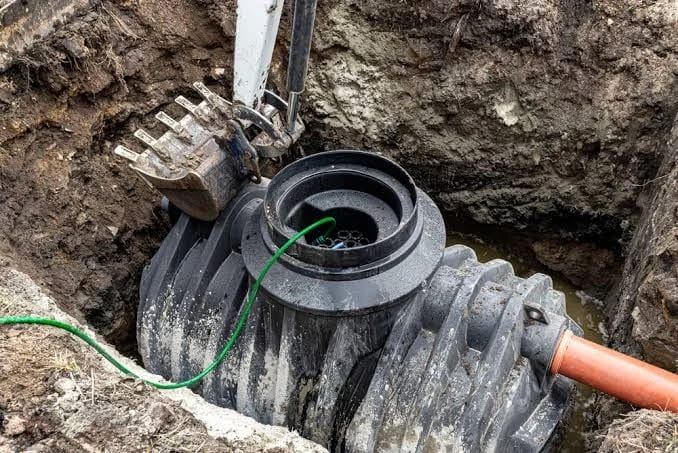
ASTM C1227 governs the tank. The Alberta Private Sewage Systems Standard of Practice (2021) governs the system it lives in — and that is the rule that determines whether your install is legal. In Alberta, private sewage is regulated under the Private Sewage Disposal Systems Regulation (Reg. 229/97), and the 2021 Standard of Practice is the technical document that sets out how on-site systems handling under 25 cubic metres per day must be designed, sized, and installed.
The single most important thing this standard does for an acreage owner is require qualified people. Whoever designs and installs your private sewage system needs a current Certificate of Competency. That is not a formality — it is your protection. A certified installer is the person who sizes the tank correctly, reads your soil and water table, decides whether anchoring is needed, and ensures the whole system meets the 2021 standard. You should ask to see that certificate the same way you would ask any trade for proof of qualification. If an installer cannot produce one, that is your answer.
The standard also shapes how the tank is sized, which we cover in the next section. The broad principle: your system has to match the demand the household will place on it, with proper working capacity to treat the waste before it moves to the field. Undersize it and the system struggles; oversize thoughtfully and you have built in headroom.
For the official requirements — including the regulation text, the Standard of Practice, and the certification framework — go to the Government of Alberta’s private sewage codes and standards page (linked in Sources). Treat it as the authority. Anything a salesperson tells you should square with what that page says, and a good supplier will point you there themselves rather than ask you to take their word for it.
6. Choosing for your acreage: bedrooms, working capacity, and the installer’s ticket
So how do you actually decide? Pull the five threads together and the choice for a permanent acreage home becomes clear, but it still has to be sized and installed for your specific lot. Three things drive the final decision.
Bedrooms and household size. Septic systems are sized to the home’s expected daily flow, and the common starting point is the number of bedrooms — a proxy for how many people will live there and how much wastewater they will generate. A four-bedroom acreage home places more demand on the system than a two-bedroom cottage, which means a larger working capacity. Your certified designer translates bedroom count and household use into the required tank size under the Alberta 2021 standard. The principle to hold onto: build for the home you will actually live in, including the people and the laundry and the long-term use, not the minimum that squeaks by on paper.
Working capacity and the water table. Working capacity is the volume the tank holds and treats before liquid moves on to the field. Get this right and the tank does its job quietly for decades. This is also where the flotation question from Section 2 comes back: if your lot has a high or seasonal water table, the design has to account for buoyancy — and that is precisely where concrete’s mass earns its keep, often handling the uplift with its own weight where a lighter tank would need anchoring.
The installer’s ticket. This is the one that protects everything else. The person who designs and installs your system must hold a current Certificate of Competency under the Alberta Private Sewage Systems Standard of Practice. The right installer sizes the tank, reads the soil, makes the flotation call, and stands behind a system that meets code. Ask for the certificate before any work begins.
Put it all together and the pattern is consistent. For a home you intend to keep, on land where the water table is a real consideration, a precast concrete tank built to ASTM C1227 — sized to your bedrooms, set by a certified installer to the Alberta 2021 standard — is the choice that asks the least of you over the next forty years. Poly has its place, particularly where speed and handling matter most and anchoring is engineered in. But when the goal is “bury it once,” the heavier, tested, code-defensible option is the one most acreage owners come back to.
The same craftsmanship that goes into a precast tank shows up across the rest of our work, too. Precast is precast: engineered in a controlled yard, delivered ready, and built to live in the ground for the long haul.
Septic tanks are only one application of engineered precast concrete. See how the same manufacturing principles are used in structural wall panels and façade systems in Architectural Precast as Structure + Façade + Fire Rating.
FAQ
Q1: Is a concrete or plastic septic tank better for an Alberta acreage? Both are legal in Alberta, so “better” depends on your priority. For a permanent home where longevity and resistance to floating matter most, precast concrete is the common default — it has a service life on the order of 40 to 60 years and its mass strongly resists buoyancy at the water table. Poly tanks are lighter and faster to install but generally need anchoring against flotation in high-water-table areas. Size and install both to the Alberta Private Sewage Systems Standard of Practice (2021) using a certified installer.
Q2: How long does a concrete septic tank last? A properly designed, installed, and maintained precast concrete septic tank has a service life on the order of 40 to 60 years. Concrete is rigid and high-mass, so it resists the load cycles and ground stresses that a buried tank faces over decades. That longevity is the main reason concrete remains the default for a permanent acreage home — though every tank, regardless of material, still needs periodic pumping and inspection to reach its full lifespan.
Q3: Do septic tanks float? Yes — an empty or partly empty buried tank can float when the surrounding soil saturates, because the sealed tank acts like a ball of air the groundwater pushes upward. This is called buoyancy. A heavy precast concrete tank usually resists flotation with its own mass, while a lightweight poly or plastic tank generally needs to be anchored — with an anti-buoyancy slab, strapping, or a deadman — in areas with a high or seasonal water table. A certified installer assesses your lot’s water table to decide what hold-down, if any, is required.
Q4: What standard applies to septic tanks in Alberta? Two layers apply. The tank itself follows ASTM C1227, the Standard Specification for Precast Concrete Septic Tanks, which governs design, concrete strength, reinforcing, loading, watertightness testing, and buoyancy resistance. The whole on-site system follows the Alberta Private Sewage Systems Standard of Practice (2021), under the Private Sewage Disposal Systems Regulation (Reg. 229/97), which covers systems handling under 25 cubic metres per day and requires a current Certificate of Competency for the designer and installer.
Q5: How is a precast concrete septic tank tested for watertightness? Under ASTM C1227, a precast concrete septic tank is tested for leaks before it leaves the yard — using a vacuum test, a water (hydrostatic) test, or an air-pressure test. That factory verification confirms the tank holds before it is delivered and buried, which is a real advantage over relying on a seal made entirely in the field. When comparing tanks, ask the supplier how watertightness is verified and whether the test happens at the plant.
Q6: What size septic tank do I need for my acreage home? Tank size is driven mainly by the number of bedrooms — a proxy for household size and daily wastewater flow — plus the required working capacity to treat the waste before it reaches the field. A larger home needs a larger tank. The sizing must be done by a certified designer to the Alberta Private Sewage Systems Standard of Practice (2021), who also factors in your soil and water table. Build for the home you will actually live in, not the minimum that passes on paper.
Sources
ASTM C1227 — Standard Specification for Precast Concrete Septic Tanks — https://www.astm.org
- NPCA — Guide to ASTM C1227 — https://precast.org
- Alberta Private Sewage Systems Standard of Practice (2021), Private Sewage Disposal Systems Regulation (Reg. 229/97) — https://www.alberta.ca/private-sewage-codes-and-standards
- Concrete Alberta — durable concrete practice — https://concretealberta.ca
- CSA A23.4-16 (R2021) — Precast concrete materials and construction — https://www.csagroup.org
About Omega Precast
Omega Precast launched in late 2025 to bring precast concrete stairs, window wells, and septic tanks to Calgary-area homeowners and acreage builders, backed by the family’s Calgary concrete experience through sister brand Omega 2000 Cribbing (since 1988). We build to the standards your home and your building official expect.