
Last updated: August 5, 2026
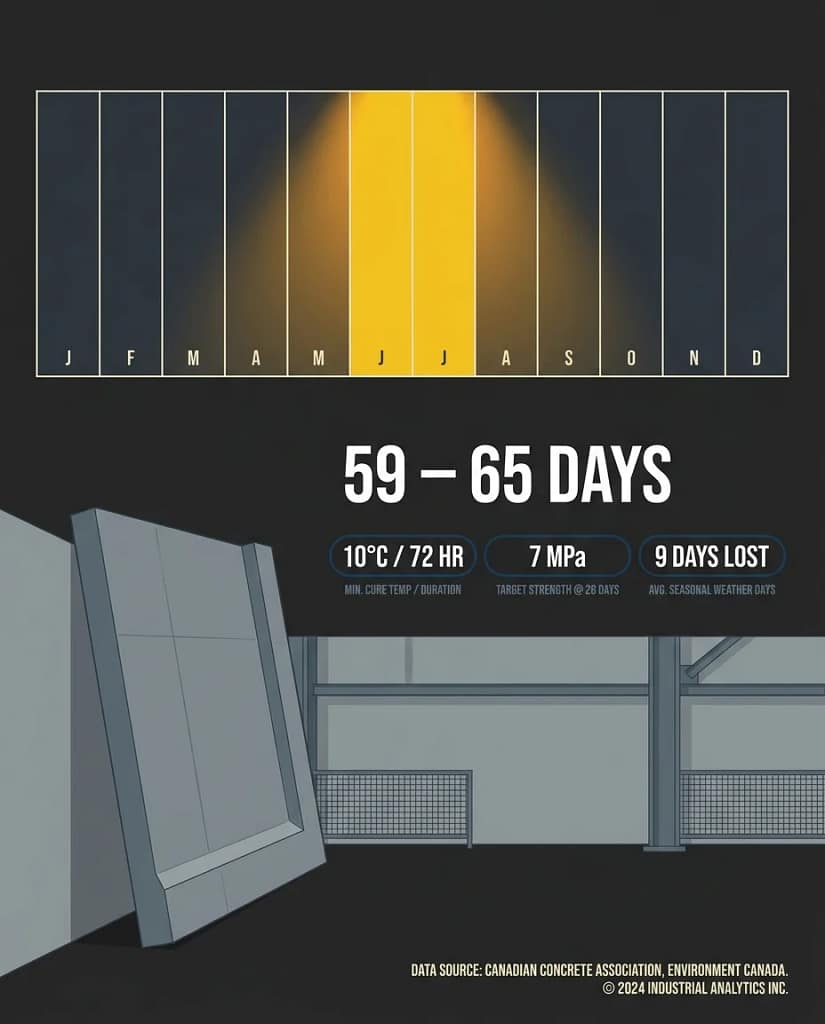
Calgary averages only 59-65 frost-free ideal pour days — the shortest window of any major Canadian city. Precast manufactured in a controlled-environment plant sidesteps the CSA A23.1:24 10°C/72-hour site-cure rule and the 15-20% winter productivity penalty, but only if lead times, panel delivery, and site erection are planned before Calgary’s October close-out window arrives.
The numbers below show how much of that pressure can be absorbed upstream, at the precast plant, before your crews encounter October.
1. Why Calgary’s Pour Season Is the Shortest in Canada (The Numbers That Drive Every Decision)
Calgary sits at roughly 51°N with a continental climate that delivers hard frost well before Halloween. Environment Canada historical data places mean daily lows below 0°C by mid-October, with overnight frost events possible as early as late August at higher-elevation pockets near the foothills. When you benchmark Calgary’s 59-65 frost-free ideal pour days against comparable Canadian cities — Vancouver operates essentially year-round, Toronto logs 90-plus comparable days — the constraint is structural, not incidental.
For a multi-family project with a structural wall system, every week lost to weather-protection overhead is a week of float consumed on your critical path. A mid-September slip that pushes structural topping to November does not cost two weeks — it costs the entire next placement window, because winter-protection costs spike and productivity drops simultaneously.
2. Reality 1 — CSA A23.1:24’s 10°C/72-Hour Cure Rule Hits Site Pours Differently Than Plant Production
CSA A23.1:24 (14th edition) requires that freshly placed concrete maintain a minimum temperature of 10°C for at least 72 hours following placement. On a site pour in late September or October, that requirement means one of three things: you install hoarding and heating at your own cost, you accept a cure risk your structural engineer must sign off on, or you do not pour at all.
In a controlled-environment precast manufacturing plant, this rule is satisfied by design rather than by field improvisation. The plant is heated, instrumented, and operated year-round. The panel that arrives on site in November has already satisfied its cure cycle under monitored conditions — not one whose 28-day strength depends on whether site staff maintained propane-heater coverage through a Tuesday night cold snap.
The regulatory delta matters to your pro forma. CSA A23.1:24 compliance on a cold-weather site pour requires documented temperature monitoring, adding inspection cost and introducing a non-conformance risk that project insurance and lender draw requirements must account for. Plant-produced precast shifts that compliance burden to a fixed overhead structure already priced into the panel cost.
3. Reality 2 — The 15-20% Winter Productivity Tax on Site Pours and What It Costs in Your Schedule
Industry data from Concrete Alberta and NPCA-affiliated field studies consistently identifies a 15-20% winter productivity penalty on site concrete operations. The penalty compounds across labour (cold gear, reduced dexterity), equipment (extended warm-up times, frost on formwork), and material handling (aggregate heating, accelerator management, delivery variability under CSA A23.1:24’s two-hour discharge clock).
For a mid-rise multi-family project, a 15% productivity penalty on a six-week structural concrete package adds roughly nine days to the critical path before weather-day shutdowns are factored in. Those nine days push mechanical, electrical, and framing starts in sequence. On a project where your lender’s schedule underwrites a spring occupancy, nine days of structural slip can cascade into a 30-45 day occupancy shift after downstream trades adjust.
Plant-manufactured precast compresses the site concrete programme to a concentrated erection sequence — panels arrive with their cure cycle complete, and the site team manages crane picks and connection details rather than monitoring fresh concrete through multiple cure cycles.
4. Reality 3 — Hoarding and Heating Budget: Cast-in-Place Winter Costs vs Plant-Manufactured Precast
Hoarding and temporary heating for cast-in-place concrete in a Calgary winter is a real project cost that belongs in your pro forma from feasibility. Industry survey ranges for hoarding and propane heating on a mid-rise concrete core run $8-$18 per square foot of enclosed area for a typical November-to-March exposure period, depending on enclosure area, duration, and propane pricing. Validate those figures against current Calgary trade quotes before locking your estimate.
The comparison to precast is not that precast always delivers a lower gross cost. The hoarding and heating cost in a cast-in-place winter programme is largely invisible at early feasibility and highly variable in the field. Plant-manufactured precast converts that variable cost into a fixed unit cost per panel known before you break ground — a cost-certainty advantage that lenders and equity partners reviewing your pro forma will recognise.
5. Reality 4 — Panel Erection in Winter: Crane Picks, Frost on Bearing Seats, and Grout Temperature
Choosing precast does not make winter irrelevant. It relocates the winter problem from a months-long cure-and-form cycle to a discrete, manageable erection programme. That distinction matters, but it comes with its own cold-weather discipline.
Crane picks in winter require attention to equipment specifications. Crane manufacturers publish cold-weather operational limits, and lubricant specifications change below -20°C. Your crane subcontractor should confirm their equipment’s operational envelope before scheduling a January erection sequence. Most Calgary multi-family erection windows target October through mid-November or March onward, using the plant’s winter production capacity to stockpile panels for a concentrated early-spring erection push.
Non-shrink grout at bearing seats must be placed and maintained above 10°C until it achieves design strength — the same CSA A23.1:24 principle applies at a much smaller volume and for a much shorter duration. Pre-heating bearing-seat areas with electric blankets or spot heaters is standard practice and low-cost relative to the consequences of an under-strength grout pad. Panel connections that rely on welded plate inserts also require confirmation that steel insert temperatures meet pre-heat requirements per CSA W47.1 and your structural engineer’s connection details.
6. Reality 5 — The Ordering Window: Why Lead Times Must Be Locked Before Calgary’s Season Closes
Precast manufacturing lead times for a multi-family panel programme in Calgary’s market currently run 10-18 weeks from approved shop drawings to first panel delivery, depending on plant capacity and panel complexity. That range means a project requiring panels on site in October must have shop drawings approved and purchase orders placed by June or July at the latest — and the structural engineer’s panel design must be advanced enough by April or May to allow the shop-drawing process to begin.
The failure mode is familiar: shop drawings are submitted in September, but the plant’s October capacity was allocated months earlier to projects that committed in spring. The project then waits for a January delivery with all the winter-erection implications above, or scrambles to a cast-in-place alternative with the hoarding and productivity costs above.
The solution requires discipline: treat the precast purchase order as a design milestone and lock lead times during design development, not during construction documents. Early coordination with your precast supplier on Alberta Transportation oversize vehicle permit requirements for larger panels avoids delivery delays independent of the plant’s production schedule.
7. Reality 6 — The 7 MPa Early-Frost Threshold and How Controlled-Cure Precast Eliminates This Site Risk
CSA A23.1:24 establishes 7 MPa as the early-frost resistance threshold — the minimum in-place concrete strength at which freshly placed concrete can be exposed to a single freeze-thaw cycle without permanent structural damage. On a site pour in late September or October, reaching 7 MPa requires monitoring, documentation, and a forecast that does not always cooperate with your schedule.
Concrete that freezes before reaching 7 MPa can experience internal expansion from ice crystal formation in the paste matrix that is invisible from the surface and can reduce long-term strength by 20-50% depending on temperature and duration. That risk does not announce itself during the pour; it surfaces during QC core sampling or a later structural review.
Plant-manufactured precast eliminates this site risk because the 7 MPa threshold — and the final 28-day or 56-day design strength — is reached under monitored plant conditions before the panel is loaded onto a transport vehicle. The panel that arrives on site carries a documented strength history, and your structural engineer reviewing plant QC records does not need to make assumptions about field curing conditions that changed overnight.
FAQ
Q1: What is CSA A23.1:24’s 10°C/72-hour rule and how does it affect Calgary projects?
CSA A23.1:24 (14th edition) requires freshly placed concrete to maintain a minimum of 10°C for at least 72 hours after placement. In Calgary’s climate, ambient temperatures fall below this threshold from approximately mid-October through April, meaning site pours in that window require active heating and monitoring. Precast manufactured in a controlled-environment plant satisfies this requirement during production, eliminating the compliance burden from the construction site.
Q2: What is the 7 MPa early-frost threshold and why does it matter for a Calgary multi-family schedule?
7 MPa is the minimum in-place concrete strength at which CSA A23.1:24 permits exposure to a freeze-thaw cycle without risk of permanent damage. On a site pour in late September or October, a hard frost arriving before that threshold is reached can cause internal damage that is difficult to detect and may reduce long-term structural performance. Controlled-cure plant precast reaches full design strength under monitored conditions before delivery, eliminating this site-level risk.
Q3: How far in advance should a Calgary multi-family developer lock precast lead times?
Current market lead times run approximately 10-18 weeks from approved shop drawings to first panel delivery. For an October erection window, purchase orders need to be placed by June or July, which means the structural panel design must be sufficiently advanced by April or May to support the shop-drawing process.
Q4: Does precast eliminate all cold-weather concerns on a Calgary multi-family project?
No. Precast relocates the primary cold-weather risk from a months-long site cure cycle to a discrete erection programme, but erection in winter still requires attention to crane operational temperature limits, non-shrink grout temperature management at bearing seats above 10°C per CSA A23.1:24, and welded connection pre-heat requirements per CSA W47.1 and your structural engineer’s details. The scope of the challenge is dramatically smaller, but it is not zero.
Q5: What does the 15-20% winter productivity penalty mean in practical schedule terms?
A 15% productivity reduction on a six-week structural concrete package adds roughly nine days to the critical path before weather-day shutdowns — those nine days ripple downstream through mechanical, electrical, and framing starts, potentially cascading into a 30-45 day occupancy shift. Plant-manufactured precast compresses the site concrete programme to a concentrated erection sequence, reducing exposure to this penalty.
Q6: Is Omega Precast CPCQA-certified, and how should buyers verify precast plant quality?
Omega Precast launched in late 2025 and does not hold CPCQA certification. For specifications requiring third-party plant certification, verify certification status directly through the CPCQA directory at cpcqa.ca. Regardless of certification status, request plant QC records, mix design submittals, and curing logs — the evidence your structural engineer needs during shop drawing approval.
Sources
- Concrete Alberta — Cold-Weather Concrete Practices — https://www.concretealberta.ca/construction/cold-weather-concrete
- CSA A23.1:24 (14th edition) — Concrete Materials and Methods of Concrete Construction — https://www.csagroup.org/store/product/2701210/
- NPCA — National Precast Concrete Association — https://precast.org
- PCI — Precast/Prestressed Concrete Institute — https://www.pci.org
- Alberta Transportation — Commercial Vehicle Oversize and Overweight Permits — https://www.alberta.ca/commercial-vehicle-oversize-and-overweight-permits
- CSA A23.3:24 — Design of Concrete Structures — https://www.csagroup.org
- CSA W47.1 — Certification of Companies for Fusion Welding of Steel — https://www.csagroup.org
About Omega Precast
Omega Precast is a Calgary-based precast concrete manufacturer launched in late 2025, producing structural and architectural panels for multi-family and commercial projects in Alberta from a controlled-environment plant.
Your biggest schedule risk isn’t winter. It’s realizing winter arrived before your structural system is ready. Omega Precast manufactures structural and architectural concrete panels in a controlled-environment Calgary facility, allowing developers to reduce site curing risk, compress schedules, and gain greater cost certainty before winter conditions arrive.