
Last updated: August 5, 2026
For an Alberta acreage, concrete is the better septic tank in almost every ground condition that matters here. Concrete tanks won’t float, won’t shift, and won’t leak in Chinook freeze-thaw or high-water-table soil — the conditions that lift and break lightweight plastic tanks. Concrete can be buried deeper (up to ~5 m / 16 ft on some models vs ~6 ft for poly), and every septic tank sold in Alberta must be certified to CSA B66 regardless of material. The honest trade-off: concrete is heavier, so the install is more involved. (SoilWorx; CSA B66:21)
If you’re building or replacing a system on an acreage around Calgary — Rocky View, Foothills, Springbank, Bragg Creek, De Winton, Cochrane — there’s no municipal sewer, so the tank isn’t optional. Here’s the material decision, made on Alberta physics, plus the sizing, setbacks, and code you’ll be held to.
Concrete vs poly: the comparison that matters in Alberta ground
| Factor | Concrete | Poly / plastic | Fibreglass |
|---|---|---|---|
| Buoyancy (will it float?) | Won’t float — mass anchors it | Can float/shift if not anchored, especially high water table | Can float; not recommended where high water tables exist |
| High-water-table sites | Best choice | Not recommended | Not recommended |
| Frost / Chinook ground movement | Mass resists heave; popular in Alberta for exactly this | More prone to shifting | More prone to shifting |
| Burial depth | Up to ~5 m (16 ft) on some models | Shallow (≤ ~6 ft) | ~2 m (6 ft) |
| Watertightness | Inherently watertight | Depends on seams/anchoring | Good if intact |
| Install weight | Heavy — needs proper equipment | Light, easy to place | Moderate |
| Lifespan / warranty | Decades; 20-yr limited warranties common | Shorter service life in tough ground | Moderate |
Sources: SoilWorx (burial depths, Chinook context, high-water-table guidance); High Plains Engineering (buoyancy/civil analysis); Westcon Precast and Tanks-A-Lot (capacity, warranty, won’t-float).
Will my septic tank float? (The buoyancy truth)
This is the question that should decide the material on most acreages, and the physics is simple. A buried empty (or partially full) tank is a hollow box in the ground. When the surrounding soil saturates — spring melt, a high water table, a poorly draining swale — that water exerts an upward buoyant force on the box. If the tank weighs less than the water it displaces and isn’t mechanically anchored, it lifts. When it lifts, it shears the pipe connections and breaks the system.
That’s why a high water table is the primary site condition driving material choice, and why “plastic tanks can float if not properly anchored” while a concrete tank “won’t float” (High Plains Engineering). Westcon puts it plainly: plastic tanks “can ‘float’ and move under the ground much more easily due to their weight” (Westcon). Concrete’s mass is the anchor. SoilWorx — the Alberta authority most homeowners find on this question — is explicit that poly and fibreglass are not recommended where high water tables exist (SoilWorx).
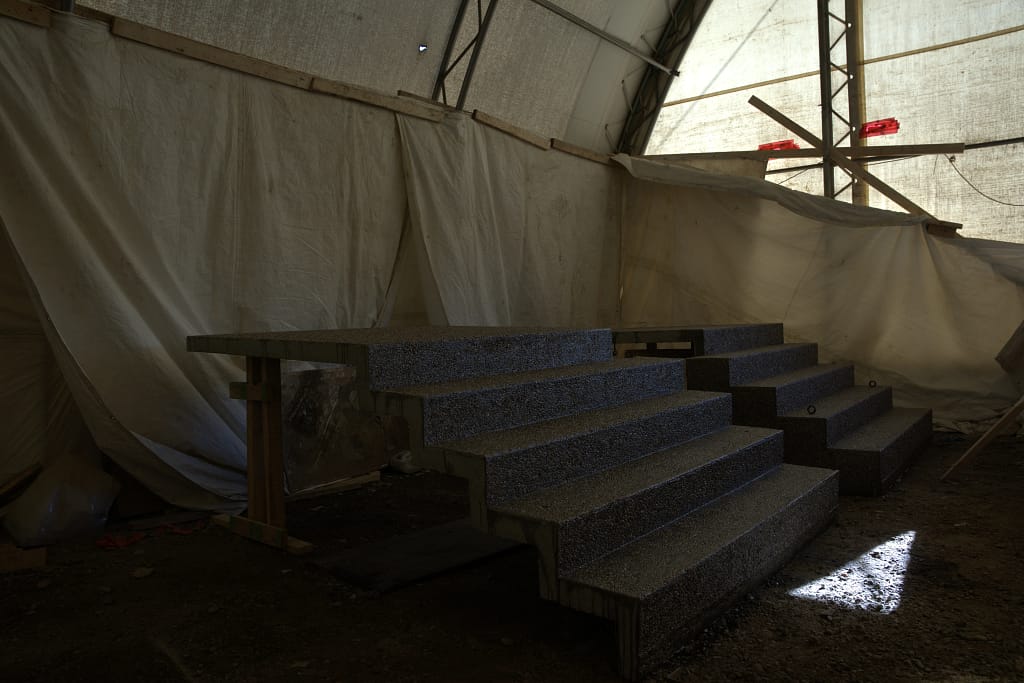
The Alberta frost and Chinook factor
Alberta ground doesn’t sit still in winter. As SoilWorx notes, concrete tanks are popular here “especially in areas prone to Chinook winds that make the ground heave and move regularly throughout the winter.” Repeated freeze-thaw cycling — Calgary sees roughly 128 a year — flexes and shifts soil around a buried tank. A heavy concrete tank rides that movement; a light tank is more easily displaced. Calgary’s frost depth is 1.2 m, and burial depth ratings reflect the difference in how each material handles being deep in moving ground: concrete up to about 5 m (16 ft) on some models, fibreglass ~2 m (6 ft), and poly shallow (≤ ~6 ft) (SoilWorx).
The same ice-segregation and adfreezing physics that heave entry steps and lift fence posts act on a buried tank — except a tank also has to resist buoyancy at the same time. Concrete answers both with mass.
What size septic tank do I need?
Alberta’s sizing logic ties tank working capacity to the number of bedrooms in the home, as a proxy for occupancy. The common working-capacity guideline is bedrooms × 1.5 persons per bedroom × ~283.91 L (75 gal) per person, set under the Alberta Private Sewage Systems Standard of Practice. For real-world reference, manufacturers position a 1,000-gallon tank (about 755 gal working capacity) for a typical 4-bedroom rural home (Westcon M-1000). Common capacity ranges run from about 407 gal (1,850 L) up to 3,200 gal (10,243 L) (Tanks-A-Lot); Westcon’s line spans 700–3,000 gal (2,649–11,356 L).
FLAG: confirm the exact minimum-capacity table in the Alberta Private Sewage SOP (2021) before relying on a hard litre figure — your certified designer sizes the actual tank from the SOP and your home’s specifics.
Setbacks: how far must a septic tank be from my well, house, and property line?
Your certified designer confirms these against the SOP and any stricter county rules, but the Alberta separation distances are the baseline you’ll be held to:
| Element | Minimum separation |
|---|---|
| Tank from buildings | ≥ 3 m (10 ft) |
| Tank from property line | ≥ 1.5 m (5 ft) |
| Treatment field from buildings | ≥ 5 m (16 ft) |
| Treatment field from property line | ≥ 3 m (10 ft) |
| Well from tank | ≥ 30 m (100 ft) |
| Well from treatment field | ≥ 90 m (300 ft) |
Source: Alberta — separation distances for sewage treatment systems; corroborated by myacreage.ca. FLAG: counties (e.g. Rocky View, Foothills) may impose stricter setbacks — verify locally.
The code: every Alberta septic tank must be CSA B66 certified
This isn’t optional, and it isn’t a marketing badge — it’s the law. Under the Alberta Private Sewage Systems Standard of Practice (4th edition, 2021; in force November 1, 2022), adopted under the Private Sewage Disposal Systems Regulation 229/97, every prefabricated septic or holding tank installed in Alberta must be certified to CSA B66 — “Design, material, and manufacturing requirements for prefabricated septic tanks and sewage holding tanks.” The current edition is CSA B66:21 (9th edition) (CSA Group; Alberta SOP PDF; Alberta private sewage codes index).
When you compare tanks, ask the manufacturer to confirm CSA B66:21 certification in writing — established makers list it openly (Tanks-A-Lot, for instance, states CSA B66-21 and a 20-year limited warranty). A tank that can’t show the certification can’t legally be installed.
You’ll also need a site evaluation and a permit, and the system must be designed and installed by a certified private sewage installer/designer. That installer is the key decision-maker most homeowners defer to — which is exactly why the material question is worth understanding before you call them.
Concrete spec, briefly (for the technically curious)
A precast concrete tank built for Alberta ground uses the same durability logic as a Calgary foundation: Type HS / sulphate-resistant cement for S-2 sulphate soil exposure, designed and produced under CSA A23.4 (precast materials and construction) with the concrete itself to CSA A23.1:24. That’s the chemistry that lets concrete sit watertight in aggressive, wet, sulphate-bearing ground for decades — and it’s why concrete tanks routinely carry 20-year limited warranties (Tanks-A-Lot; Westcon).
The honest trade-off: the heavier install
Concrete’s strength is also its one real downside — weight. A concrete tank needs proper delivery and placement equipment (a crane or boom truck and good site access), where a poly tank can be manhandled into a hole. On a tight or remote acreage that’s a genuine logistics consideration, and we won’t pretend otherwise. But it’s a one-day install consideration weighed against a multi-decade buried asset. In Alberta ground, the tank you install once is concrete; the tank you risk re-excavating after it floats or shifts is the light one. Concede the heavier install, win on permanence.
FAQ
Concrete or plastic septic tank for an Alberta acreage — which is better? Concrete, in almost every Alberta condition that matters. It won’t float in high water tables, resists Chinook freeze-thaw ground movement through sheer mass, is inherently watertight, and can be buried deeper. The trade-off is a heavier, more involved install. Poly and fibreglass are not recommended where high water tables exist.
Will my septic tank float? A light tank can. Saturated soil exerts an upward buoyant force on a buried tank; if the tank weighs less than the water it displaces and isn’t anchored, it lifts and breaks the pipe connections. A concrete tank’s mass anchors it — it won’t float.
What size septic tank do I need? Alberta sizes tanks by occupancy: roughly bedrooms × 1.5 persons × ~283.91 L (75 gal) per person of working capacity. A 1,000-gallon tank suits a typical 4-bedroom rural home. Your certified designer sets the exact size from the Alberta SOP.
How deep can a concrete septic tank be buried? Commonly 2–10 ft of earth cover, and up to about 5 m (16 ft) on some concrete models — deeper than fibreglass (~2 m) or poly (shallow). Burial depth is part of the design and depends on the specific tank and your site.
How far must a septic tank be from my well, house, and property line? Baseline Alberta separations: tank ≥ 3 m from buildings and ≥ 1.5 m from the property line; treatment field ≥ 5 m from buildings and ≥ 3 m from the line; and a well ≥ 30 m from the tank and ≥ 90 m from the field. Counties may require more.
Does my tank need to be CSA B66 certified in Alberta? Yes. Every prefabricated septic or holding tank installed in Alberta must be certified to CSA B66 (current edition CSA B66:21) under the Alberta Private Sewage Systems Standard of Practice. Ask for the certification in writing — an uncertified tank can’t legally be installed.
How long does a concrete septic tank last? Decades. Built with sulphate-resistant cement for Alberta soil, concrete tanks routinely carry 20-year limited warranties and commonly outlast that in service.
Do I need a permit and a certified designer? Yes — a site evaluation and a permit are required, and the system must be designed and installed by a certified private sewage installer/designer. That installer is usually the one who recommends the tank, so understanding the material decision first puts you in a stronger position.
Not every septic tank survives Alberta ground equally.
Before you install a system on your acreage, talk to our team – Omega Precast. We understand Chinook freeze-thaw, high water tables, and rural Alberta site conditions — not just tank pricing.