
Last updated: August 4, 2026
For Alberta builders, precast concrete installs fast and is produced year-round in a controlled plant, while cast-in-place is poured on site and suits monolithic, custom shapes. Precast reduces weather delays, site labour, and schedule risk; cast-in-place offers on-site flexibility. Climate and schedule usually tip Alberta projects toward precast.
You’re looking at the blueprints for a new build in Beltline, or you’ve been handed the budget for a foundation pour in Bridlewood. The choice between concrete methods isn’t just academic—it’s a decision that shapes your timeline, your costs, and the project’s success for the next fifty years. Here’s what you actually need to know to make the best call for your Calgary build. This guide will walk through the advantages, drawbacks, and local considerations of precast and cast-in-place concrete so you can make an informed, confident choice.
Precast Concrete
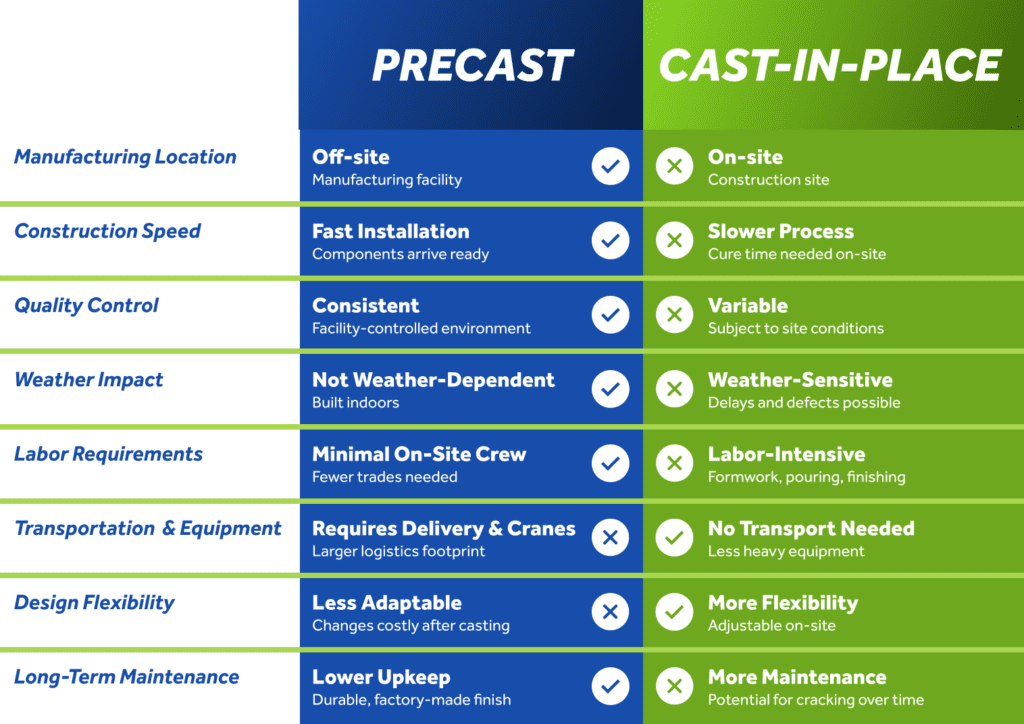
Precast concrete refers to structural components that are fabricated off-site in a controlled factory setting, then transported and assembled on your project site. For Alberta builders facing unpredictable Chinooks and a short build season, this method offers distinct advantages that can be a game-changer for adhering to schedule. Local companies like OmegaPrecast specialize in producing these high-quality elements, from wall panels to double tees, ensuring they arrive on-site ready for installation.
Advantages
Choosing precast isn’t just about speed; it’s about control and consistency. By moving the production indoors, you eliminate many of the variables that plague on-site construction.
This translates to predictable quality, less waste, and a significantly reduced need for skilled labour at the location itself.
High Quality Control and Consistency
Every precast element is poured in a controlled environment, away from the rain, snow, or heatwaves we see off Deerfoot Trail. Strict quality control measures govern the mix design, curing process, and finishing, resulting in uniform strength and a superior finish right off the truck. This consistency is critical for multi-unit projects where every piece must fit perfectly with the next.
Fast Installation and Reduced Timeline
While the concrete cures in the factory, your site crew can focus on excavation, foundation work, and utility installation, effectively running two schedules in parallel. Once the components arrive, assembly is rapid—think of it like building with giant, precision-made Lego blocks. This can cut weeks or even months off a project, a vital advantage for commercial developers on a tight timeline.
Reduced On-Site Labor Requirements
Since the complex work of forming, pouring, and curing is handled off-site, you don’t need nearly as many skilled concrete finishers and formwork carpenters on-site. This not only helps manage labour costs in a competitive Calgary market but also simplifies site safety and logistics, especially on tight urban lots in neighbourhoods like Inglewood.
Minimal Weather Impact
Alberta’s weather is notoriously fickle, but a precast schedule is largely immune to it. Factory production continues rain, snow, or shine, and installation can proceed in conditions that would halt a traditional pour. This reliability is key to hitting year-end deadlines and avoiding costly delays.
Economy of Scale for Repetitive Designs
For projects with repetitive elements—like hotel rooms, parking garages, or multi-warehouse units—precast shines. Using the same moulds repeatedly drives down the per-unit cost and maximizes efficiency, making it the most economical choice for standardized designs.
The bottom line: precast excels where schedule, quality control, and labour efficiency are top priorities.
Disadvantages
Of course, no method is perfect for every scenario. The very strengths of precast can become limitations depending on your project’s unique demands and location.
It’s crucial to weigh these potential drawbacks against the benefits to ensure it’s the right fit.
Transportation Costs
Large, heavy concrete elements require specialized trucks and potentially costly transportation logistics. For sites with difficult access—common in older Calgary communities with narrow lanes or in new developments with unfinished roads—these costs and challenges can escalate quickly.
Limited Customization
The need for transportable pieces and reusable moulds inherently limits the size, shape, and design of individual components. Truly unique, one-of-a-kind architectural features are often more suited to cast-in-place methods.
Not Ideal for Earthquake-Resistant Architecture
Monolithic, cast-in-place structures are typically considered superior for seismic design, as they create a continuous, ductile framework that can flex and absorb energy. While precast connections can be engineered for seismic zones, they require meticulous design and are generally more complex than a continuous pour.
Higher Upfront Material Costs
The factory overhead, specialized equipment, and transportation all contribute to a higher initial material cost compared to basic site-cast concrete. Builders must evaluate this against the long-term savings in time and labour to determine the true value.
Cast-in-Place Concrete

Cast-in-place (or poured-in-place) concrete is the traditional method most people picture: building forms on-site, placing steel reinforcement, pouring fresh concrete, and letting it cure in its final location. This approach offers unparalleled flexibility and is the backbone of custom residential and complex commercial projects across Alberta. It’s the go-to for creating a truly seamless, monolithic structure.
Advantages
This method’s core strength is its adaptability. You’re not limited by transport size or factory moulds, allowing creativity and structural integration that other methods can’t match.
For a custom home on a sloped lot in Strathcona Park or a complex commercial core, this flexibility is priceless.
Greater Design Flexibility
From curved walls and complex geometric shapes to integrated embeds and last-minute design changes, cast-in-place is the ultimate in adaptability. The design is only limited by the engineer’s imagination and the formwork crew’s skill, making it ideal for architectural statements and one-off projects.
Monolithic, Continuous Structure
When concrete is poured continuously, it creates a single, unified structural element with no joints between components. This continuity provides excellent structural integrity, a seamless finish, and inherently better waterproofing for below-grade applications like foundations—a major consideration for Calgary’s clay soil and potential for water pressure.
Ideal for Custom Shapes and Dimensions
Need a massive, irregularly shaped mat slab or a foundation that follows an unusual property line? Cast-in-place is your only practical option. It allows you to build the formwork to the exact, site-specific dimensions required.
Better for Complex or Irregular Designs
Projects with numerous penetrations, varying slab thicknesses, or integrated post-tensioning are often best served by a cast-in-place approach. The ability to place reinforcement and conduit exactly where needed during the pour is a significant advantage.
Fewer Transportation Costs
While you pay for ready-mix concrete delivery, you avoid the high cost and logistical headache of moving massive precast panels. For single, remote, or highly complex sites, this can be a decisive factor.
The takeaway: choose cast-in-place when design complexity, structural continuity, or site-specific adaptation are non-negotiable.
Disadvantages
The trade-off for this flexibility is a greater dependency on on-site conditions and labour. The success of a cast-in-place project lives and dies by the crew’s expertise and the weather’s cooperation.
Longer Installation and Curing Time
Every step—formwork, rebar tying, pouring, curing, and stripping forms—happens sequentially on-site. The concrete must also achieve sufficient strength before work can continue, adding days or weeks to the critical path that you don’t face with precast.
Weather Dependency and Delays
Pouring concrete in sub-zero temperatures requires expensive heating and insulating measures. Rain can wash out the surface, and extreme heat can cause premature curing and cracking. Alberta’s weather can bring all of these in a single week, risking costly delays and compromised quality.
Higher On-Site Labor Demands
This method is labour-intensive, requiring skilled carpenters for formwork, ironworkers for rebar, and concrete finishers. In Calgary’s busy construction season, securing and managing a large, qualified crew adds complexity and cost.
More Variable Strength and Finish
Quality is directly in the hands of the on-site crew. Variations in placement, curing, and finishing techniques can lead to inconsistencies in strength and appearance, such as honeycombing or colour variation, that are less common with factory-controlled precast.
Precast vs. Cast-in-Place: Direct Comparison
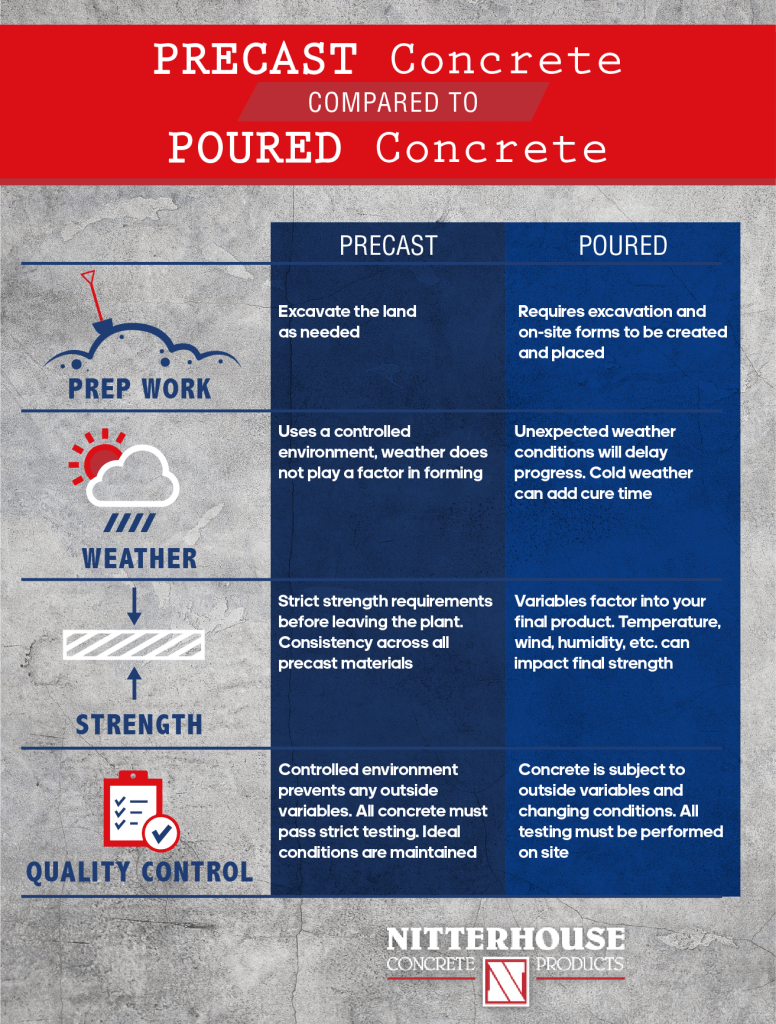
Let’s put these two methods head-to-head across the factors that matter most for your bottom line and project success. Every build is unique, but this comparison table gives you the framework to start weighing your priorities.
| Factor | Precast Concrete | Cast-in-Place Concrete |
|---|---|---|
| Cost | Higher upfront material costs, but potential for lower total installed cost due to labour/time savings. | Lower material costs, but higher total labour costs and potential for budget overruns due to delays. |
| Durability | High, consistent durability due to controlled curing; joint details are critical. | High potential durability; dependent on excellent on-site workmanship and curing. |
| Best For | Repetitive projects, tight schedules, urban sites with limited space, parking structures, warehouse walls. | Custom designs, complex foundations, monolithic structures, remote sites, seismic design. |
| Calgary Climate Suitability | Excellent. Factory production avoids weather delays; ideal for our short build season. | Good, but risky. Requires meticulous planning for temperature swings and precipitation. |
| Maintenance Required | Focus on maintaining sealant at panel joints to prevent water ingress. | Potential for cracks or spalling due to freeze-thaw; requires monitoring of the monolithic surface. |
Cost Analysis
Cost is never just about the price per cubic yard of concrete. You have to look at the total project financial picture from start to finish.
Upfront Costs
Precast typically has a higher sticker price for the materials themselves, incorporating factory overhead. Cast-in-place starts with cheaper raw material costs but quickly adds up with formwork materials, extensive labour, and on-site expenses.
Long-Term Value and Lifecycle Costs
A faster precast schedule means earlier occupancy and revenue generation for commercial projects. Its consistent quality may also lead to lower long-term maintenance costs, offsetting the higher initial investment.
Installation Time
This is where the difference is most stark. Precast projects can achieve “dried-in” status incredibly fast, protecting interior work from the elements. A cast-in-place schedule is linear and exposed to every delay, from formwork inspections to unplanned frost.
Which matters more to you: a predictable, fast timeline or maximum budget flexibility on the front end?
Quality and Durability
Both methods can produce incredibly durable structures that last generations. Precast offers guaranteed consistency, while cast-in-place offers proven monolithic performance but relies more on the crew’s skill. For critical infrastructure, the choice often comes down to the specific performance specification and the reliability of the chosen contractor.
Design Flexibility
If your design is standard or repetitive, precast wins on efficiency. If your vision is unique, sculptural, or highly integrated, cast-in-place is the only path forward. There’s simply no substitute for wet concrete when it comes to pure creative freedom.
Labor Requirements
Precast shifts the skilled labour need to the factory, reducing on-site complexity. Cast-in-place demands a large, multi-trade crew on-site for an extended period, with all the associated management and coordination challenges that entails.
When to Use Each Method

Making the final call means matching the method’s strengths to your project’s core requirements. Let’s break down the ideal applications for each approach.
Precast Concrete Applications
Think repetition, speed, and quality control. Precast is the champion for large-scale commercial and infrastructure projects. This includes parking garages (like those needed near the Calgary Stampede grounds), tilt-up warehouse walls, prefabricated bridge components, sound barrier walls along Stoney Trail, and standardized structural elements for multi-family buildings.
If your goal is to enclose a building shell before the first snowfall hits, precast from a local expert like OmegaPrecast is a proven strategy.
Precast concrete has become increasingly popular for commercial and infrastructure projects because of its speed, consistency, and reduced on-site labour requirements. Industry standards and best practices for precast manufacturing can be explored through the National Precast Concrete Association.
Cast-in-Place Concrete Applications
Think custom, complex, and continuous. This method is the gold standard for custom residential foundations, especially on challenging sites. It’s essential for high-rise building cores, massive mat foundations, irregularly shaped structures, swimming pools, and any project where seismic performance or absolute waterproofing is the top priority.
Combined Approach
The most innovative projects often use a hybrid strategy. It’s not an either/or decision; it’s about leveraging the right tool for each part of the job.
Using Both Methods on Projects
A common and effective approach is to use cast-in-place for the building’s core and foundations to achieve monolithic strength, while utilizing precast for the exterior wall panels and floor planks to accelerate the enclosure schedule. This hybrid model captures the design flexibility of cast-in-place where it’s needed most and the speed and quality of precast for repetitive elements.
This balanced approach requires careful coordination but can offer the best of both worlds for large, complex builds.
FAQ: Concrete Choices for Alberta Builders
Let’s tackle some of the most frequent questions we hear from Calgary contractors and developers weighing their concrete options.
Which method is more resistant to Calgary’s freeze-thaw cycles?
Both can be extremely durable when designed and executed properly. The key factor is the quality of the concrete mix itself—using air-entrained concrete is non-negotiable for our climate. Precast has an edge in consistency, as the controlled curing process ensures proper strength development. Cast-in-place can be just as resilient, but it’s more vulnerable to poor on-site curing practices that can lead to surface scaling.
For either method, ensure your spec includes a 32 MPa mix with 6% air entrainment for optimal freeze-thaw resistance.
Is precast or cast-in-place better for a fast-track project in Calgary?
Precast is almost always the faster option for achieving a building envelope. Because the components are manufactured while site work proceeds, it compresses the overall schedule significantly. For a fast-track commercial project in an area like Quarry Park, where time-to-lease is critical, precast can shave months off the timeline compared to sequential cast-in-place work, getting you to revenue-generating occupancy much sooner.
Can precast concrete be used for custom home foundations?
While possible, it’s less common and often not cost-effective for a one-off custom home. The design flexibility of cast-in-place is usually better suited to the unique layouts, elevations, and integration with other systems found in high-end residential builds. Precast foundation walls are more typical for production-style housing where the same panel designs are repeated.
For your custom dream home on an acreage near Springbank, a cast-in-place foundation is typically the recommended route for maximum adaptability.
What are the biggest hidden costs to watch for?
For precast, the hidden costs are in transportation logistics and crane access—always confirm site accessibility and crane requirements upfront. For cast-in-place, the hidden costs are almost always in labour overruns and weather delays. An unexpected week of -20°C temperatures or heavy rain during a pour can blow a budget through extra heating, labour standby time, and repair work.
Always build a 10-15% contingency into your budget specifically for weather-related delays with cast-in-place.
Conclusion
Choosing between precast and cast-in-place concrete isn’t about finding a single “best” method. It’s about strategically matching the right process to your project’s specific goals for design, timeline, budget, and location. Precast delivers speed, quality control, and schedule certainty for repetitive or time-sensitive builds. Cast-in-place offers unmatched flexibility and monolithic strength for one-of-a-kind or highly complex structures.
For many Alberta builders, the most prudent path involves consulting with an experienced provider early in the design phase. A local expert can help you weigh these pros and cons against your specific site conditions in communities like McKenzie Towne or University District.
Ready to make a confident decision on your next project’s concrete strategy? The team at OmegaPrecast brings local Calgary expertise to help you evaluate both precast and cast-in-place options, ensuring you choose the method that delivers the best value and performance for your build.