
Last updated: August 6, 2026
Precast and tilt-up are both concrete wall systems, but precast is cast in a factory and delivered finished, while tilt-up is cast on site and tilted into place. Precast offers year-round production, tighter quality control, and design flexibility; tilt-up can suit large, simple footprints. Alberta’s climate favours factory-cast precast.
Waking up to a cracked foundation slab in Ogden or planning a massive warehouse near Deerfoot Trail? Choosing the right concrete wall system can feel overwhelming with so much conflicting advice online. Here’s how to cut through the noise and make a smart choice for your Alberta build. This complete comparison breaks down precast and tilt-up construction from a local perspective.
We’ll look at cost, timelines, durability in our climate, and what makes sense for your specific Calgary project. As a trusted local authority, OmegaPrecast has the experience to guide you from the drawing board to the final pour.
What is Tilt-Up Construction?
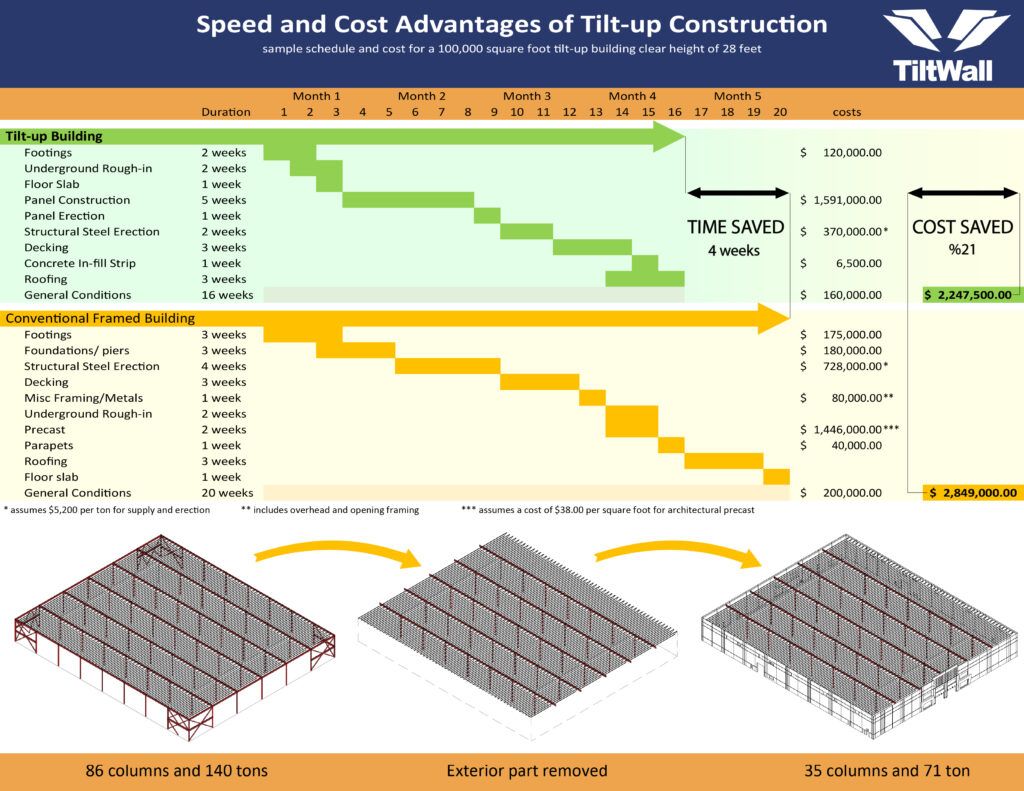
Tilt-up construction is an on-site method where large concrete wall panels are cast directly on the building’s future floor slab. Crews set up forms, place steel reinforcement, and pour the concrete flat on the ground. Once the panels have gained enough strength, they are literally “tilted up” into vertical position by a large crane and secured to the foundation.
This method is incredibly popular for single-story commercial buildings like warehouses and retail big-box stores. The primary appeal is the ability to use the building slab as the casting bed, which can streamline certain site logistics.
Process and Benefits of Tilt-Up Panels
The process begins with preparing a perfectly level and smooth concrete slab. Workers then lay out the panel shapes, install rebar cages, and pour the concrete directly onto this surface. After curing, the giant panels, which can weigh over 100 tons each, are lifted by crane and braced temporarily until the roof structure locks them in place.
The major benefit is the significant reduction in transportation costs, as the panels are made right where they’ll stand. This also allows for last-minute adjustments if site conditions change. For a straightforward warehouse off Stoney Trail, the streamlined, on-site workflow can be a major advantage.
In short, tilt-up turns your building site into a temporary factory, maximizing control over the panel production schedule.
To better understand Alberta’s extreme weather conditions and their impact on construction, check Environment and Climate Change Canada.
What is Precast Construction?
Precast construction involves manufacturing concrete wall panels, columns, and beams in a controlled factory environment. These components are cast in reusable steel molds, cured under ideal conditions, and then transported to the job site for assembly. Think of it like building with giant, precision-made Lego blocks that are engineered to fit together perfectly.
This method is used for everything from multi-story apartment complexes to institutional buildings and sophisticated commercial facades. The controlled factory setting is the key differentiator, separating it from the weather-dependent nature of on-site work.
Process and Advantages of Precast Panels
In a precast plant, steel molds are prepared to exact specifications. High-strength concrete is poured, vibrated to eliminate air pockets, and then steam-cured in a controlled environment. This results in panels with exceptional strength and a consistent, high-quality finish that is difficult to achieve on-site.
The primary advantage is year-round production. While a Calgary winter can shut down a tilt-up site for months, a precast plant keeps working. This controlled process also allows for intricate architectural details, complex insulation packages, and embedded fixtures to be installed in the panel before it ever leaves the factory.
Precast delivers factory precision and weather-proof scheduling, which is a game-changer for Alberta’s short construction season.
Key Differences Between Precast and Tilt-Up

While both methods create durable concrete walls, their core philosophies differ. Tilt-up is a site-built solution, embracing the constraints and opportunities of the local environment. Precast is a factory-built component system, prioritizing control, precision, and schedule certainty.
This fundamental difference impacts everything from your project budget and timeline to the final architectural quality. Your choice often comes down to whether you value the adaptability of on-site work or the predictability of factory manufacturing.
Location of Panel Production (On-Site vs Factory)
This is the most obvious difference. Tilt-up panels are born and raised on your property. This eliminates transport costs for the panels themselves but requires enough clear, flat space on-site for casting and crane access.
Precast panels are born in a factory and delivered to you. This requires careful logistics planning for trucking large components, often along designated haul routes like Glenmore Trail. The trade-off is that zero panel production space is needed on your potentially cramped inner-city site in Bridgeland.
Manufacturing and Curing Process
Tilt-up curing relies on ambient weather. In July, this is fast; in October, it’s slow and risky if an early freeze hits. The concrete’s final strength and finish can be inconsistent due to wind, sun, and temperature changes during the critical curing period.
Precast curing happens in a factory with steam kilns. This accelerates the process to mere hours and guarantees the concrete achieves its full design strength reliably, every single time. The result is a more durable, higher-quality product with fewer potential defects.
Where you make the panels dictates their quality, cost, and how much you’re at the mercy of Alberta’s unpredictable weather.
Cost Comparison
Cost is never a simple number with construction. For concrete walls, you need to look at the total installed cost, which includes materials, labour, equipment, and indirect expenses like schedule delays. A cheaper per-panel price can vanish quickly if weather pushes your project into the next season.
Let’s break down the costs head-to-head. The following table gives you a clear, side-by-side look at the major financial factors.
| Factor | Tilt-Up Construction | Precast Construction |
|---|---|---|
| Cost | Lower initial material cost, but vulnerable to weather-related overruns. | Higher initial panel cost, but more predictable total project cost. |
| Durability | High, but quality depends on on-site curing conditions. | Very High. Factory curing ensures optimal strength and consistency. |
| Best For | Large, simple footprint warehouses and single-story commercial builds. | Multi-story buildings, projects with tight urban sites, and complex designs. |
| Calgary Climate Suitability | Good for Spring/Summer builds. High risk of delays in Fall. | Excellent. Factory production continues year-round regardless of site weather. |
| Maintenance Required | Moderate. On-site joints and finishes may require more long-term attention. | Low. Factory-applied finishes and precise joints typically last longer. |
Material Costs: On-Site Pouring vs Precast Panels
The raw materials for concrete are similar, but tilt-up often uses a simpler mix poured on-site. Precast panels can use specialized mixes and high-performance concrete, which adds to the base material cost. However, the factory’s bulk purchasing power can offset some of this premium.
Where tilt-up saves is on forming. It uses inexpensive, single-use forms built on the slab. Precast requires expensive, reusable steel molds, a cost factored into each panel. For a one-off project, tilt-up forming is cheaper; for repetitive designs, precast mold costs are amortized.
Labor and Installation Costs
Tilt-up requires a large on-site crew for forming, pouring, curing, and lifting. This labour is subject to weather delays and overtime if the schedule slips. Crane time is extensive, as it’s used for every single lift.
Precast shifts much of the labour to the factory, where it’s more efficient and not weather-dependent. On-site, erection is faster with a smaller crew. Crane time is focused solely on placement, which can be quicker than the multi-step tilt-up process.
Transportation and Fixed Costs
Tilt-up has near-zero panel transport cost. Precast has a fixed cost to truck panels from the plant, which must be calculated based on distance. For a project in far southeast Calgary, this is a real factor.
Conversely, tilt-up has a high fixed cost for the large crane required for tilting. Precast may use a smaller crane. The key is to get a total quote that includes all mobilization, equipment, and indirect costs for a true comparison.
Overall Cost-Effectiveness by Project Size
For a massive, simple 100,000 sq ft warehouse, tilt-up often wins on pure cost per square foot. The economies of scale on-site are hard to beat. For projects under 50,000 sq ft, or those with complex designs, the efficiency and schedule certainty of precast often provide better overall value, even with a higher initial tag.
Always compare total project costs, not just the price per square foot of wall.
Construction Speed and Timeline
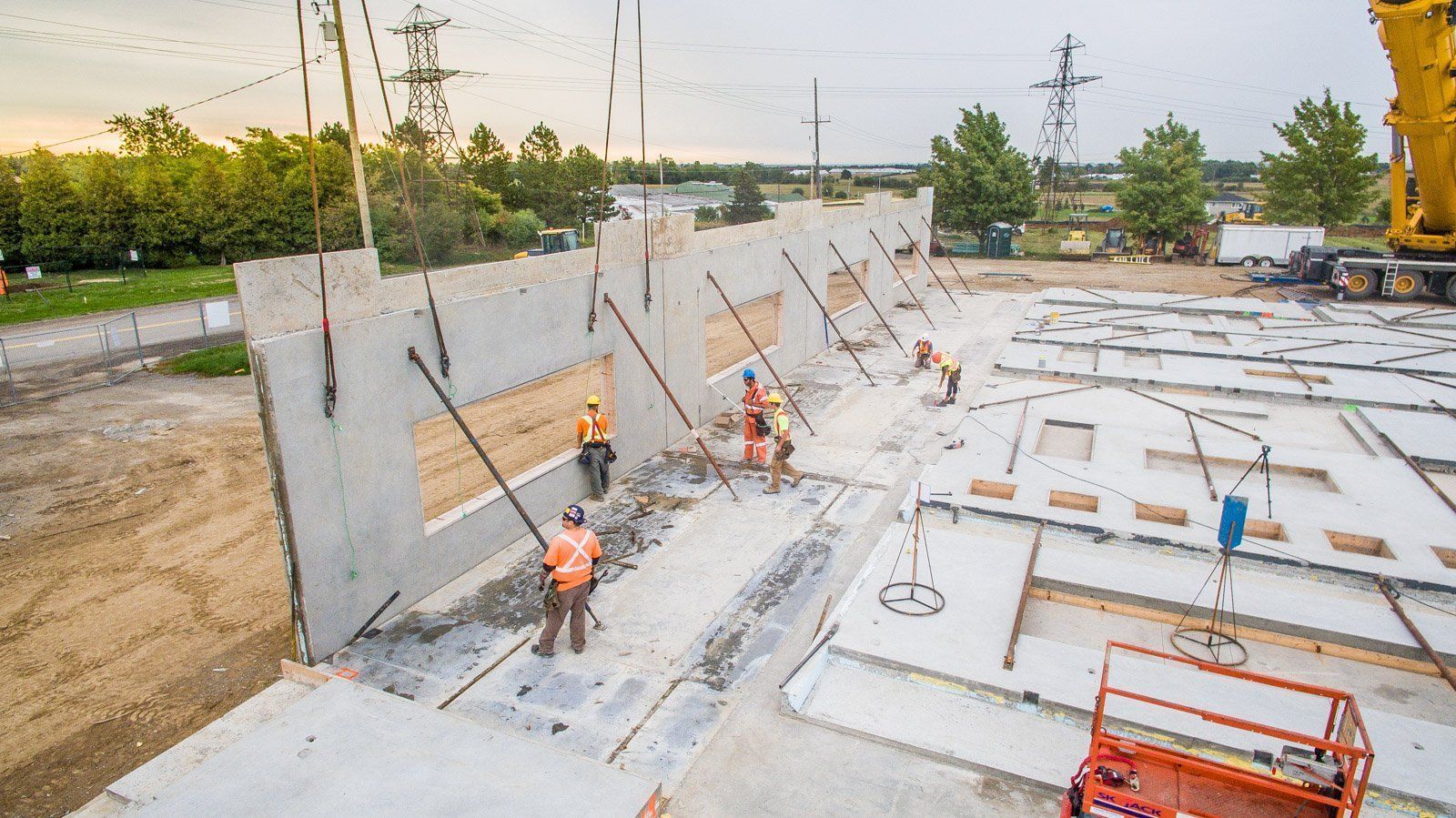
Speed isn’t just about how fast the walls go up; it’s about how predictably the entire project finishes. A faster method that gets delayed by three weeks of rain may ultimately be slower than a reliably scheduled alternative. This is critical for project financing and ROI.
Erection and Assembly Time
Once panels are ready, tilt-up erection is fast. Casting all panels, however, can take weeks and is sequential. Precast panel manufacturing happens concurrently with site foundation work. When the site is ready, panels arrive on trucks and go up in a rapid, assembly-line fashion.
For a building in a busy industrial park like Skyview Ranch, the reduced on-site congestion and faster enclosure time with precast can be a major benefit to neighbouring operations.
Impact on Project ROI
A delayed building can’t generate rent or house inventory. The financial cost of a weather delay in September, pushing occupancy into the new year, can dwarf any savings from a cheaper wall system. Precast’s lockable schedule de-risks the project timeline.
This predictability allows for accurate financing draw schedules and lets tenants plan their move-in with confidence. For developers, time certainty is often worth a premium.
A predictable finish date is often more valuable than a theoretically faster start.
Weather and Environmental Factors
Alberta’s climate isn’t just cold; it’s a rollercoaster of freeze-thaw cycles, chinooks, and sudden storms. Concrete is vulnerable during its curing phase, making weather a primary risk factor for any on-site construction activity.
Weather Delays: On-Site vs Controlled Environments
Rain can wash out tilt-up formwork. Wind can damage freshly poured surfaces. A sudden freeze before concrete has fully cured can cause catastrophic internal damage, leading to spalling and reduced lifespan. Each weather event adds cost and delay.
In a precast plant, none of these factors exist. Pouring, curing, and finishing happen in a climate-controlled building. Your project’s weather risk is limited to the erection phase, which is a much shorter, more manageable window.
Suitability for Alberta’s Climate and Winter Conditions
Tilt-up has a very narrow optimal window in Alberta—roughly May through September. Even then, a hailstorm or early cold snap can cause issues. This compresses the construction season and floods the market with demand, potentially raising labour costs.
Precast is inherently suited for our climate because the manufacturing season is 12 months long. You can break ground in March and know your panels will be ready on time, even if there’s snow on your site in Coventry Hills. This extends the viable building season significantly.
Building with precast is like having a guaranteed “weather insurance” policy for your project’s critical path.
Space and Site Requirement
Your available land isn’t just for the building footprint. You need space for construction activities, material storage, and crane swings. A cramped urban site or a lot with challenging topography can instantly rule one method out.
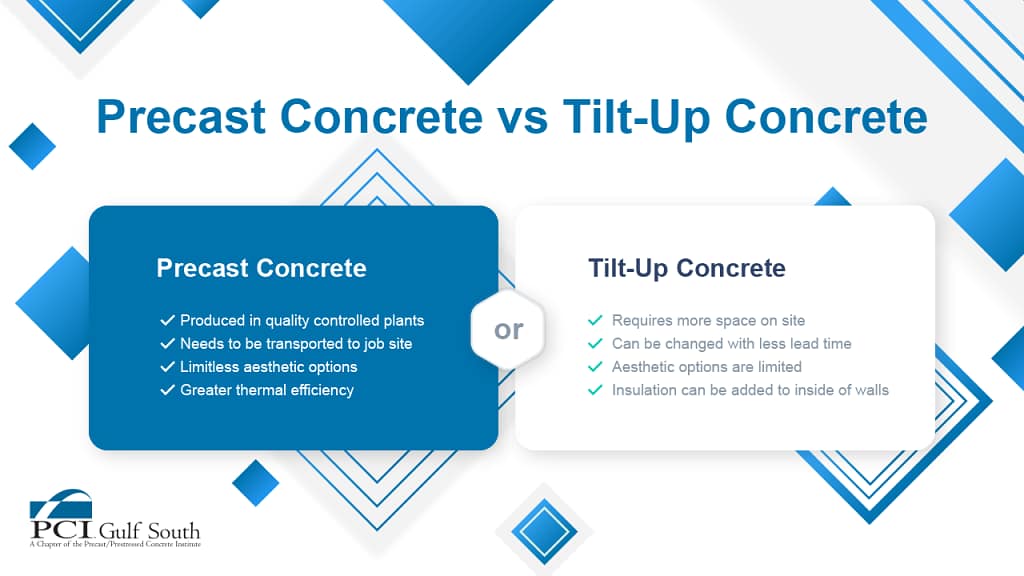
Tilt-up demands a “casting yard”—a large, clear, level area around the building perimeter equal to the area of the walls themselves. This space must also accommodate crane access from multiple angles. If your site is tight, this is a major hurdle.
Precast requires much less on-site staging area. Panels are delivered just-in-time and placed directly from the truck. This makes it ideal for infill developments in established communities like Inglewood or for sites with significant slopes or limited access.
Durability, Strength, and Maintenance
All concrete is durable, but not all concrete is created equal. The conditions during its creation directly impact its long-term performance, especially against Alberta’s relentless freeze-thaw assault. A wall’s lifespan and maintenance needs are decided during the first few days of its life.
Concrete Strength and Longevity
Precast concrete is consistently high-strength due to controlled curing. The steam-curing process allows for a lower water-to-cement ratio, resulting in a denser, less permeable, and more durable product. This density is the best defence against water infiltration and freeze-thaw damage.
Tilt-up concrete strength can vary based on on-site curing practices. Improper curing on a hot, windy day can lead to a weaker surface more prone to scaling and cracking over the decades.
Quality Consistency
Factory production means every precast panel is virtually identical. The finish, dimensions, and embed locations are precise. This leads to tighter, more uniform joints and a higher-quality overall appearance.
On-site production is subject to daily variables. While a great crew can do excellent work, the potential for minor inconsistencies in finish or colour between panels poured on different days is higher.
For a building you want to stand for 50+ years with minimal fuss, the controlled start of precast is a compelling advantage.
Design Flexibility and Building Size Efficiency

Your building needs to function well and look good. The chosen wall system can enable or limit your architectural vision and the efficiency of the interior space. It’s not just about the walls; it’s about what the walls allow you to do inside.
Limitations by Project Size (Under 50,000 sq ft vs Larger)
For very large, simple boxes (big-box retail, distribution centres), tilt-up is highly efficient. The repetition and scale work in its favour. For buildings under 50,000 sq ft, the fixed costs of crane mobilization and forming can make tilt-up less economical per square foot.
Precast is efficient at virtually any scale because the factory’s fixed costs are spread across multiple projects. Whether it’s a 20,000 sq ft office building in Quarry Park or a 200,000 sq ft facility, the production model remains cost-effective.
Architectural Options and Customization
Tilt-up offers good basic finishes—broom, exposed aggregate, light form-liners. Achieving complex shapes, deep reveals, or intricate patterns is difficult and expensive with on-site forms.
Precast excels here. Steel molds can be crafted to create virtually any shape, texture, or pattern. This allows for stunning architectural facades, detailed cornices, and integrated insulation systems that are simply not feasible with tilt-up.
Pros and Cons of Each Method
Let’s summarize the trade-offs clearly. Every project is a balance of priorities, and understanding these lists will help you weigh what matters most for your build in Alberta.
- Tilt-Up Pros: Lower initial material cost for large projects. No panel transportation cost. Can adapt to minor site changes.
- Tilt-Up Cons: Highly weather-dependent. Requires large, clear casting area. Less design flexibility. Quality subject to on-site conditions.
- Precast Pros: Year-round, weather-proof production. Superior quality control and consistency. Faster on-site erection. Excellent design flexibility. Ideal for tight or urban sites.
- Precast Cons: Higher initial panel cost. Requires transportation logistics. Less flexibility for last-minute on-site changes.
Neither system is universally “better.” The best choice is the one that aligns with your project’s specific constraints for budget, timeline, site, and design. What’s the wrong choice? Picking a system based on a single factor without considering the whole picture.
Which is Best for Alberta Projects? Factors to Consider
So, how do you decide? Start by being brutally honest about your project’s non-negotiables. Is an absolute rock-bottom initial cost the only goal, even if it means winter risk? Or is hitting a firm completion date to secure a tenant the top priority?
For most commercial builds in Calgary, the climate is the deciding factor. The ability to build on a predictable schedule often outweighs a modest upfront savings that could evaporate with one bad weather month.
Regional Considerations for Northern Climates
Alberta’s short, volatile construction season adds a massive hidden cost to any weather-sensitive method. The financial impact of a delay—from extended construction financing to lost lease revenue—must be part of your calculation. Precast systematically removes this climate risk.
Furthermore, the superior durability and consistent quality of factory-cured concrete are a long-term advantage in a region where freeze-thaw is the primary cause of concrete deterioration.
Ideal Applications for Warehouses and Commercial Builds
Choose Tilt-Up If: Your project is a large, simple, single-story warehouse or retail box on a sprawling, flat greenfield site. You are building in the core summer months and have schedule flexibility to absorb potential weather delays. Absolute lowest upfront cost is the primary driver.
Choose Precast If: Your project is multi-story, has architectural complexity, or is on a tight urban site. You are building on any timeline that brushes against spring or fall. Predictable cost and schedule are critical. You prioritize long-term durability and low maintenance.
Frequently Asked Questions
Can precast concrete panels be used for residential projects in Calgary?
Absolutely. While more common in commercial, precast is excellent for multi-family residential like apartment complexes and townhouse projects. The speed of enclosure is a huge benefit for getting buildings weather-tight fast, and the quality of finish is superior for lasting curb appeal in communities like McKenzie Towne.
The main consideration is scale; for a single custom home, the cost of custom molds may be prohibitive compared to traditional wood-frame or ICF construction.
Is tilt-up construction safe in Calgary’s earthquake zone?
Yes, when engineered properly. Both tilt-up and precast buildings are designed to meet the National Building Code of Canada, which includes seismic provisions for our region. The connections between panels and the roof/foundation are critically engineered to handle lateral forces.
A qualified structural engineer will design the system specifically for your site’s requirements, ensuring safety regardless of the concrete method chosen.
How much longer does a precast building last compared to tilt-up?
Both systems will last for many decades with proper design and maintenance. The key difference is in the potential for long-term maintenance issues. The higher, more consistent density of factory-cured precast concrete generally makes it more resistant to moisture ingress and freeze-thaw damage over a 50-100 year lifespan.
This often translates to lower lifecycle costs, as the envelope may require less repair and resealing over the building’s life.
Can I get a green or sustainable building with both methods?
Yes, and precast often has an edge. The factory environment allows for extremely precise integration of continuous insulation layers within the wall panel, eliminating thermal bridging far more effectively than typical site-applied systems. This creates a superior building envelope for energy efficiency.
Furthermore, factory production generates less material waste, and any waste concrete is recycled within the plant, contributing to a more sustainable project overall.
Our Verdict for Alberta Builders
For the majority of commercial and industrial projects in Calgary and across Alberta, precast construction presents the lower-risk, higher-certainty choice. The ability to manufacture year-round in a controlled factory removes the single biggest variable in Alberta construction: the weather. This predictable timeline protects your project budget and ROI from costly overr0uns.
When you add in the benefits of superior quality control, design flexibility, and suitability for tighter urban sites, the value proposition of precast becomes very strong. While tilt-up retains a cost advantage for massive, simple structures built in ideal summer conditions, that window is narrow and fraught with risk.
Ready to build with the confidence of a predictable schedule and a superior product? OmegaPrecast brings local expertise and factory precision to your next project. Let’s discuss how precast construction can deliver the durability, speed, and value your Alberta build demands.