
Last updated: August 4, 2026
This glossary explains common precast concrete terms — like hollow-core, double-tee, embed, blockout, camber, lifting insert, and shop drawing — so builders and owners can read specs and coordinate confidently. Understanding the vocabulary prevents miscommunication and costly errors during precast design, fabrication, and installation.
If you have ever sat in a pre-construction meeting where half the room nodded confidently while the other half quietly Googled terms under the table, you already know the problem: precast concrete terminology is not always clearly understood. Misused or misunderstood terms can lead to design errors, incorrect pricing, delays in fabrication, or costly site fixes. In an industry where precision matters, language matters just as much.
This comprehensive glossary is designed specifically for builders, engineers, architects, and project managers who work with precast concrete across Canada. Drawing on real-world manufacturing and site experience, this guide explains key precast concrete terms in plain language—while still respecting the technical depth professionals expect. Whether you are new to precast or looking to standardize communication across your team, this glossary is built to be a practical, bookmark-worthy reference.
At Omega Precast, we manufacture and supply precast concrete components nationwide, working daily with contractors, consultants, and developers. The terminology below reflects what is actually used on drawings, in plants, and on job sites—not just textbook definitions.

What Is Precast Concrete? (Quick Context for Builders)
Definition of Precast Concrete
Precast concrete refers to concrete elements that are manufactured in a controlled factory environment, then transported to the construction site for installation. Unlike cast-in-place concrete, which is poured and cured on site, precast components are produced off-site using reusable molds, engineered reinforcement, and controlled curing conditions.
From a terminology standpoint, the word “precast” does not describe a single product—it describes a process. Precast concrete can include structural elements (such as beams or wall panels), architectural components (such as façades or staircases), or infrastructure products (such as utility vaults and culverts).
Precast vs Cast-In-Place: Key Terminology Differences
Many construction misunderstandings stem from using precast and cast-in-place terms interchangeably. The table below highlights common terminology differences that matter during design, pricing, and scheduling:
| Category | Precast Concrete | Cast-In-Place Concrete |
|---|---|---|
| Production Location | Manufactured in a precast plant | Poured and cured on site |
| Quality Control | Factory-controlled, repeatable | Weather- and site-dependent |
| Scheduling Terms | Lead time, production slots, delivery sequencing | Pour dates, cure time, form stripping |
| Common Vocabulary | Panels, erection, embedded plates | Forms, pours, finishing |
Understanding these differences early helps teams choose the right system—and speak the same language from concept to completion.
Many of the terms explained in this glossary—such as lead time, erection sequencing, and controlled curing—directly relate to why precast concrete performs so well on commercial projects. When builders fully understand this terminology, they can better evaluate the real-world benefits of precast concrete for commercial construction, including faster schedules, reduced site risk, and long-term cost predictability.
Core Precast Concrete Manufacturing Terminology
Precast Concrete Plant
A precast concrete plant is a dedicated manufacturing facility where concrete elements are produced under controlled conditions. These plants are equipped with batching systems, molds, reinforcement stations, curing chambers, and quality control laboratories.
From an industry perspective, plant-based production is what enables precast concrete to achieve consistent strength, tight tolerances, and repeatable finishes—advantages often referenced in specifications and bids.
Formwork (Molds)
Formwork, often referred to as molds in precast terminology, defines the shape and surface finish of a precast element. Unlike site-built forms, precast molds are typically reusable and engineered for long-term accuracy.
- Steel forms: High durability, tight tolerances, common for structural elements
- Fiberglass or composite forms: Used for complex shapes and architectural finishes
- Adjustable forms: Allow dimensional variation without building new molds
Reinforcement
Reinforcement refers to steel or fiber materials embedded within precast concrete to resist tensile forces. Common reinforcement terms include:
- Rebar (reinforcing steel): Deformed steel bars placed according to engineered layouts
- Welded Wire Mesh (WWM): Prefabricated steel grids used in panels and slabs
- Fiber reinforcement: Synthetic or steel fibers mixed into concrete for crack control
Correct reinforcement terminology is critical when reviewing shop drawings or structural schedules.
Prestressing
Prestressing is a specialized reinforcement method used to improve structural performance by introducing compressive forces into the concrete.
- Pretensioning: Steel strands are tensioned before concrete is poured
- Post-tensioning: Steel tendons are tensioned after the concrete has cured
Prestressed precast elements can span longer distances, reduce cracking, and support higher loads—terms commonly seen in parking structures, bridges, and long-span systems.
Curing
Curing describes the process of maintaining moisture and temperature to allow concrete to achieve its design strength. In precast manufacturing, curing is carefully controlled to improve consistency and production speed.
- Steam curing: Accelerates early strength gain
- Moist curing: Maintains humidity for long-term strength development
- Accelerated curing: Used to meet tight production schedules
According to industry research, controlled curing can improve early strength by up to 30–40% compared to uncontrolled site conditions—one reason precast is often selected for fast-track projects.
Terms like load-bearing panels, sandwich panels, architectural finishes, and embedded connections are most commonly encountered when working with wall systems. For a deeper technical breakdown beyond definitions, our guide on precast concrete wall panels—types and applications explains how these terms translate into real building performance across commercial and industrial projects.

Structural Precast Concrete Terms
Load-Bearing Precast Elements
Load-bearing precast elements are structural components designed to carry gravity loads, lateral forces, or both. These elements are engineered as part of the building’s primary structural system.
- Structural wall panels: Support floors and roofs while acting as exterior or interior walls
- Precast columns: Vertical load-carrying members
- Precast beams: Horizontal members transferring loads to columns or walls
- Double tees: Long-span floor and roof elements common in parking structures
Non-Load-Bearing Precast Elements
Non-load-bearing precast components serve architectural or enclosure functions rather than structural support. Understanding this distinction is critical when coordinating structural responsibility.
- Cladding panels: Exterior façade elements
- Architectural screens: Decorative or privacy features
- Spandrel panels: Panels located between floors
Connections
Connections describe how precast elements are joined to each other or to other structural systems. Connection terminology often appears in shop drawings and erection plans.
- Embedded plates: Steel plates cast into concrete for welding or bolting
- Welded connections: Common in structural precast assemblies
- Bolted connections: Allow adjustability during erection
- Grouted joints: Filled with grout after installation for load transfer
As one structural engineer quoted by the Precast/Prestressed Concrete Institute notes, “Connections are often the most critical part of a precast system—both structurally and logistically.”
Summary of Key Takeaways So Far
Understanding precast concrete terminology at the manufacturing and structural level creates a strong foundation for successful projects. Clear language improves coordination between designers, manufacturers, and installers—reducing risk, controlling cost, and accelerating schedules.
In the next section of this glossary, we will explore architectural precast terminology, common precast components, and installation-related terms that builders encounter on active job sites across Canada.
Need guidance on selecting or specifying precast components? Reach out to the Omega Precast team for expert support, clear communication, and reliable nationwide manufacturing.

Architectural Precast Concrete Terminology
Architectural Precast Concrete
Architectural precast concrete refers to precast elements where appearance, texture, and finish are just as important as structural performance. These components are often used on building façades, entry features, stair systems, and public-facing structures where aesthetics influence design decisions.
In practice, architectural precast can be structural, non-structural, or a hybrid of both. The terminology used in drawings and specifications helps clarify whether the element contributes to load resistance or serves primarily as an enclosure or visual feature.
Surface Finishes
Surface finish terminology defines the final appearance of precast elements. These terms are critical during mock-ups, approvals, and quality inspections.
- Smooth form finish: Clean, uniform surface straight from the mold
- Sandblasted finish: Light abrasion to expose fine aggregate
- Exposed aggregate: Decorative reveal of coarse aggregate
- Acid-etched finish: Chemical treatment for subtle texture
- Form liner finish: Patterned textures created using liners
Color & Texture Terms
Architectural precast color is typically achieved through integral pigmentation rather than surface coatings. Common terminology includes:
- Integral color: Pigment mixed directly into the concrete
- Natural aggregate: Stone selected for color and texture
- Custom blend: Unique mix design for a specific project
Precast Concrete Components & Products
Common Precast Products
Precast terminology often overlaps with product naming. Builders and estimators should be familiar with the most commonly specified components:
- Precast stairs and landings
- Precast wall panels (solid, insulated, sandwich panels)
- Precast beams and columns
- Precast foundations and footings
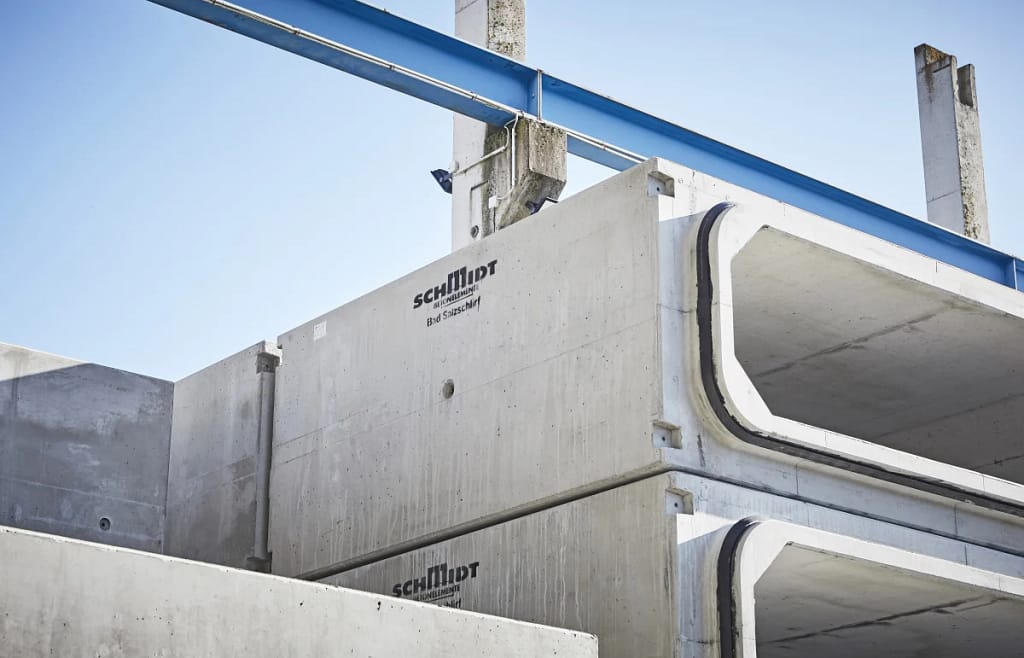
- Precast utility structures (manholes, vaults, chambers)
Using correct product terminology ensures accurate pricing and prevents scope gaps during procurement.
Custom vs Standard Precast
Standard precast refers to repeatable components manufactured using existing molds, while custom precast involves project-specific molds, shapes, or finishes.
Custom precast allows greater design flexibility but may introduce longer lead times and higher upfront costs. Understanding this distinction helps teams balance budget, schedule, and design intent.
This glossary focuses on language and definitions, but terminology only becomes valuable when applied correctly. Builders planning projects in Western Canada may find it helpful to reference our complete guide to precast concrete products for Alberta projects, which connects these terms to real applications, climate considerations, and construction sequencing.
Installation & Site Terminology
Lifting & Handling Terms
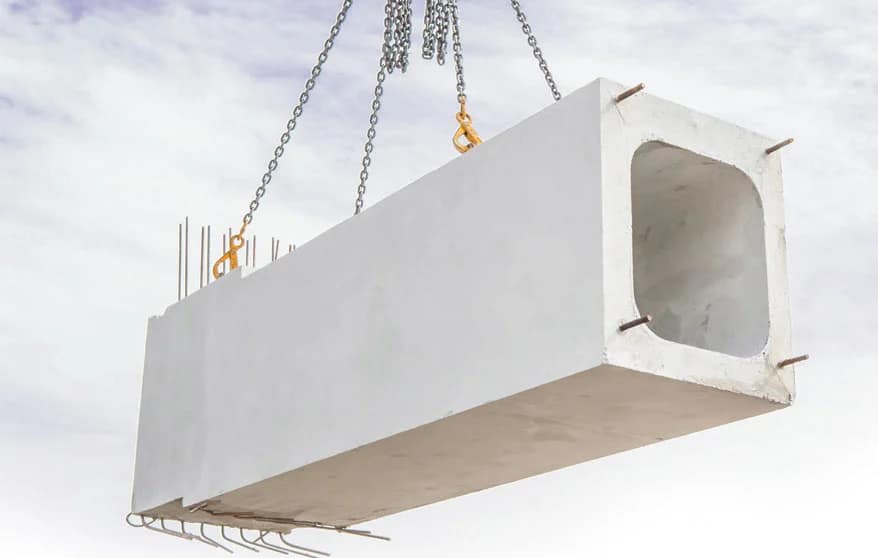
Precast elements are heavy, and proper lifting terminology is essential for safe installation.
- Lifting anchors: Embedded devices used for hoisting
- Rigging: Slings, chains, and hardware used during lifting
- Crane picks: Individual lifting operations
- Load charts: Crane capacity references
Erection
Erection refers to the on-site installation of precast components. This phase includes setting, aligning, temporarily bracing, and permanently connecting elements.
- Panel setting
- Temporary bracing
- Final alignment and connection
Tolerances
Tolerances define acceptable dimensional variation. Precast tolerances are typically tighter than cast-in-place systems, which is why coordination between trades is critical.
Quality Control & Compliance Terminology
CSA & Industry Standards
In Canada, precast concrete is governed by standards such as CSA A23.4, which outlines requirements for materials, manufacturing, and performance.
Quality Assurance (QA)
Quality assurance terminology commonly referenced includes:
- Concrete batch testing
- Compressive strength testing
- Dimensional inspections
- Finish acceptance criteria
Shop Drawings
Shop drawings are detailed fabrication drawings prepared by the precast manufacturer and reviewed by the design team. These drawings translate design intent into buildable components and often include reinforcement layouts, connection details, and lifting points.
Precast Concrete Logistics & Scheduling Terms
Lead Time
Lead time refers to the duration required for design coordination, mold preparation, manufacturing, and curing before delivery. Understanding lead time terminology helps prevent unrealistic scheduling expectations.
Delivery & Transport
Because precast components are large and heavy, delivery terminology is often discussed early in planning:
- Sequenced deliveries
- Shipping restraints
- Site access limitations
Sustainability & Performance Terminology
Thermal Performance
Thermal terminology is especially important for insulated precast panels:
- R-value: Thermal resistance rating
- Sandwich panel: Two concrete wythes with insulation core
Durability & Lifespan
Precast concrete is known for long-term durability, often exceeding 50–75 years with minimal maintenance. Common durability terms include freeze-thaw resistance, chloride resistance, and service life.
Environmental Terminology
- Lifecycle assessment (LCA)
- Material efficiency
- Waste reduction
Commonly Confused Precast Terms (Clarified)
Precast vs Tilt-Up
Tilt-up panels are cast on site and lifted into place, while precast panels are manufactured in a plant and delivered ready to install.
Prestressed vs Reinforced
Prestressed elements actively apply force to counter loads, while reinforced concrete relies on passive steel reinforcement.
Architectural vs Structural Precast
Architectural refers to appearance-driven design; structural refers to load-bearing function. Some elements serve both roles.
Why Understanding Precast Terminology Matters for Builders
Cost Control
Clear terminology prevents scope gaps, change orders, and pricing misunderstandings.
Faster Project Timelines
Accurate communication improves scheduling and reduces on-site delays.
Reduced Risk & Rework
When teams share a common language, errors are caught earlier—before fabrication or installation.
Why Builders Across Canada Work With Omega Precast
- Nationwide precast manufacturing capability
- Experienced engineering and production teams
- Consistent quality and tight tolerances
- Responsive communication from design through installation
Frequently Asked Questions (FAQ)
What is the difference between precast and cast-in-place concrete?
Precast is manufactured in a plant and installed on site, while cast-in-place is poured and cured directly at the job site.
Is precast concrete structural or architectural?
Precast can be either—or both—depending on design intent and engineering requirements.
How long does precast concrete last?
Properly manufactured precast concrete can last several decades, often exceeding 75 years.
Does precast concrete reduce construction time?
Yes. Off-site manufacturing allows site work and fabrication to happen simultaneously.
Is precast concrete more expensive?
While upfront costs may be higher, total project costs are often lower due to speed, quality, and reduced rework.
Conclusion & Key Takeaways
Understanding precast concrete terminology is more than an academic exercise—it is a practical tool for building better projects. Clear language improves coordination, reduces risk, and unlocks the full value of precast construction.
This glossary is intended to serve as a living reference for builders and design professionals across Canada.
Call to Action
Planning a project that involves precast concrete?
Contact Omega Precast for expert guidance, precise manufacturing, and dependable nationwide service.