
Last updated: August 4, 2026
In 2026, precast concrete steps in Canada typically run $150–$250 per step for standard treads and $250–$400 per step for custom dimensions or finishes, with Alberta pricing about 5–10% below the national average. A full set lands roughly $1,500–$4,000 for a 10-step run and $3,000–$8,000 for 20 steps, before delivery, crane, site prep, and permits. The single biggest Calgary variable isn’t the step — it’s whether the base is built to defeat frost heave. (Sanderson Concrete, 2026)
Nobody local publishes real numbers — most Calgary suppliers send you to a “request a quote” form with no price guidance, which is the #1 frustration homeowners report. So here are honest 2026 ranges, exactly what moves them, and why cheap steps fail twice in Calgary ground.
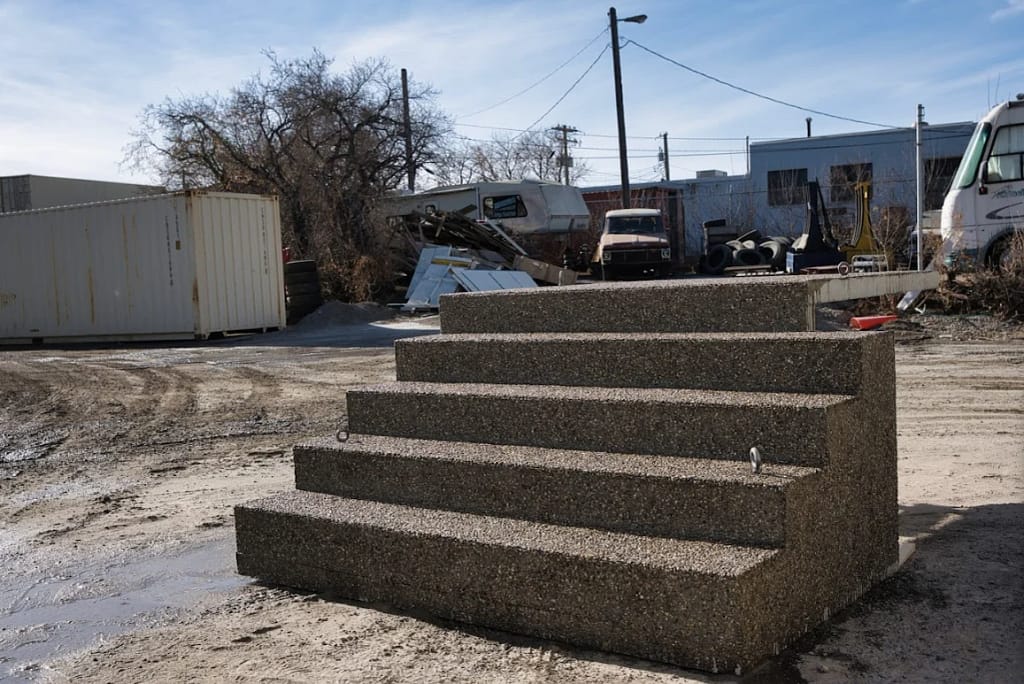
Precast steps pricing in Calgary, 2026 (per step and per project)
The most cited transparent benchmark in Canada is Sanderson Concrete’s 2026 per-step guide. Here’s how it breaks down, with the Alberta adjustment applied.
| Step type | Per-step (Canada 2026) | Notes |
|---|---|---|
| Standard precast tread | $150–$250 | Typical 6″ rise × 11″ tread depth; broom finish included |
| Custom dimensions / finishes | $250–$400 | Wider treads, non-standard rise, decorative finishes |
| High-volume (20+ steps) | $120–$200 | Per-step price drops with quantity |
| Specialty (anti-slip / tactile) | $200–$450 | Accessibility, code-driven surfaces |
| Alberta regional adjustment | −5 to −10% | Apply to the figures above |
| Project size | Total range (2026) |
|---|---|
| 10-step run | $1,500–$4,000 |
| 20-step run | $3,000–$8,000 |
| Finish upgrade | Added cost |
|---|---|
| Broom finish | Included |
| Exposed aggregate | +$10–$50 |
| Polished | +$50–$80 |
Source: Sanderson Concrete — Precast Concrete Stairs Price (Canada). A generic North American cross-check from Angi puts precast/hollow steps near $200/step and notes site prep and logistics can add roughly $5,000 on harder jobs. These are national figures — validate against current Calgary quotes before relying on a hard number.
The add-on cost stack — the honest caveats
The per-step price is only part of the bill. A precast steps project in Calgary carries a logistics and site stack that a wet-cast crew pouring on site doesn’t always itemize the same way. Plan for these:
| Line item | Typical range | What drives it |
|---|---|---|
| Installation labour | $800–$1,500 / day (2–4 workers) | Crew size, set complexity |
| Crane / boom truck | $500–$2,000 / day | Step weight, reach to your entry |
| Site preparation | $300–$1,500 | Excavation, granular base, grading |
| Permits | $200–$800 | Varies by scope (handrail/guard, structural) |
Source: Sanderson (above). Install timeline: a 10-step set is typically a 4–6 hour job; a 20-step set runs about a full day.
A turnkey Calgary supplier should roll most of this into one quote and tell you what’s included — delivery, crane, install, and haul-away of the old steps — rather than leaving you to coordinate a separate crane day. Ask for that explicitly.
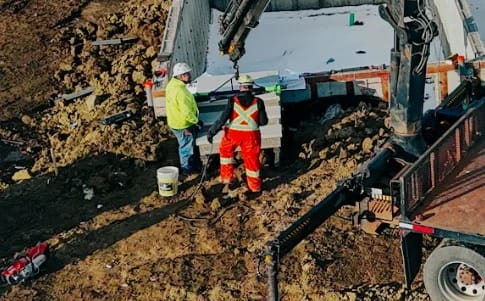
Why your old concrete steps heaved (and why cheap ones fail here)
This is the part that decides whether a step lasts five years or thirty in Calgary, and it’s pure physics. When the ground freezes, ice segregation draws water up to the freezing front and forms ice lenses that lift the soil above them. Frost-susceptible soils — clays, silts, fine sands — heave; clean gravels don’t.
Worse, adfreezing bonds the soil to the concrete and lifts the whole element with the ground; this is exactly why “concrete stoops at entry doors go up and down in winter,” sometimes returning in spring because a porous granular base let them settle back. The forces are not trivial — frost heave has been measured at up to 19 tons per square foot (Concrete Network / NRC; NRC Canadian Building Digest CBD-182).
Calgary’s frost depth is 1.2 m, and the city sees roughly 128 freeze-thaw cycles a year — among the most of any major Canadian metro. That’s the environment your steps live in.
So the value isn’t the step alone — it’s the mass plus the base detail. A heavy, plant-cast solid step set on a properly compacted granular base, with the base detailed to reduce adfreezing (and the right gap so heave can’t grab the underside and “tear it right off”), is the combination that survives Calgary winters. A thin, cheap, wet-cast step dropped on poorly prepped ground is the one you replace twice.
Precast vs poured vs wood steps in Calgary
- Wood steps are cheapest up front and fastest to build, but rot, warp, and need refinishing — and they conduct nothing against frost. Short lifespan in Chinook freeze-thaw.
- Poured (cast-in-place) steps are monolithic and customizable on site, but they cure on your lot through whatever weather arrives and are exposed to the September 30 cold-weather trigger. Quality depends heavily on the crew and the pour conditions.
- Precast steps are factory-cast to uniform strength, arrive ready to set in an afternoon, and — when paired with a proper base — resist heave through sheer mass and a controlled cure. The trade-off is the logistics: they’re heavy, so delivery and a crane/boom truck are part of the job.
For most Calgary entry steps, precast wins on durability-per-dollar if the base is done right. That “if” is the whole game.
FAQ
How much do precast concrete steps cost in Calgary in 2026? Standard precast treads run about $150–$250 per step and custom $250–$400, with Alberta pricing roughly 5–10% below the national average. A 10-step set totals about $1,500–$4,000 and a 20-step set $3,000–$8,000, before delivery, crane, site prep, and permits. Validate against a current Calgary quote.
Why are my old concrete steps heaving or sinking? Frost heave. Ice lenses form in frost-susceptible clay/silt soil and lift whatever sits above, and adfreezing bonds the soil to the concrete so it rides up with the ground — measured at up to 19 tons per square foot. Calgary’s 1.2 m frost depth and ~128 freeze-thaw cycles a year make this the default failure mode for poorly based steps.
What’s included in a precast steps quote? A good turnkey quote covers delivery, the crane or boom truck, installation, site/base preparation, and haul-away of your old steps. Ask which of those are bundled — crane and site prep are the line items most often quoted separately and most likely to surprise you.
Precast vs poured vs wood steps — which lasts in Calgary? Precast generally offers the best durability-per-dollar when set on a proper base, because of its mass and controlled factory cure. Poured can match it but depends on pour-day conditions. Wood is cheapest up front but rots and warps fastest in freeze-thaw.
Do I need a permit for new front steps in Calgary? It depends on scope. Simple replacement at grade often doesn’t, but adding or altering a handrail/guard, or structural work, can. Permit costs in the stack run roughly $200–$800. FLAG: confirm current City of Calgary permit thresholds for exterior stairs and guards before relying on this.
How long does installation take? A 10-step set is typically a 4–6 hour job; a 20-step set runs about a full day, depending on access and crane positioning.
How do you stop new steps from heaving? Build the base to defeat frost: a properly compacted granular pad, a base detail that reduces adfreezing, and the right gap so frost can’t grab the underside. Mass helps, but the base is what keeps the step from being lifted by ice lenses each winter.
How heavy is a precast step, and can you reach my site? Solid precast steps are heavy — often around a tonne for a full unit — which is why delivery and a crane or boom truck are part of the job. A supplier should confirm crane reach to your entry and any tight-access constraints before quoting.
Need new front steps in Calgary?
At Omega Precast, we build precast step systems designed for Alberta freeze-thaw ground — with proper granular base preparation, crane placement, and turnkey installation included.